
In short
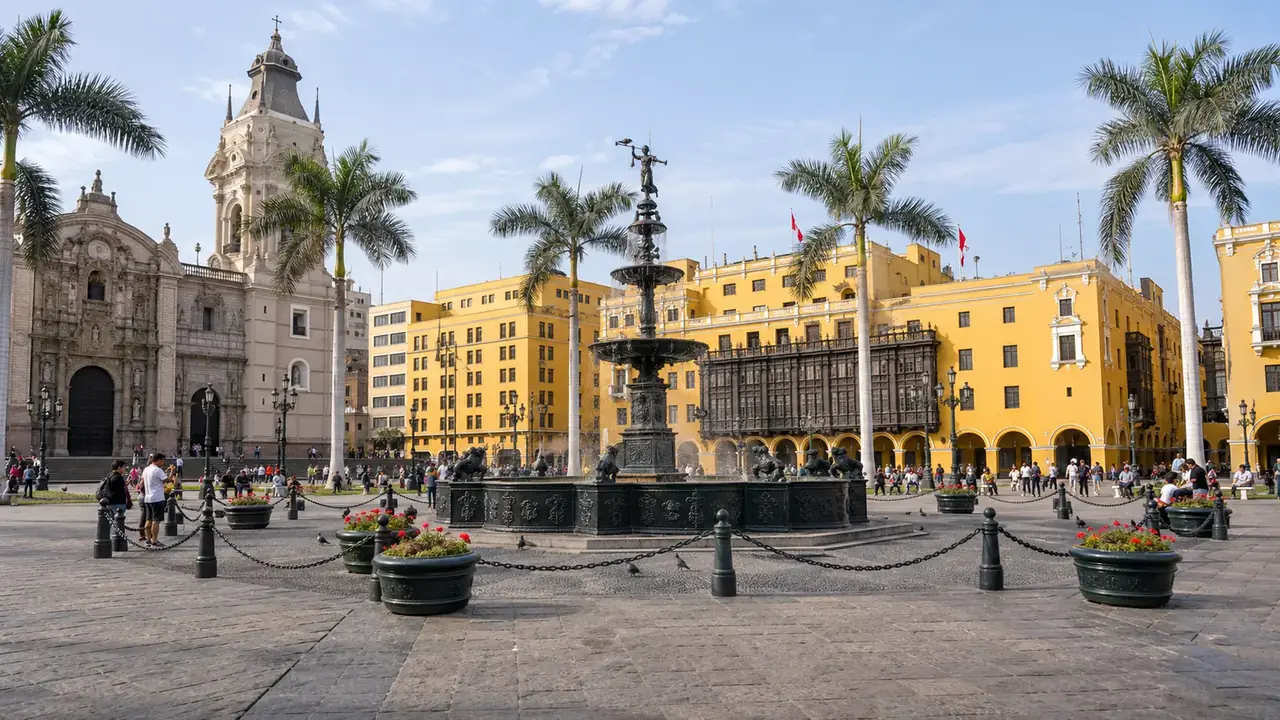
In three hours: Plaza San Martín, Jirón de la Unión, Plaza Mayor (cathedral, Government Palace), the San Francisco monastery and its catacombs. In a day: add Santo Domingo, the balconies of Jirón Ucayali, the Barrio Chino and the central market, and, in the afternoon, Rímac or the MALI. Come in the morning on a weekday, by Metropolitano or taxi, and leave before nightfall.
A city founded in 1535 on land that was already inhabited
Francisco Pizarro founded Lima in January 1535 under the name “Ciudad de los Reyes”, the City of Kings, in the Rímac Valley, on land then governed by a local chiefdom. The valley had been inhabited and developed for centuries, as Huaca Pucllana and the sanctuary of Pachacámac remind us.
For two centuries, Lima was the capital of the Viceroyalty of Peru and the most important city in Spanish South America. The religious orders built considerable convents and churches there; San Marcos University was founded there in 1551. The creation of the viceroyalties of New Granada (1718) and then Río de la Plata (1777) gradually reduced its role. The city remained surrounded by walls until 1870.
What the earthquakes did to the architecture
The earthquakes of 1586, 1687 and 1746 transformed the way buildings were made. After them, ground floors were built of brick and earth, and upper floors of quincha, a technique of pre-Hispanic origin made of a frame of wood and reeds covered with mud and plaster, more flexible in the face of tremors. It is on these light upper floors that the famous wooden enclosed balconies hang, overhanging the street, which made it possible to see without being seen. UNESCO cites them as a characteristic of Lima’s civil architecture, which remained stable until the end of the 19th century.
In the 20th century, further earthquakes (1940, 1966, 1970, 1974) and new roads cut through the city changed the centre again: Avenida Abancay, opened in 1940, cut off part of the great San Francisco monastery. The historic centre was inscribed as a World Heritage site in 1988, then extended in 1991 to include monuments in Rímac, on the other side of the river. To understand these earthquakes and what the earthquake-resistant design standard requires today, see earthquakes and tsunamis in Peru.
Visiting inside or looking from outside
Many buildings in the centre are admired from the street: the Government Palace, the Archbishop’s Palace and, on weekdays, the Torre Tagle palace. Others can be visited with a ticket:
| Place | Visit | Practical details |
|---|---|---|
| Cathedral and its museum | Chapels, carved choir stalls, crypts, Pizarro’s tomb | S/ 30 for a foreign adult (S/ 20 for a Peruvian or resident, free under 6); Monday to Friday from 9:00 to 20:00, Saturday from 10:00 to 22:00, Sunday from 13:00 to 19:00 |
| San Francisco monastery | Cloisters, library, chapter house, catacombs; guided tour | every day, from 9:00 to 20:15 according to the official register; admission charged |
| Santo Domingo | Dominican church and convent, places of remembrance of Rose of Lima and Martin de Porres | Museum from Tuesday to Sunday, 9:30 to 13:00 and 14:00 to 17:00; S/ 15 for an adult, S/ 7 for a student |
| Casa de la Literatura Peruana | Public cultural centre in the former Desamparados railway station | Tuesday to Sunday, 10:00 to 19:00; free admission |
For the San Francisco monastery, the published information differs: the Ministry of Culture’s register of museums gives opening hours every day from 9:00 to 20:15, the municipal website Visita Lima closing at 18:00 and free admission, and recent guides a paid ticket. Plan to arrive before 17:00 and to have the means to pay. The opening hours for Santo Domingo and the Casa de la Literatura come from the same municipal website (Visita Lima).
The other churches, free to enter
According to the city council’s website, these four churches can be visited freely during opening hours (Visita Lima). They are places of worship: go in quietly and avoid visiting during Mass.
| Church | What you see | Opening hours |
|---|---|---|
| San Pedro, Jr. Azángaro 451 | The Jesuit church, built from 1618 on the model of the Jesuits’ mother church in Rome, with three naves | Monday to Saturday 7:45 to 13:00 and 17:00 to 20:30; Sundays until 19:00 |
| La Merced, Jr. de la Unión 621 | A Baroque altarpiece façade carved from 1697 to 1704, the first in Lima with Solomonic columns | Monday to Saturday, 11:00 to 13:00 and 14:00 to 20:00 |
| Santa Rosa sanctuary, Av. Tacna 100 | The Dominican church built where Rose of Lima lived, inaugurated in 1685 | Monday to Saturday, 9:30 to 12:00 and 14:00 to 18:00 |
| Las Nazarenas, Jr. Huancavelica 515 | The sanctuary of the Christ of Miracles, painted on a wall in the 17th century and still standing despite the earthquakes | Monday to Friday 8:00 to 13:00 and 16:00 to 18:00; Saturdays 8:00 to 12:00 |
The Christ of Las Nazarenas is the Señor de los Milagros, followed every October by Lima’s great processions. See festivals and calendar.
Historic houses and museums in the centre
Again according to the city council’s website (Visita Lima):
| Place | What you see | Opening hours and admission |
|---|---|---|
| Casa de Aliaga, Jirón de la Unión 224 | Lima’s oldest mansion, built in 1535 and still lived in by its founder’s descendants | Tuesday to Sunday, 9:30 to 17:00; free admission according to the municipal website |
| Torre Tagle palace, Jr. Ucayali 363 | An 18th-century palace, home of the Ministry of Foreign Affairs | Free guided tours on Saturdays and Sundays, 16:00 to 19:00 |
| National Afro-Peruvian Museum, Jr. Ancash 542 | The history of Afro-Peruvians, from slavery to music and dance | Every day, 9:00 to 12:30 and 14:00 to 16:30; free admission |
| Bodega y Quadra site museum, Jr. Ancash 213 | Remains of the colonial city, found during the restoration of the house in 2005 | Tuesday to Sunday, 10:00 to 13:00 and 14:00 to 18:00; S/ 10 |
| Casona de San Marcos, Parque Universitario | A 17th-century Jesuit complex, later a royal college and the historic house of the University of San Marcos | Monday to Saturday, 10:00 to 13:00 and 14:00 to 16:00; S/ 8 |
| Museum of Italian Art, Paseo de la República 250 | A basilica-shaped building, a gift from the Italian community for the centenary of independence | Tuesday to Saturday, 10:00 to 17:00; S/ 6 |
Opening hours sometimes change without notice: check the day before for the place that matters most to you.
The Barrio Chino and the central market
The first Chinese immigrants arrived in Peru in 1849, to work on the coastal haciendas. By 1854, many of them lived around Calle Capón, opposite today’s central market. The neighbourhood, with its arch donated by the Chinese community and inaugurated in 1971, its associations and its shops, is the birthplace of chifa, a cuisine born of the meeting between Cantonese recipes and Peruvian produce, now found throughout the country. Having lunch there is part of a visit to the centre.
Eating in the centre. Besides the chifas of the Barrio Chino, the centre keeps some long-standing addresses, such as the sanguchería El Chinito, founded in 1960, for a chicharrón sandwich. The set lunch menú, served in the small restaurants of the shopping streets, remains the simplest option. See where to eat in Lima.
Coming and going
From Miraflores or Barranco, the Metropolitano drops you at the Jirón de la Unión, Colmena or Estación Central stations. Come in the morning on a weekday: the churches and convents open, the streets are lively and the light lets you see the façades properly. The FDFA recommends particular caution in the centre after dark; leave in the late afternoon, or by booked taxi if you are staying for dinner.
Frequently asked questions
Is Lima’s historic centre safe?
By day it is lively and easy to explore on foot, with the usual precautions in crowds, at the central market in particular. The FDFA recommends particular caution after dark: head back in the late afternoon, or take a booked taxi if you stay for dinner.
How long do you need to visit the centre?
Three hours are enough for the essentials: the two main squares, the cathedral and the San Francisco monastery. A full day lets you add Santo Domingo, the balconies, other churches, the Barrio Chino and the central market.
Which churches can you visit for free?
According to the city council’s website, admission is free at San Pedro, La Merced, the Santa Rosa sanctuary and Las Nazarenas, during opening hours. The cathedral museum and the Santo Domingo museum charge for entry.
Can you visit the Torre Tagle palace?
On weekdays, it is admired from the street. According to the city council’s website, free guided tours take place on Saturdays and Sundays, from 16:00 to 19:00.
How do you get there from Miraflores?
By Metropolitano, to the Jirón de la Unión, Colmena or Estación Central stations, or by booked taxi. Come in the morning on a weekday, when the churches and monasteries are open.
Sources and dates
9 sources
Prices, opening hours and rules change: every piece of information cited links to its source, with the date it was consulted.
Figures and rules cited
- S/ 30 for a foreign adult (S/ 20 for a Peruvian or resident, free under 6): Visit to Lima Cathedral and its museum, foreign adult (Lima Cathedral, Plaza Mayor (entrance on jirón Carabaya))
Site management: Lima Cathedral, visitor information (new tab) · consulted on 2 October 2026 - Monday to Friday from 9:00 to 20:00, Saturday from 10:00 to 22:00, Sunday from 13:00 to 19:00: Visiting hours of Lima Cathedral (Lima Cathedral, Plaza Mayor)
Site management: Lima Cathedral, visitor information (new tab) · consulted on 2 October 2026 - every day, from 9:00 to 20:15 according to the official register: Opening hours of the San Francisco convent museum and catacombs (San Francisco convent, corner of jirón Áncash and jirón Lampa, Lima) . Opening hours and entry price change from time to time.
Old source: Ministry of Culture, register of museums: Museo Convento de San Francisco (new tab) · consulted on 2 October 2026
Sources consulted
- UNESCO, Historic Centre of Lima (outstanding universal value) (new tab) (consulted on 2 October 2026)
- Lima Cathedral, visitor information (new tab) (consulted on 2 October 2026)
- Ministry of Culture, register of museums: Museo Convento de San Francisco (new tab) (consulted on 2 October 2026)
- Visita Lima (Prolima), Museo del Convento de San Francisco y Catacumbas (new tab) (consulted on 2 October 2026)
- Visita Lima (Prolima, Lima city council), churches of the historic centre: opening hours and admission (in Spanish) (new tab) (consulted on 13 October 2026)
- Visita Lima (Prolima), museums of the historic centre: opening hours and prices (in Spanish) (new tab) (consulted on 13 October 2026)
- Visita Lima (Prolima), historic houses: Casa de Aliaga, Torre Tagle, Casona de San Marcos (in Spanish) (new tab) (consulted on 13 October 2026)
- Wikipedia (Spanish), Barrio chino de Lima (new tab) (consulted on 2 October 2026)
- FDFA, Conseils pour les voyages – Pérou (travel advice, in French: caution in the centre at night) (new tab) (consulted on 1 October 2026)
How we choose and date our information: our method. Has something changed? Let us know.