
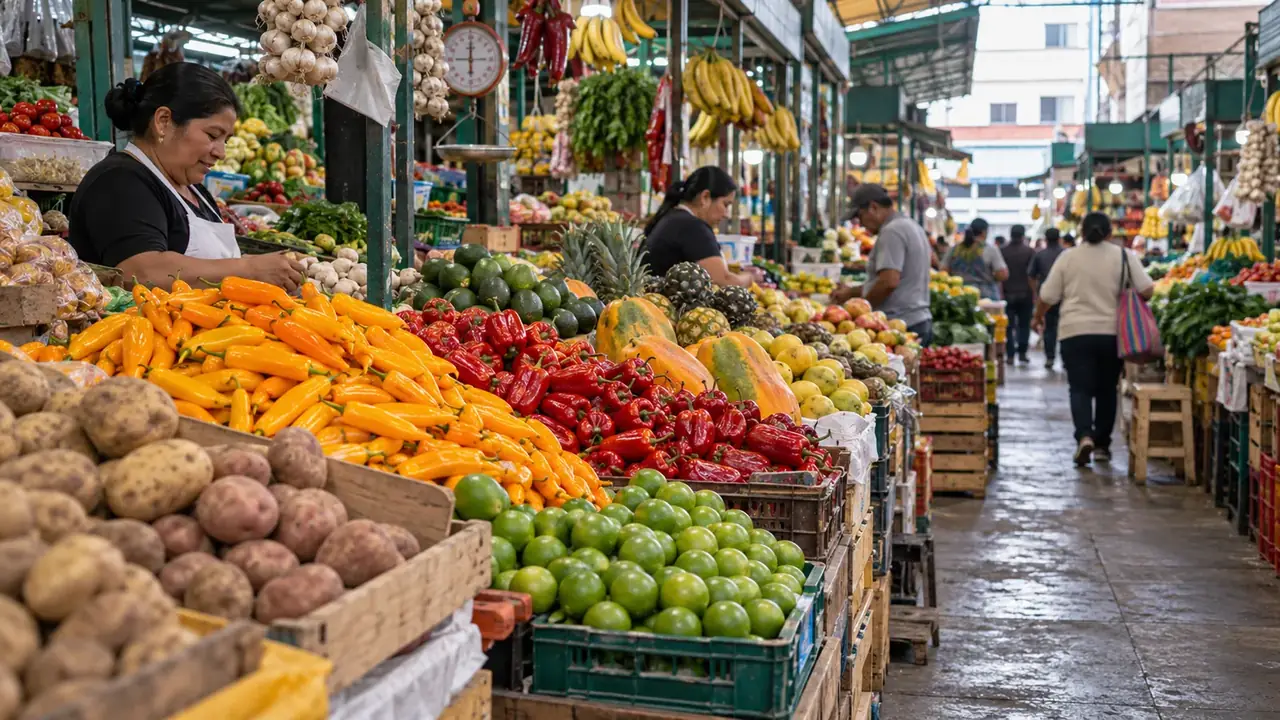
In short
For a first market, go to the central market, in the historic centre, on a weekday morning, then have lunch in the nearby Barrio Chino. For a neighbourhood market with a reputation among cooks, the Magdalena market. In Surquillo, two separate markets: No. 1, long the most often mentioned, partly reopened after two years of closure, and No. 2, a covered market reopened in 2024. On Saturday mornings, the Miraflores bioferia brings together organic producers.
Five markets compared
| Market | What it is | Who it suits | Good to know |
|---|---|---|---|
| Central market (Mercado Central Ramón Castilla), historic centre | The city’s big market: more than 930 stalls on three levels, meat, fish, fruit and vegetables, groceries, but also shoes and textiles | A first immersion, combined with the Barrio Chino | Dense crowds, keep an eye on your bag and phone; a weekday morning |
| Magdalena market, Jirón Bolognesi, Magdalena del Mar | A large neighbourhood market founded in 1936, about 900 stalls, renowned for its produce and its food counters | Those curious about food, those who want to see where cooks get their supplies | An ageing building, already closed several times by the municipality: check that it is open |
| Surquillo market No. 1, next to Miraflores | The market long most often mentioned by chefs, partly reopened | Those staying in Miraflores, in the morning, knowing that it is not yet the big market hall it was before 2024 | partly open again, not fully but enough for a visit, according to our information from October 2026, after the building closed in August 2024. Details: Surquillo |
| Surquillo market No. 2, Jirón Leonardo Barbieri | Another covered market in the same district, more than 500 stalls | Seeing a working neighbourhood market hall, 1 km from No. 1 | reopened on 1 May 2024 after obtaining its safety certificate (ITSE); more than 500 stalls, nearly 70 years old according to the municipality. Details: Surquillo |
| Miraflores bioferia, Parque Reducto No. 2 | An organic producers’ market, on Saturday mornings | Fruit, vegetables, bread, cheese and honey from small producers | More expensive than a municipal market; an open-air market atmosphere |
The central market came about through a decision by President Ramón Castilla, who in 1847 had part of the Concepción convent expropriated to set up a market there. A fire on 29 February 1964 destroyed three quarters of it; the current building was inaugurated in 1967. It stretches between Avenida Abancay and Jirón Andahuaylas, right next to the Barrio Chino: see the route on the Historic centre page.
The Magdalena market is the classic example of a Lima neighbourhood market, where people come as much to eat as to shop. Combine it with the Huaca Huantille in the same district; see Magdalena del Mar.
Ten ingredients to recognise on the stalls
Go round once without buying anything, looking for these ten products. Each one leads to dishes you will taste during the trip.
| Product | How to recognise it | What it is used for |
|---|---|---|
| Ají amarillo | An elongated chilli, orange-yellow, sold fresh or as a paste | The base of many sauces: ají de gallina, causa, papa a la huancaína |
| Rocoto | A round chilli, red or yellow, fleshy, with black seeds; very hot | Rocoto relleno from Arequipa, table sauces |
| Huacatay | A herb with thin leaves and a powerful scent somewhere between mint and aniseed | Ocopa from Arequipa, Andean marinades |
| Papa amarilla | A yellow, floury potato that falls apart when cooked | Causa, purées; one variety among hundreds |
| Choclo | Andean corn with very large white kernels, not very sweet | A side for ceviche, salads |
| Camote | Sweet potato, orange or purple | With ceviche, in the pan con chicharrón sandwich |
| Limón | A small, very sour lime, sold by the kilo | Ceviche, salsa criolla, pisco sour |
| Chirimoya | A green fruit with scaly skin and creamy white flesh | Eaten with a spoon or as a juice |
| Lúcuma | A fruit with green skin and orange, dry, floury flesh that tastes of caramel | Ice creams and desserts; rarely eaten raw |
| Maíz morado | Dark purple corn cobs, sold dried | Chicha morada and mazamorra morada |
The detailed listings, with possible substitutes in Europe, are in Peruvian ingredients.
Understanding the units
At a market, the price is rarely given for the same unit as at the supermarket:
- por kilo: by the kilo; you can ask for medio kilo (half a kilo) or un cuarto (a quarter of a kilo);
- por unidad: by the piece (avocados, mangoes, pineapples);
- por docena: by the dozen (eggs, small fruit);
- el montón or la porción: a small pile set out on the stall, sold at a fixed price (limes, chillies, herbs).
To compare with a supermarket price, convert everything to the kilo. The table at the bottom of the page shows prices recorded online at a supermarket on 2 October 2026: they give an order of magnitude, not the market price, which is often different.
| Phrase | Meaning |
|---|---|
| ¿Cuánto está el kilo? | How much is a kilo? |
| ¿Se vende por kilo o por unidad? | Is it sold by the kilo or by the piece? |
| Medio kilo, por favor. | Half a kilo, please. |
| ¿Está maduro para hoy? | Is it ripe for today? |
| ¿Cómo se prepara? | How is it prepared? |
Buying, tasting, sitting down: three ways to use the market
Buying. Take a look round, compare two stalls, go back to the seller who gave you good information. Ask the price before having something cut or weighed. Haggling is not the done thing for small quantities of food; for several kilos, asking for a price for the lot is common.
Tasting. Many traders offer you a taste of a fruit before buying. The juguerías, counters serving fruit juice freshly pressed in front of you, are an institution: choose fruit you can see being prepared.
Sitting down. The big markets have food counters (“puestos de comida”) where you have lunch sitting on a stool: ceviche, soup, the dish of the day. It is a meal in its own right, often excellent, served at midday. Choose a busy counter, where the dishes come out quickly.
Two ways to visit
On your own. A weekday morning (markets are at their liveliest and best stocked early on), a simple goal (recognising the ten products in the table, buying fruit for the next day), a little cash in small notes, a closed bag carried in front of you.
With someone. Cooking classes and guides offer guided market tours. We do not recommend any of them for the moment: ask who leads the tour, how long it lasts, what is tasted and whether the meal is included. See Peru can also be discovered at the table.
Tasting with the right habits
For a first tasting, favour what is well cooked or what you can peel yourself. Market ceviche is made with raw fish: eat it at midday, at a counter where the fish arrives in the morning. Ask permission before photographing a person; photographing a colourful stall is not a problem, photographing someone without asking is.
Sources and dates
9 sources
Prices, opening hours and rules change: every piece of information cited links to its source, with the date it was consulted.
Figures and rules cited
- partly open again, not fully but enough for a visit, according to our information from October 2026, after the building closed in August 2024: Surquillo market no. 1: status (Market no. 1, avenida Paseo de la República and jirón Narciso de la Colina, Surquillo) . Partial reopening: information gathered by SwissLima on 7 October 2026; no public source consulted gives a date for it. Building closed in August 2024 and selling in the street during the closure according to El Comercio and Panamericana; traders’ fair authorised from 1 to 30 July 2026 (resolution D002326-2026-SCA-GDE-MDS); reopening ordered by the courts at the end of August 2026 according to La República.
Press or reseller: El Comercio, “Veinte meses cerrado y sin solución: la disputa entre Surquillo y Miraflores paraliza el Mercado N.° 1” (25 June 2026) (new tab) , published on 25 June 2026 · consulted on 7 October 2026 - reopened on 1 May 2024 after obtaining its safety certificate (ITSE); more than 500 stalls, nearly 70 years old according to the municipality: Surquillo market no. 2: status and size (Market no. 2, jirón Leonardo Barbieri 742 (OpenStreetMap), block bounded by jirón Lizardo Montero and calle Santa Rosa, Surquillo) . Visited by travellers according to our information from October 2026, with no guarantee that it opens every day. Several addresses are in circulation (Barbieri, Montero, Santa Rosa): they are entrances or landmarks of the same block, not two markets.
Official source: Municipality of Surquillo, “Mercado N° 2 reabre sus puertas tras recibir licencia municipal” (1 May 2024) (new tab) , published on 1 May 2024 · consulted on 7 October 2026
Sources consulted
- Infobae, history of Lima’s central market (12 December 2023) (new tab) (consulted on 2 October 2026)
- Wikipedia (Spanish), Mercado de Magdalena (new tab) (consulted on 2 October 2026)
- El Comercio, Surquillo market No. 1 closed, its traders in the street (25 June 2026) (new tab) (consulted on 4 October 2026)
- Municipality of Surquillo, reopening of market No. 2 (1 May 2024) (new tab) (consulted on 7 October 2026)
- Municipality of Surquillo, fair of the market No. 1 traders, July 2026 (resolution of 8 July 2026) (new tab) (consulted on 7 October 2026)
- La República, Surquillo market No. 1 (27 August 2026) (new tab) (consulted on 2 October 2026)
- Andina, the Miraflores bioferia in Parque Reducto (new tab) (consulted on 2 October 2026)
- PROMPERÚ, Peruvian gastronomy and produce (new tab) (consulted on 2 October 2026)
- Plaza Vea and Metro, online prices (comparison basket) (new tab) (consulted on 2 October 2026)
How we choose and date our information: our method. Has something changed? Let us know.