
In short
Choose the route first: circuit 1 gives the overall view from the upper terraces without going into the city, circuit 2 crosses several of the main urban sectors and also passes an overall view (the lower terrace on 2-B), circuit 3 shows the royal buildings up close and opens up the mountains (Waynapicchu, Huchuypicchu). Buy the ticket on tuboleto.cultura.pe, then the train that fits the entry time, then the night in Machu Picchu Pueblo or Ollantaytambo. The ticket, the sanctuary fee, the shuttle bus, the train and the guide are all paid for separately.
What you are going to see
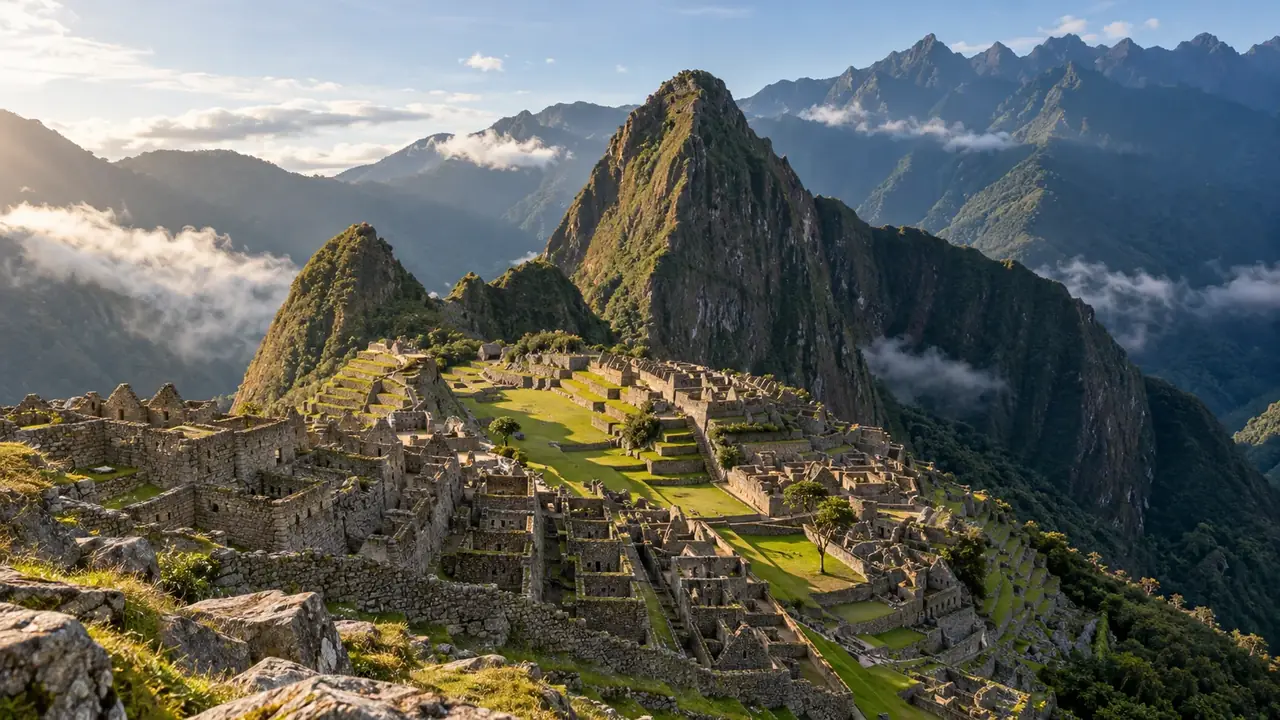
Machu Picchu occupies a narrow ridge between two peaks, Machupicchu mountain to the south and Waynapicchu to the north, at about 2,430 m, some 400 metres above the Vilcanota River, which almost encircles it. UNESCO counts about two hundred structures, divided between an upper town and a lower town separated by a large plaza, and surrounded by agricultural terraces. The listed property is mixed: 32,592 hectares of mountains, cloud forests and valleys protected for their nature as much as for their architecture.
When and for whom. Tradition, drawn from the Spanish chronicles, attributes its construction to the Inca Pachacútec around 1450 and sees it as a royal estate. In 2021, a Yale University team dated the remains of twenty-six people buried on the site: occupation began around 1420 and ended around 1530, a generation earlier than the chronicles said. No written document from the period describes the function of the place; “royal estate” remains the most widely shared interpretation, not a certainty.
How it was built. The builders used the granite of the ridge itself: route 2-B passes through the quarries, where split blocks are still waiting to be cut. The most important buildings are in cut stone fitted without mortar; ordinary buildings, in rubble stone bound with earth. The terraces are not simple steps: the excavations of the engineer Kenneth Wright, in the 1990s, revealed successive layers of large stones, gravel, sand and fertile soil, which drain the heavy rain and hold the slope in place. A channel, marked on the official maps near the entrance, brought water from the mountainside to the ceremonial fountains of the city.
After the Incas. The site was abandoned in the 16th century. It was never “lost” to the farmers of the valley: the Peruvian explorer Agustín Lizárraga wrote his name there in charcoal in 1902, and it was with the help of local residents as guides that the American Hiram Bingham made it known to the world in 1911.
What is not known is as important as what is known. The “Intiwatana stone” is a carved rock whose exact function is still debated; the astronomical alignments attributed to the Temple of the Sun are interpretations. Be wary of stories about energies, lost technologies or “melted” stones: no archaeological research supports them.
The nature of the sanctuary
Around the Inca city, the historic sanctuary is also a protected natural area, managed by SERNANP. It runs from humid mountain forests, at about 1,900 metres, to snow-capped peaks of more than 6,000 metres. SERNANP lists 24 ecosystems there, 332 species of trees, 75 of mammals, 444 of birds and 365 of butterflies (SERNANP). Among them: the spectacled bear, the otter, the torrent duck, the Andean cock-of-the-rock, with its bright orange plumage, and orchids, of which there are more than 170 varieties according to the Andina agency.
From the visiting routes, you mostly see birds and the vegetation of the slopes. The botanical garden of the site museum, at the foot of the mountain, shows part of this flora close up (see below).
Three circuits, ten routes: what each ticket shows
Since 1 June 2024, the visit has been organised into three circuits grouping ten visiting routes. Each ticket carries a route, an entry time and a maximum length of stay; the route is signposted and monitored by ministry staff, with checkpoints at the start of the mountain trails.
| Route | What you see (official descriptions) | Return distance | Effort | Season |
|---|---|---|---|---|
| 1-A Machupicchu mountain | The mountain south of the site; from the summit, a view of the city and the glaciers of Salkantay and Pumasillo | 3.8 km | High | All year round |
| 1-B Upper terrace | The viewpoint from which the classic photo is taken, the meanders of the Vilcanota | 1.6 km | Moderate | All year round |
| 1-C Intipunku gate | The “Sun Gate”, the end of the Inca Trail, and a view of the city from another angle | 3.4 km | Moderate | High season |
| 1-D Inca bridge | A bridge of stone and wood clinging to the cliff, above the valley | 2.6 km | Moderate | High season |
| 2-A Classic route | The terraces, the main gate, the Temple of the Sun viewpoint, the main plaza, the Sacred Rock, the water mirrors | 2.5 km | Moderate to high | All year round |
| 2-B Lower terrace | The overall view from the lower terrace, the quarries, the main plaza, the Sacred Rock, the water mirrors | 2.7 km | Moderate to high | All year round |
| 3-A Waynapicchu | The Temple of the Sun, the House of the Inca, the fountains, the Three Doorways, then the climb up Waynapicchu and the Temple of the Condor on the way back | 2.4 km | High | All year round |
| 3-B Royal route | The same royal route, without a mountain; a wheelchair-accessible section | 1.3 km | Moderate | All year round |
| 3-C Great Cavern | The royal route, then the descent to a cave fitted out on the side of Waynapicchu | 3 km | High | High season |
| 3-D Huchuypicchu | The royal route, then the small peak next to Waynapicchu | 1.7 km | Moderate | High season |
Maximum time on the site: 2 hr 30 min for routes 1-B, 2-A, 2-B and 3-B; 3 hr (1-D); 3 hr 30 min (3-D); 4 hr (1-C); 6 hr (3-A); 7 hr (1-A and 3-C). The high-season days in 2026 are 1 January, 2 to 5 April, 19 June to 2 November, 30 and 31 December. The distances for routes 2-A and 2-B differ between official sources (2.5 and 2.7 km on the ticketing site, 1.3 and 1.4 km on the signs installed in 2026): in any case, allow about two hours of slow walking, with stairs.
What no single ticket shows
The official maps let you see what each route leaves out:
- Circuit 1 stays in the upper sector. Routes 1-A to 1-D start from the upper terraces and do not go into the city: you see it in full, but from a distance.
- Circuit 2 does not climb any mountain. It is the circuit that crosses the most urban sectors, from the Sacred Plaza to the residential quarters, as far as the Sacred Rock; no circuit, however, gives free access to every building, and some sectors may be closed for conservation on the day of your visit. The official map of each route says what it covers.
- Circuit 3 goes through the lower part of the city. It shows the Temple of the Sun, the House of the Inca and the Temple of the Condor up close, but not the Sacred Plaza or the Intiwatana; the mountain routes then leave via the Sacred Rock.
One ticket or two? For a first visit, a single ticket is often enough: the circuit 2 routes already combine an overall view (from the lower terrace on 2-B, from the agricultural sector on 2-A) and a walk through the city. A second ticket is only justified for a specific combination: the viewpoint from the upper terrace (1-B), a mountain (Machupicchu, Waynapicchu, Huchuypicchu), the Intipunku gate or the Inca bridge, in addition to a route through the city. Name the route and the viewpoint you want, look at the official map, then check on the ticketing site that the two times follow one another; each entry is paid for.
Choosing according to your priority
- A single visit, understanding everything: route 2-A or 2-B.
- The finest overall view: route 1-B, the shortest in circuit 1.
- Reduced mobility or tiredness: route 3-B, the shortest, with an adapted section.
- A mountain: Waynapicchu (3-A) is steep, with narrow steps on the edge of the drop; Machupicchu mountain (1-A) is longer, up a long staircase. Both require good fitness and a sure foot.
- After the Inca Trail: hikers enter by route 3-B only, on reserved daily places, bought through a registered agency.
Step by step, from booking to leaving
- The ticket. On the state ticketing site, tuboleto.cultura.pe: circuit, route, date, entry time, then the name and passport number of each visitor. Check the spelling: the ticket and your passport (or the identity document used for the purchase); a valid higher-education student card for the student rate.
- The train. Choose a train that arrives in Machu Picchu Pueblo at least two hours before the entry time if you are coming on the same day: you then have to join the shuttle bus queue and go up. From Ollantaytambo, the journey takes about 1 hr 30 min; from Poroy, near Cusco, about 3 hr 30 min.
- The night. For an entry before 9:00, sleep in Machu Picchu Pueblo (about 2,040 m). For an entry in the late morning or the afternoon, a round trip from Ollantaytambo is feasible, at the cost of a long day.
- Going up to the site. Shuttle bus by road (about 8.9 km of hairpin bends), or on foot (see below).
- Entering. Arrive at the time on your ticket; the tolerance is 30 minutes in low season, 45 minutes in high season. Passport and ticket are checked at the entrance.
- Visiting. Follow the signposted route; the explanation points and photo stops are marked on the official maps. The maps show no toilets along the route: they are near the entrance, with the shuttle bus station.
- Going down and leaving. Leave a margin of at least an hour and a half between the end of your maximum time and the return train, for the shuttle bus and the walk to the station.
Which season, which time of day
The season. SERNANP recommends visiting from April to October; the rainy season runs from November to March. The site stays open all year: in the rainy season, it often rains and the clouds come and go over the ridge. The Inca Trail closes in February, and the train from Cusco switches to the bus-then-train service from January to April. See when to go.
The temperature. Around the site, SERNANP puts it at between 14.5 and 16.5 °C on average; the sun quickly warms the terraces in the middle of the day, and a shower cools things down at once. Dress in layers.
The entry time. It depends mainly on the train: an early-morning entry means a night in Machu Picchu Pueblo; an entry in the late morning or the afternoon goes with a round trip from Ollantaytambo. On high-season days, the daily limit is higher and all the routes are open; it is also the period when you need to book furthest ahead.
Altitude. The site (about 2,430 m) is lower than Cusco: you breathe more easily than in the city, but the stairs are still tiring. See altitude.
Two ways to organise the day
With a night on the spot, the most comfortable option:
- The day before, train from Ollantaytambo (about 1 hr 30 min) or from Poroy, near Cusco; arrival in Machu Picchu Pueblo during the day.
- Depending on your arrival time, the site museum and its botanical garden, or the village hot springs.
- The next day, shuttle bus or the walk up for an early-morning entry, visit, walk down, a meal in the village and the afternoon train.
As a day trip from Ollantaytambo, possible but with no margin:
- Morning train, arriving in the village at least two hours before your entry time.
- Shuttle bus, entry in the late morning or early afternoon, visit.
- Return shuttle bus and late-afternoon train, at least an hour and a half after the end of your maximum time.
The slightest train delay or queue for the shuttle bus affects the whole day. With children, or if the visit is the most awaited moment of the trip, choose the night on the spot.
The day’s budget, item by item
| Item | Amount or order of magnitude | Good to know |
|---|---|---|
| Entry ticket, foreign adult | S/ 152 | More expensive for the mountain routes: the ticketing site shows the amount when you choose the route |
| Historic Sanctuary fee (SERNANP) | S/ 11 | On top of the ticket, since 1 May 2026 |
| Shuttle bus, return | USD 24 (foreign visitor) | Operator under a provisional contract since 2025: the fare may change |
| Train, return | Variable depending on the company, the service, the time and the date | Can cost more than the entry ticket; compare the two companies for the same time |
| Guide | Variable depending on the length and the size of the group | recommended, without being compulsory |
| A night in Machu Picchu Pueblo | Variable | To book after the ticket, on a changeable rate if possible |
For a Peruvian visitor, a resident or a national of the Andean Community, the Andina agency gives S/ 112 instead of S/ 64 for routes without a mountain. For a foreign visitor, the supplement for the mountain routes is shown on the ticketing site when you choose the route. The budget calculator lets you add these items to your trip.
The train: two companies, the same rails
| PeruRail | Inca Rail | |
|---|---|---|
| Services | Expedition, Vistadome, Vistadome Observatory, Hiram Bingham (luxury, Belmond) | The Voyager, The 360°, The Prime, The First Class, The Private |
| Departures | Ollantaytambo, Urubamba depending on the season; in Cusco, Poroy, San Pedro or Wanchaq depending on the season and the service | Ollantaytambo; from Cusco, bus then train |
| Luggage included | one 8 kg backpack (100 cm, sum of the three sides) or one 12 kg piece of hand luggage (115 cm) | one 8 kg piece of hand luggage (118 cm, sum of the three sides) |
| Conditions | at the station at least 60 minutes before departure; free left-luggage at Ollantaytambo (4:15–21:00) and Machu Picchu (8:00–22:00); changes or cancellations no later than 24 hr before departure, with a 10% fee, except promotional fares | Arrive 30 minutes before; changes 24 hours before, 10% fee |
During the rainy season, from January to April, departures from Cusco go by bus to a station in the valley, then by train: this is the so-called “bimodal” service. The two companies run on the same line, along the Vilcanota: the difference lies in the comfort, the windows, the on-board service and above all the time available on the day you want.
Going up: shuttle bus or on foot
The shuttle bus leaves from the bottom of the village and climbs the Hiram Bingham road. According to the press in January 2026, the former concession holder has been running the service on a provisional basis since its concession ended in September 2025: prices and arrangements may still change.
On foot, allow about 4 km, including 2.3 km of stepped path from the Ruinas bridge, for nearly 400 m of ascent. The tarmac road to the Ruinas bridge is flat; after that, the path cuts across the hairpin bends on Inca stairs. According to the usual hikers’ rule of thumb (one hour per 5 km on the flat, plus one hour per 600 m of climbing), the climb takes about an hour and a half, longer at a relaxed pace. Walking down after the visit is a good way to save half the shuttle bus fare.
Machu Picchu Pueblo, the day before or the day after
The village, formerly Aguas Calientes, at about 2,040 m, lives from the site: hotels, restaurants, a craft market, the station. No road links it to Cusco: you arrive by train, or on foot from Hidroeléctrica (see below).
The Manuel Chávez Ballón site museum. Run by the Ministry of Culture, it stands at the foot of the mountain, a few metres from the Ruinas bridge, about twenty minutes’ walk from the village. According to the Andina agency, it presents objects found in the sanctuary, the research carried out at the site and recent discoveries (Andina). Behind the museum, a botanical garden shows native species, ferns and orchids. It is a good introduction to the visit, or a good complement if you walk back down. Opening hours and price: check on the spot.
The hot springs. The village has its own hot springs, not to be confused with those of Cocalmayo, near Santa Teresa.
The visiting rules
| Rule | Detail |
|---|---|
| Bag | No larger than 40 x 35 x 20 cm; leave the rest at the hotel or in the station’s left luggage |
| Prohibited | Food and tableware, alcohol, tobacco and e-cigarettes, walking poles, umbrellas, folding chairs, tripods and selfie sticks, aerosols, pushchairs, drones, shoes with heels or hard soles, loudspeakers |
| Animals | Assistance dogs only |
| Length of stay | Depending on the route: see the table of circuits |
| Visitor numbers | 5,600 visitors a day in high season, 4,500 in low season |
| Penalty | An offence can lead to expulsion from the site, with no refund |
A water bottle is useful: it is often hot and humid in the middle of the day, and the sun beats down on the terraces. A light rain jacket replaces the forbidden umbrella. SERNANP advises insect repellent and sun cream: bring them as a cream or lotion, since aerosols are not allowed.
With children or with reduced mobility
- Children. Entry is free for children under 3; from 3 to 17, minors must be accompanied, and their identity document is checked like an adult’s. Pushchairs are not allowed: bring a baby carrier. The routes of circuit 2 or route 3-B are better suited than the mountains, which are steep, with passages along sheer drops.
- Reduced mobility. Route 3-B, the shortest, includes a section accessible by wheelchair; the rest of the site is made up of stairs and uneven steps. Walking poles are not allowed: if you need a stick for medical reasons, ask the Ministry of Culture before your visit.
- Breaks. Food is not allowed on the site: eat before or after, and keep some water with you.
If the ticket you want is sold out
- Change the route, not the date: another route on the same day often gives you the essentials (2-B instead of 2-A, 3-B instead of 3-A).
- Change the time: afternoon slots sometimes become free later.
- Buy on site: according to the Andina agency, 1,000 tickets a day, at the cultural centre of the Machu Picchu Pueblo municipality. That means already being in the village, with a spare night, and accepting whatever route and time are left.
- Keep flexibility upstream: book a changeable train and night as long as the entry ticket has not been bought.
- Visit in another way: the great sites of the Sacred Valley (Ollantaytambo, Pisac) show the same architecture, and the Choquequirao hike leads to another Inca city, accessible only on foot.
Via Hidroeléctrica: the long way round
Another way to reach Machu Picchu Pueblo, which the authorities call the “Amazon access”, takes the road from Cusco to Santa María, Santa Teresa and Hidroeléctrica, then the railway for the last stretch, by train or on foot along the tracks. According to the kilometre markers on the line (km 122 at Hidroeléctrica, km 112 at the Ruinas bridge), the walk is about ten kilometres to the bridge, then about twenty minutes to the village.
- The SERNANP checkpoint on this access is open from 7:30 to 16:30: you do not set off on foot late in the day.
- The train on this stretch, run by PeruRail, is used mainly by local people, according to the press.
- In the rainy season, the line is exposed to landslides. On 31 March 2026, after a mudslide that had destroyed the railway and the footpath at kilometre 115, at Mandor, Gercetur Cusco asked agencies to take precautions or postpone their programmes (El Tiempo); the trains started running again on 6 April.
It is a much longer route than the train from Ollantaytambo: allow a day on the road from Cusco, and a night in Machu Picchu Pueblo before the visit. A programme that goes this way should state in writing how it gets you to the village, at what time, and what happens if the line is cut. See Santa Teresa.
Getting there on foot
The classic Inca Trail arrives through the Intipunku gate; its tickets are sold only by registered agencies, and entry into the city then takes place via route 3-B. The Salkantay programmes link the glaciers with the valley of Santa Teresa, where you can stop at the Cocalmayo hot springs, then go on to Machu Picchu Pueblo; they may or may not include the entry ticket. Whatever the trek, ask in writing which route, which day and which entry time are included. See hiking.
Frequently asked questions
Which circuit should you choose for a first visit?
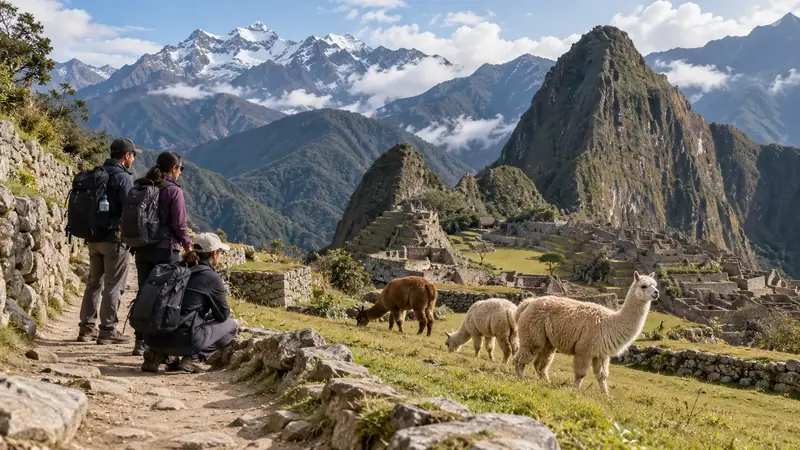
If you only take one ticket, route 2-A or 2-B (circuit 2) is the most complete: it starts from the terraces, from where you can see the whole site (the lower terrace on 2-B), then crosses several of the main urban sectors, depending on the route and what is open that day. Circuit 1 gives the highest view but does not go into the city; circuit 3 shows the royal buildings up close without passing through the Sacred Plaza.
Can you see the “classic photo” with every ticket?
The official descriptions announce an overall view from the upper terrace (1-B), the lower terrace (2-B), the agricultural sector (2-A) and, closer to the city, from the circuit 3 routes. The highest viewpoint is that of circuit 1.
Is a guide compulsory?
According to the regulations amended in September 2026 and reported by the Andina agency, a guide is recommended but not compulsory. An official guide helps you understand a city without detailed explanatory signs; the guide is paid for separately.
What should you do if the ticket is sold out?
Look at the other routes and times on the same day, then at nearby days. Some tickets are sold on site, in Machu Picchu Pueblo, according to the Andina agency, but that means already being in the village and accepting whatever is left. As a last resort, move the visit and keep the night in Ollantaytambo changeable.
What is the luggage rule on the train?
One small bag per person: with PeruRail, an 8 kg backpack or a 12 kg piece of hand luggage depending on its dimensions, with Inca Rail an 8 kg bag. Your big bag stays at your hotel in Cusco or the Sacred Valley, or in the free left luggage at PeruRail stations.
How much time should you allow at the site?
Each ticket sets a maximum time: 2 hr 30 min for routes 1-B, 2-A, 2-B and 3-B; 3 hr (1-D); 3 hr 30 min (3-D); 4 hr (1-C); 6 hr (3-A); 7 hr (1-A and 3-C). A route without a mountain takes about two hours at a gentle pace. With the train, the shuttle bus and the waiting, the visit takes up the whole day anyway.
Do you need to sleep in Machu Picchu Pueblo?
It is not compulsory, but it is the most relaxed option for an entry before 9:00. For an entry in the late morning or the afternoon, a round trip by train from Ollantaytambo is possible, at the cost of a long day.
Can you visit Machu Picchu with young children?
Yes. Entry is free for children under 3, and minors aged 3 to 17 must be accompanied. Pushchairs are not allowed on the site: bring a baby carrier. The routes of circuit 2 or route 3-B are better suited than the mountains, which are steep and exposed.
What is the best season for Machu Picchu?
SERNANP recommends April to October; the rainy season runs from November to March. The site stays open all year, but the Inca Trail closes in February and, from January to April, the train from Cusco becomes a bus journey followed by the train.
Sources and dates
14 sources
Prices, opening hours and rules change: every piece of information cited links to its source, with the date it was consulted.
Figures and rules cited
- 2 hr 30 min for routes 1-B, 2-A, 2-B and 3-B; 3 hr (1-D); 3 hr 30 min (3-D); 4 hr (1-C); 6 hr (3-A); 7 hr (1-A and 3-C): Maximum time allowed on the site, depending on the route on the ticket (Llaqta de Machu Picchu)
Site management: Ministry of Culture, official maps of the ten routes (PDF) (new tab) , published on 1 June 2024 · consulted on 2 October 2026 - about 2,430 m: Altitude of the Machu Picchu site (Machu Picchu)
Press or reseller: Wikidata, Machu Picchu (Q676203), altitude (new tab) · consulted on 1 October 2026 - three circuits grouping ten visiting routes: Organisation of visits: number of circuits and visiting routes (Llaqta de Machu Picchu) (All visitors) . Four routes are only offered in high season (1-C, 1-D, 3-C, 3-D).
Site management: Ministry of Culture, Machupicchu: circuits and visiting routes (new tab) , published on 1 June 2024 · consulted on 1 October 2026 - 1 January, 2 to 5 April, 19 June to 2 November, 30 and 31 December: High-season days in 2026 (maximum capacity and routes 1-C, 1-D, 3-C, 3-D open) (Llaqta de Machu Picchu) . Calendar announced by the state news agency; the rest of the year is low season.
Press or reseller: Andina, “Planning to visit Machu Picchu in 2026?” (3 November 2025) (new tab) , published on 3 November 2025 · consulted on 2 October 2026 - by route 3-B only, on reserved daily places, bought through a registered agency: Entry to the Llaqta for walkers arriving via the Inca Trail network (Llaqta de Machu Picchu) . Ministerial resolutions 000333-2026-MC and 000334-2026-MC.
Press or reseller: Andina, the changes to visits to Machu Picchu and to the Inca trail network (12 September 2026) (new tab) , published on 12 September 2026 · consulted on 2 October 2026 - the ticket and your passport (or the identity document used for the purchase); a valid higher-education student card for the student rate: Documents required at the site entrance (Llaqta de Machu Picchu) . Minors aged 3 to 17 must be accompanied; entry is free under 3.
Press or reseller: Andina, “¿Irás a Machu Picchu en 2026?” (26 December 2025) (new tab) , published on 26 December 2025 · consulted on 2 October 2026 - about 1 hr 30 min: Length of the train journey from Ollantaytambo to Machu Picchu Pueblo (Ollantaytambo station)
Site management: PeruRail, frequently asked questions (new tab) · consulted on 1 October 2026 - about 3 hr 30 min: Length of the train journey from Poroy (Cusco) to Machu Picchu Pueblo (Poroy station, Cusco)
Site management: PeruRail, frequently asked questions (new tab) · consulted on 1 October 2026 - about 2,040 m: Altitude of Machu Picchu Pueblo (Aguas Calientes), at the bottom of the valley (Machu Picchu Pueblo)
Old source: Wikipedia, Aguas Calientes (Peru) (new tab) · consulted on 1 October 2026 - about 8.9 km of hairpin bends: Shuttle road between Machu Picchu Pueblo and the site entrance (Hiram Bingham road) (Machu Picchu Pueblo–site entrance)
Press or reseller: Road route calculated on OpenStreetMap (FOSSGIS routing server) (new tab) · consulted on 2 October 2026 - 30 minutes in low season, 45 minutes in high season: Grace period after the entry time printed on the ticket (Llaqta de Machu Picchu) . After that, entry may be refused except in justified cases of force majeure.
Press or reseller: PeruRail, Tickets to Machu Picchu and New Visit Circuits 2026 (new tab) · consulted on 1 October 2026 - S/ 152: Basic entry ticket, foreign adult (circuits without a mountain) (Llaqta de Machu Picchu) (Foreign adult, from outside the Andean Community ; excludes: SERNANP entry fee for the Historic Sanctuary, Bus and train) . The price varies with the circuit; routes that include climbing a mountain cost more. The official ticket office (tuboleto.cultura.pe) shows the exact amount at the time of purchase.
Press or reseller: Infobae, “Suben tarifas de ingreso a Machu Picchu” (9 February 2026) (new tab) , published on 9 February 2026 · consulted on 1 October 2026 - S/ 11: Entry fee for the Historic Sanctuary (SERNANP), on top of the ticket, foreign visitor, since 1 May 2026 (Historic Sanctuary of Machu Picchu) (Foreign visitor (S/ 5 for a Peruvian visitor)) . The amount and how to pay it are shown when you buy the ticket.
Press or reseller: Infobae, SERNANP entry fee (5 February 2026), Resolución Directoral N° 000006-2026-SERNANP/DUSRN (new tab) , published on 5 February 2026 · consulted on 1 October 2026 - USD 24 (foreign visitor): Shuttle between Machu Picchu Pueblo and the site entrance, return (Hiram Bingham road, Machu Picchu) (Foreign visitor (USD 15 for a Peruvian visitor)) . The service changed operator in 2025: the price and the point of sale may still change.
Old source: Infobae, “Consettur seguirá cobrando tarifas de entre 15 y 24 dólares” (6 January 2026) (new tab) , published on 6 January 2026 · consulted on 1 October 2026 - recommended, without being compulsory: Being accompanied by a guide in the Llaqta de Machu Picchu (Llaqta de Machu Picchu) . Regulations amended by ministerial resolution 000334-2026-MC.
Press or reseller: Andina, the changes to visits to Machu Picchu and to the Inca trail network (12 September 2026) (new tab) , published on 12 September 2026 · consulted on 2 October 2026 - S/ 112 instead of S/ 64 for routes without a mountain: Ticket with a mountain route (Montaña Machupicchu, Waynapicchu, Gran Caverna), general national rate (Llaqta de Machu Picchu) (Peruvian adult, foreign resident or national of the Andean Community) . For a foreign visitor, the ticket office shows the exact price when you choose the route.
Press or reseller: Andina, “Planning to visit Machu Picchu in 2026?” (3 November 2025) (new tab) , published on 3 November 2025 · consulted on 2 October 2026 - one 8 kg backpack (100 cm, sum of the three sides) or one 12 kg piece of hand luggage (115 cm): Luggage allowance per passenger, PeruRail, Machu Picchu line (PeruRail Expedition, Vistadome, Vistadome Observatory, Hiram Bingham trains) . Free left-luggage at Ollantaytambo and Machu Picchu stations.
Site management: PeruRail, luggage policy (new tab) · consulted on 1 October 2026 - one 8 kg piece of hand luggage (118 cm, sum of the three sides): Luggage allowance per passenger, Inca Rail (Inca Rail trains) . Check in at the station at least 30 minutes before departure; passport and ticket required.
Site management: Inca Rail, conditions of carriage (new tab) · consulted on 1 October 2026 - at the station at least 60 minutes before departure; free left-luggage at Ollantaytambo (4:15–21:00) and Machu Picchu (8:00–22:00); changes or cancellations no later than 24 hr before departure, with a 10% fee, except promotional fares: PeruRail: check-in at the station, left luggage, changes and cancellations (PeruRail trains, Machu Picchu line) . Children: free up to the age of 2 on a lap, 75% of the adult fare from 3 to 11.
Site management: PeruRail, frequently asked questions (new tab) · consulted on 2 October 2026 - from January to April: Period of the “bimodal” service (bus then train) from Cusco (Cusco (Wanchaq station), via Pachar or Ollantaytambo)
Site management: PeruRail, frequently asked questions (new tab) · consulted on 1 October 2026 - about 4 km, including 2.3 km of stepped path from the Ruinas bridge, for nearly 400 m of ascent: Walking up from Machu Picchu Pueblo (Manco Cápac square) to the site entrance (Machu Picchu Pueblo–site entrance) . Ascent worked out from the altitudes in the register (village about 2,040 m, site about 2,430 m). The routing server does not take the slope into account.
Press or reseller: Walking route calculated on OpenStreetMap (FOSSGIS routing server, pedestrian profile) (new tab) · consulted on 2 October 2026 - 40 x 35 x 20 cm: Maximum size of bags allowed on the site (Llaqta de Machu Picchu)
Site management: Ministry of Culture, Machupicchu: rules of conduct (new tab) · consulted on 1 October 2026 - 5,600 visitors a day in high season, 4,500 in low season: Daily capacity of the site (Llaqta de Machu Picchu)
Press or reseller: PeruRail, Tickets to Machu Picchu and New Visit Circuits 2026 (new tab) · consulted on 1 October 2026 - 1,000 tickets a day, at the cultural centre of the Machu Picchu Pueblo municipality: Tickets sold on the spot, in Machu Picchu Pueblo (Machu Picchu Pueblo) . The rest of the quota is sold online. Day of sale, queue and routes offered: to be seen on the spot.
Old source: Andina, “¿Irás a Machu Picchu en 2026?” (26 December 2025) (new tab) , published on 26 December 2025 · consulted on 2 October 2026
Sources consulted
- Ministry of Culture, Machupicchu: visiting circuits and routes (PDF maps of the ten routes and the 2026 signs) (new tab) (consulted on 2 October 2026)
- Ministry of Culture, Tu Boleto ticketing, Llaqta Machupicchu (official descriptions of the routes) (new tab) (consulted on 2 October 2026)
- Ministry of Culture, code of conduct (new tab) (consulted on 12 October 2026)
- UNESCO, Historic Sanctuary of Machu Picchu (new tab) (consulted on 2 October 2026)
- Yale University, Department of Anthropology: new dating of Machu Picchu (11 August 2021) (new tab) (consulted on 2 October 2026)
- Andina, changes to the visiting rules (12 September 2026) (new tab) (consulted on 2 October 2026)
- Andina, 2026 prices and capacity (3 November 2025) (new tab) (consulted on 2 October 2026)
- SERNANP, Santuario Histórico de Machupicchu (biodiversity, visiting season, access opening hours; in Spanish) (new tab) (consulted on 12 October 2026)
- Andina, the Manuel Chávez Ballón site museum and its botanical garden (29 November 2023, in Spanish) (new tab) (consulted on 12 October 2026)
- El Tiempo, Gercetur Cusco’s call for caution on the Hidroeléctrica access (31 March 2026, in Spanish) (new tab) (consulted on 12 October 2026)
- Forbes Perú, the Machu Picchu Pueblo–Hidroeléctrica train restored after a landslide (6 April 2026, in Spanish) (new tab) (consulted on 12 October 2026)
- PeruRail, frequently asked questions and luggage policy (new tab) (consulted on 2 October 2026)
- Inca Rail, conditions of carriage (new tab) (consulted on 1 October 2026)
- Wikipedia (English), Machu Picchu (terraces, Kenneth Wright’s studies) (new tab) (consulted on 2 October 2026)
How we choose and date our information: our method. Has something changed? Let us know.