
In short
Tell the recurring landmark (the Candelaria in Puno in February, Holy Week in Ayacucho, Inti Raymi in Cusco on 24 June, the Señor de los Milagros in Lima in October) apart from the programme published for the year of your trip. Book accommodation and transport early, arrive before the event, and remember that a procession is first and foremost a religious celebration.
The calendar, month by month
| Period | Festival | Where | Type | Date |
|---|---|---|---|---|
| Late January or early February | National Marinera Contest | Venue announced each year by the organiser, Club Libertad of Trujillo; in 2026, at the Polideportivo del Callao | Dance contest | Annual; 31 January and 1 February in 2026 |
| February | Virgen de la Candelaria | Puno | Religious and folk festival | Around 2 February, over several weeks |
| February | Verano Negro | Chincha, El Carmen | Afro-Peruvian festival | February |
| February or March | Carnival | Cajamarca and the whole country | Popular festival | Movable (before Ash Wednesday) |
| March or April | Holy Week | Ayacucho above all | Religious festival | Movable (Easter) |
| May or June | Qoyllur Rit’i | Sinakara Valley (Cusco), at more than 4,500 m | Andean pilgrimage | Movable: begins 58 days after Easter, just before Corpus Christi |
| May or June | Corpus Christi | Cusco | Religious festival | Movable (Easter) |
| 24 June | Inti Raymi | Cusco | Theatrical re-enactment | Fixed |
| 24 June | San Juan | The Amazon (Iquitos, Tarapoto, Pucallpa…) | Popular festival | Fixed |
| 15 to 18 July | Virgen del Carmen | Paucartambo (Cusco) | Religious festival, masked dances | Fixed, main day on the 16th |
| 28 and 29 July | Fiestas Patrias | The whole country | National holiday | Fixed |
| October | Señor de los Milagros | Lima | Religious procession | Several processions in October |
| December | Hatajo de Negritos and Pallitas | El Carmen, Chincha | Afro-Peruvian Christmas dances | Christmas to 6 January |
The movable festivals depend on the Easter calendar; detailed programmes are published every year. This table is not a 2027 diary: the programme published for the year of your trip is what counts.
A festival as lived, a re-enactment, a paid show
Three very different experiences sometimes go by the same name:
- The festival as lived: a religious or community celebration, organised by and for the residents (the Candelaria, Holy Week, Paucartambo, the Señor de los Milagros). You attend it, you do not buy it; you behave as a guest.
- The re-enactment: today’s Inti Raymi is a staging, created in 1944 from the chroniclers’ accounts and performed by hundreds of artists. It is spectacular and popular, but it is not a continuous Inca ceremony.
- The paid show: reserved stands, dinner shows, “festival” outings sold by agencies. Nothing wrong with that, as long as you know what you are paying for.
The big festivals, a few pointers
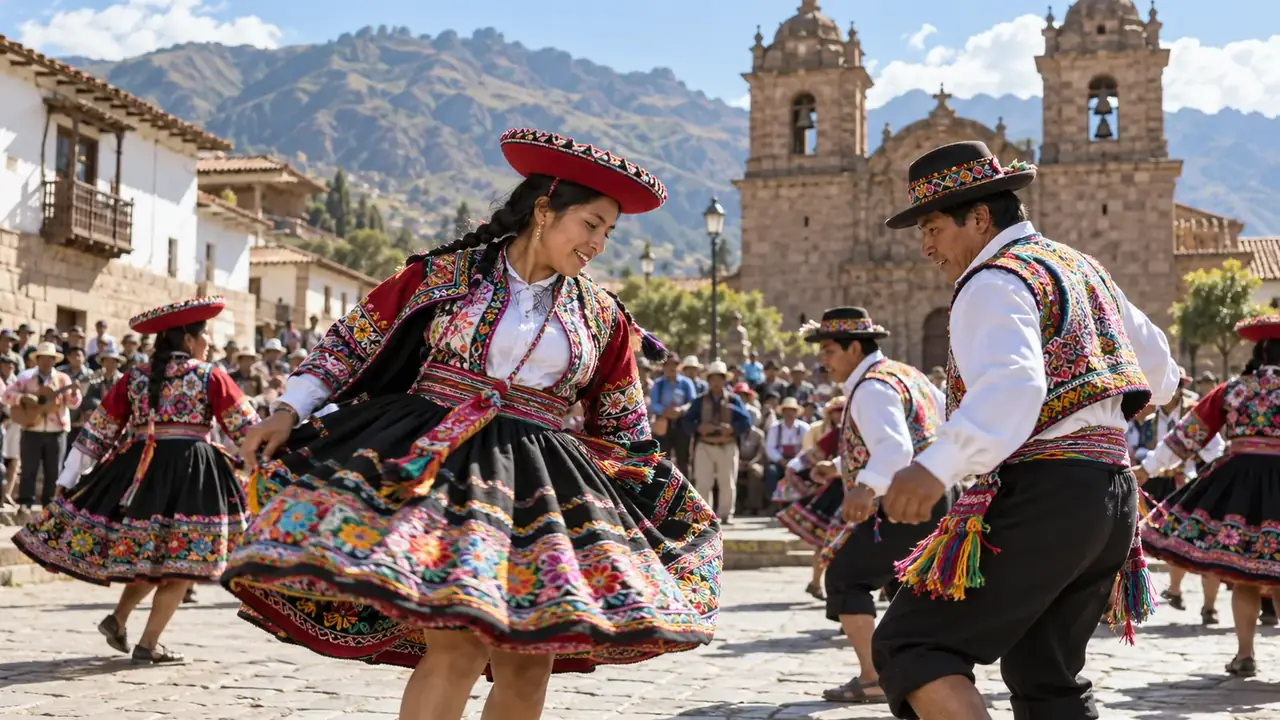
The Virgen de la Candelaria, in Puno. For several weeks in February, thousands of dancers and musicians from the region’s Quechua and Aymara communities parade in honour of the Virgin of Candlemas, with embroidered costumes and masks. It is one of the biggest festivals in the country, inscribed on UNESCO’s intangible heritage list. Puno is full at that time: book very early. See Puno and Lake Titicaca.
Holy Week, in Ayacucho. For ten days, the city lives through a representation of the Passion that blends Catholic tradition and Andean nuances, with many processions. It was declared cultural heritage of the Nation in 2022. See Ayacucho.
Qoyllur Rit’i. An Andean pilgrimage to the Sinakara Valley, at the foot of a glacier, at more than 4,500 metres, at the end of the southern autumn. Its calendar follows Easter: according to UNESCO, it begins 58 days after Easter Sunday, a few days before Corpus Christi; check the programme for the year. It combines the celebration of the Pleiades, linked to the harvests and the Andean new year, and devotion to the Lord of Qoyllur Rit’i. Inscribed by UNESCO in 2011. It is a walk at very high altitude, at night, in the cold, among thousands of pilgrims: it should only be done accompanied, well acclimatised, and with respect for an experience that is not organised for visitors.
Inti Raymi, in Cusco. The Festival of the Sun celebrated the winter solstice and the Inca new year, before being banned in colonial times. Since 1944, a theatrical re-enactment has taken place every 24 June, in three parts: at the Qorikancha, on the Plaza de Armas, then on the esplanade of Sacsayhuamán. The stands at Sacsayhuamán are ticketed; Cusco is packed all week. See Cusco.
San Juan, in the Amazon. On 24 June, the Amazonian towns celebrate Saint John, patron saint of the region: river bathing, music, and juane, rice with chicken cooked in a bijao leaf, which is its emblematic dish.
The Virgen del Carmen, in Paucartambo. From 15 to 18 July, this mountain village east of Cusco celebrates its patron saint with processions and some twenty troupes of masked dancers who re-enact episodes from the history of Peru. The village is small: accommodation there is very limited.
The Fiestas Patrias. On 28 and 29 July, Peru celebrates its independence (proclaimed on 28 July 1821) and its armed forces. These are holidays: Peruvians travel, and transport and hotels at the tourist sites fill up.
The Señor de los Milagros, in Lima. In October, hundreds of thousands of faithful dressed in purple accompany through the centre of Lima an image of Christ painted in the 17th century by an enslaved man of Angolan origin, which remained standing after the earthquakes that destroyed the city. It is one of the largest Catholic processions in the world; the streets of the centre are then closed along its route.
The Cajamarca carnival. In February or March, the city lives to the rhythm of parades, songs and games with water and paint, until the burial of the “Ño Carnavalón” on Ash Wednesday.
Access, crowds, booking
- Book accommodation very early for the Candelaria, Inti Raymi, Holy Week in Ayacucho and Paucartambo, and for the tourist sites during the Fiestas Patrias.
- Arrive the day before or two days before: transport is packed on festival days, and the altitude of Puno or Cusco needs a period of adjustment in any case.
- Plan a meeting point that is easy to find, and ask your accommodation which streets are closed.
- Keep your belongings close to you in the crowd: festivals also attract thieves.
- Choose your spot according to your comfort: you can enjoy the atmosphere without staying all day in the densest part.
Photographing with respect
A religious or community celebration exists first and foremost for those who take part in it. Ask before photographing a person close up; do not block a passage or a procession to take a shot again; no flash during ceremonies in churches. A guide can explain the customs, but their presence does not amount to general permission to film.
Public holidays and opening hours
Museums, markets, shops and services may change their opening hours during festivals and on public holidays: the Museo Larco, for example, announces exceptions for certain festivals. Check the opening times of what matters to you before building your day.
Frequently asked questions
Do you need a ticket for Inti Raymi?
The re-enactment takes place in three locations: the Qorikancha, the Plaza de Armas and the esplanade of Sacsayhuamán. The stands at Sacsayhuamán are ticketed; you can also follow the ceremony from the heights or in the streets. Check the official programme and ticketing for the year.
Are the dates fixed?
Some are (24 June for Inti Raymi and San Juan, 16 July in Paucartambo, 28 and 29 July for the Fiestas Patrias, October for the Señor de los Milagros). Others depend on Easter: carnival, Holy Week, Corpus Christi, Qoyllur Rit’i. Check the calendar for the year.
Can you photograph a procession?
Yes, from a distance and without blocking the way. Ask before photographing a person close up, and never block a procession to take a shot again.
Sources and dates
12 sources
Prices, opening hours and rules change: every piece of information cited links to its source, with the date it was consulted.
Sources consulted
- Wikipedia (English), Inti Raymi (re-enactment since 1944, three locations) (new tab) (consulted on 2 October 2026)
- Wikipedia (English), Lord of Miracles (October processions) (new tab) (consulted on 2 October 2026)
- Wikipedia (English), Qoyllur Rit’i (UNESCO 2011) (new tab) (consulted on 2 October 2026)
- UNESCO, pilgrimage to the sanctuary of the Lord of Qoyllurit’i (begins 58 days after Easter, inscribed in 2011) (new tab) (consulted on 7 October 2026)
- IRTP, 2026 National and World Marinera Contest at the Polideportivo del Callao (3 February 2026) (new tab) (consulted on 7 October 2026)
- Diario Correo, final of the World Marinera Contest in Callao, organised by Club Libertad (1 February 2026) (new tab) (consulted on 7 October 2026)
- Wikipedia (Spanish), Semana Santa en Ayacucho, Virgen del Carmen de Paucartambo, Carnaval de Cajamarca (new tab) (consulted on 2 October 2026)
- Wikipedia (English), Fiestas Patrias (Peru) (new tab) (consulted on 2 October 2026)
- PROMPERÚ, Inti Raymi (new tab) (consulted on 26 September 2026)
- PROMPERÚ, dishes of the Amazon and the San Juan festival (new tab) (consulted on 26 September 2026)
- PROMPERÚ, the festival of the Virgen de la Candelaria (new tab) (consulted on 26 September 2026)
- Andina, Chincha: Verano Negro and Afro-Peruvian dances (25 October 2023) (new tab) (consulted on 2 October 2026)
How we choose and date our information: our method. Has something changed? Let us know.