
In short
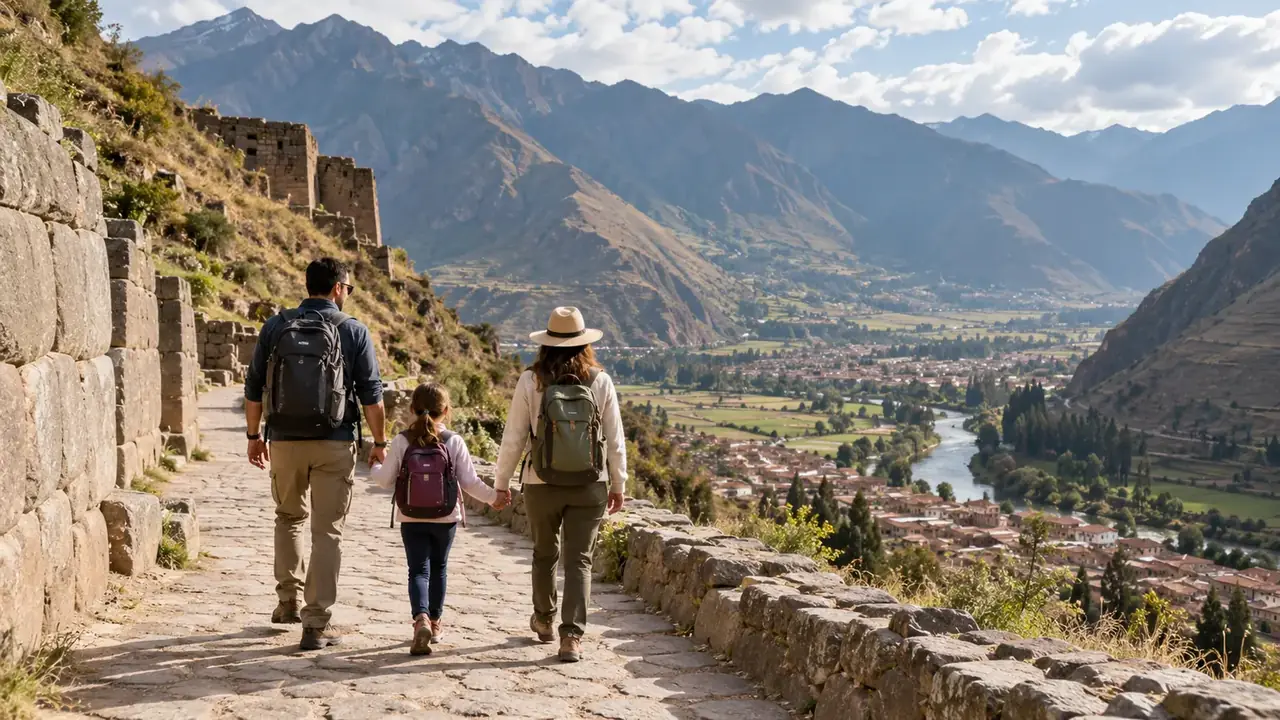
Start by counting the changes of accommodation: each one costs half a day. As a family or at a relaxed pace, two or three bases are enough for two weeks. Alone, private transfers and rooms cost more per person: shared excursions and hostels make up for it. As a couple, each choose your priorities and accept a few days apart. For mobility, ask place by place: Caral lends wheelchairs, Machu Picchu’s route 3-B has an accessible section, Cusco is hilly.
Three routes, three numbers of transitions
A change of accommodation means repacking your bags, checking out of the room, a journey, a new arrival: half a day, often more. To compare two programmes, count these changes before the kilometres.
Route A, two Andean bases, 12 nights, 3 changes. Lima 3 nights; flight to Cusco (about 1 hr 25 min) and a direct transfer to Urubamba, in the Sacred Valley (about 1 hr by car, 1 hr 30 min by bus, for some 45 km), to sleep first at about 2,870 m rather than in Cusco; 5 nights in Urubamba, with Machu Picchu by train from Ollantaytambo as a day trip; 3 nights in Cusco; 1 night in Lima before the return flight.
Route B, southern loop, 15 nights, 7 changes. Lima 2 nights; flight to Arequipa (about 1 hr 30 min), 3 nights; road to Chivay, in the Colca (about 3 hr to 3 hr 30 min for some 160 km), 1 night; road to Puno (273 km at altitude), 2 nights; road to Cusco (387 km), 3 nights; Machu Picchu Pueblo, 1 night; Cusco, 2 nights; Lima, 1 night.
Route C, a single base, 8 nights, no changes. Lima, with day trips: Pachacámac, the Palomino Islands, Caral, the neighbourhoods and the museums. See Lima and around.
| A: two Andean bases | B: southern loop | C: a single base | |
|---|---|---|---|
| Nights | 12 | 15 | 8 |
| Changes of accommodation | 3 | 7 | 0 |
| Domestic flights | 2 | 2 | 0 |
| Long road journeys | 1 short one (Cusco–Urubamba) | 3 (Colca, Puno, Cusco) | None; day trips |
| Altitude | Gradual (Urubamba, then Cusco) | Gradual (Arequipa about 2,335 m, Chivay about 3,600 m, Puno about 3,830 m) | None |
| Who it suits | Families, first trip, relaxed pace | Solo travellers or active couples, used to journeys | Reduced mobility, slow stay, first contact |
Route B shows more places; it also means repacking your bags seven times, three long days on the road and a night at nearly 3,600 metres before Puno. That is not a flaw if it suits you; it is a choice to make with full knowledge of the facts. See also A first trip to Peru in 15 days.
As a family: ages, beds, breaks, activities
- Beds. Ask for the exact configuration: a “cama matrimonial” is a double bed, “dos camas” two separate beds; a triple or family room does not always have a real bed for each child. Have the number of beds and their size put in writing.
- Breaks. Plan a day without travel after each change of altitude or each early-morning flight, and meals at set times: Peruvian lunch, served between 13:00 and 15:00, comes late for some children.
- Transport. In a private car, ask whether a child seat is provided; do not assume it is. For intercity buses and trains, ask from what age a child pays for their place and whether they are entitled to a seat.
- Activities. For each outing, ask the minimum age, the real distance on foot, the equipment and what happens if the child cannot carry on. A “family” label in a brochure does not replace these answers.
- Altitude. Young children find it hard to express the symptoms of altitude sickness: discuss the itinerary with a paediatrician. See altitude.
- Documents. A child travelling with only one parent may need an authorisation to leave Peru: non-Peruvian minor who has stayed less than 90 days: no exit authorisation; non-Peruvian minor who is resident or has stayed more than 90 days, or Peruvian minor (including dual nationals): authorisation from the absent parent, drawn up before a notary in Peru or at a Peruvian consulate. See borders.
Alone: the cost per person and meeting people
What costs more alone. Everything paid per vehicle or per room. An example published in Cusco: an outing to Maras, Moray and the salt pans costs S/ 280 per vehicle, entry fees and guide not included. Alone, you pay the lot; as two, half each (S/ 140); as four, a quarter (S/ 70). A single room also often costs almost as much as a double.
What narrows the gap. Shared excursions, sold per person; private rooms in hostels; public buses for simple journeys. For a shared excursion, ask the minimum number of participants and what happens if it is not reached: departure cancelled, postponed or an extra charge.
Meeting people. A hostel with common areas, a cooking class, a guided walking tour or a trek in a small group offer chances to meet people without any particular organisation. Independent accommodation suits those who prefer peace and quiet.
Safety. Share your programme with someone close to you, take booked taxis in the evening, keep your confirmations offline. See everyday safety.
As a couple: choosing without doing everything together
Before building the route, each of you writes down three things you want to do and two things to avoid. One wants to walk, the other prefers towns; one likes to leave at dawn, the other wants to sleep. This list settles things more easily than an itinerary packed with popular activities.
A day apart is not a failure. In Cusco, one of you can go to Vinicunca, the Mountain of 7 Colours (a very early start and a long road), while the other visits the city and San Pedro market. At Machu Picchu, each of you can buy the route that suits you, a mountain route for one, route 3-B for the other, with a meeting point at the exit. Also keep some leeway in the budget for decisions made on the spot.
Reduced mobility: place by place
Accessibility information remains scarce and changes: always ask the place before you go. What we know, place by place:
| Place | What helps | What remains difficult |
|---|---|---|
| Lima, Metro Line 1 | Lifts in the stations | Crowds at rush hour |
| Lima, MALI | Ramps, lifts, wheelchairs, adapted toilets | |
| Lima, the Miraflores malecón | A flat, continuous promenade | Steep slopes or steps down to the beaches |
| Lima, historic centre | A flat route | Catacombs and convent rooms reached by stairs |
| Lima, Huaca Pucllana | Guided tour | Climbs and steps on part of the route |
| Pachacámac | A long route, in the sun, on sandy ground | |
| Caral | An inclusive circuit since 2008, a 1.6 km adapted path, adapted wheelchairs lent at the ticket office; TUR4All accessibility award in May 2026 | A journey of several hours from Lima |
| Machu Picchu | Route 3-B, the shortest (1.3 km), recommended for older people and people with reduced mobility, with a wheelchair-accessible section | The rest of the site is made up of stairs; the climb is by bus from Machu Picchu Pueblo |
| Cusco | Steep, cobbled streets, narrow pavements, altitude |
For accommodation, ask for a ground-floor room or a lift, the width of the doors, a walk-in shower, and whether the property can be reached by car right up to the door. A taxi or a booked vehicle is often simpler than a public network. See getting around Lima and Lima’s museums.
Treks and altitude: advice for each person
Within the same group, each person reacts differently to the altitude, whatever their age or physical condition. The CDC recommends that pregnant women avoid sleeping above about 3,050 metres, and medical advice for people with a heart or lung condition. See altitude.
If someone in the group does not want to or cannot walk for several days, there is almost always an alternative: the train to Machu Picchu instead of the Inca Trail, the Llanganuco lakes, reachable by car, rather than the walk to Laguna 69 (about 4,600 m), a day in town while the others hike. See hiking.
Staying several weeks
Start with your usual journeys: work, family and friends, activities, shopping. A pleasant neighbourhood for three nights on holiday is not necessarily the one that suits everyday life. Also check the length of stay allowed for your nationality. See staying several weeks in Lima and borders.
Frequently asked questions
How many changes of hotel for two weeks as a family?
Three or four at most. A 12-night route with Lima, the Sacred Valley and Cusco has three; a southern loop through Arequipa, the Colca and Puno has seven, which means a lot of packing and journeys for children.
Is Peru wheelchair accessible?
Unevenly. Some places are adapted: Line 1 of the Lima Metro and the MALI have lifts, Caral lends wheelchairs, Machu Picchu’s route 3-B includes an accessible section. Hilly old town centres, such as Cusco, and many archaeological sites remain difficult. Ask before each visit.
Is travelling alone more expensive?
Yes, for everything paid per vehicle or per room. A private transfer costs the same for one person as for four. Shared excursions, dormitories or private rooms in hostels and public buses narrow the gap.
Sources and dates
4 sources
Prices, opening hours and rules change: every piece of information cited links to its source, with the date it was consulted.
Figures and rules cited
- about 1 hr 25 min: Length of a direct Lima–Cusco flight (Jorge Chávez (Lima) and Velasco Astete (Cusco) airports) . Direct flights operated by LATAM, Sky and JetSMART among others.
Press or reseller: KAYAK, Lima–Cusco flights (average length of direct flights) (new tab) · consulted on 1 October 2026 - about 1 hr by car, 1 hr 30 min by bus, for some 45 km: Length of the road journey from Cusco to Urubamba (Sacred Valley) (Cusco–Urubamba road)
Press or reseller: Rome2rio, Cusco–Urubamba (new tab) · consulted on 1 October 2026 - about 2,870 m: Altitude of Urubamba (town) (Urubamba, Sacred Valley)
Press or reseller: Wikidata, Urubamba (Q2304483), altitude (new tab) · consulted on 1 October 2026 - about 1 hr 30 min: Length of a direct Lima–Arequipa flight (Jorge Chávez (Lima) and Rodríguez Ballón (Arequipa) airports) . Direct flights operated by LATAM, Sky and JetSMART among others.
Press or reseller: KAYAK, Lima–Arequipa flights (average length of direct flights) (new tab) · consulted on 1 October 2026 - about 3 hr to 3 hr 30 min for some 160 km: Length of the road journey from Arequipa to Chivay (Colca valley) (Arequipa–Chivay road via the Patapampa pass)
Press or reseller: Rome2rio, Arequipa–Chivay (bus and car) (new tab) · consulted on 1 October 2026 - about 2,335 m: Altitude of Arequipa (centre) (Arequipa)
Press or reseller: Wikidata, Arequipa (Q159273), altitude (new tab) · consulted on 1 October 2026 - about 3,600 m: Altitude of Chivay (the main town of the Colca valley) (Chivay)
Press or reseller: Wikipedia (English), Chivay (new tab) · consulted on 1 October 2026 - about 3,830 m: Altitude of Puno (town, on the shore of Titicaca) (Puno)
Press or reseller: Wikidata, Puno (Q232842), altitude (new tab) · consulted on 1 October 2026 - non-Peruvian minor who has stayed less than 90 days: no exit authorisation; non-Peruvian minor who is resident or has stayed more than 90 days, or Peruvian minor (including dual nationals): authorisation from the absent parent, drawn up before a notary in Peru or at a Peruvian consulate: Leaving Peru with a minor accompanied by only one parent (Peru) . With both parents: prove the parent–child relationship (family record book or equivalent).
Official source: France Diplomatie, Pérou, entrée et séjour (entry and stay, in French; updated on 21 September 2026) (new tab) , published on 21 September 2026 · consulted on 2 October 2026 - S/ 280 per vehicle, up to 4 passengers according to the provider: Cusco → Maras–Moray–Salineras → Cusco (Travel Inkas Route (indicative prices), Cusco) (Group of up to 4 passengers)
Price recorded: Travel Inkas Route, indicative prices (new tab) · consulted on 26 September 2026 - about 4,600 m: Altitude of Laguna 69 (Huascarán National Park) (Laguna 69, Cordillera Blanca) . Wikidata gives 4,625 m.
Official source: PROMPERÚ (Y tú qué planes), Laguna 69 (4,604 m) (new tab) · consulted on 26 September 2026
Sources consulted
- Caral Archaeological Zone, TUR4All accessibility award (14 May 2026) (new tab) (consulted on 2 October 2026)
- Infobae, accessible route and Inca Trail places at Machu Picchu (11 November 2025) (new tab) (consulted on 2 October 2026)
- CDC Yellow Book, Peru (altitude, pregnancy, children) (new tab) (consulted on 2 October 2026)
- France Diplomatie, Pérou, entrée et séjour (entry and stay, in French: minors leaving the country) (new tab) (consulted on 2 October 2026)
How we choose and date our information: our method. Has something changed? Let us know.