
In short
To stay: Miraflores (practical, first stay) or Barranco (walks, evenings). To visit: the historic centre and Rímac (colonial heritage), Pueblo Libre (Museo Larco), Barranco and Miraflores on foot. The other districts are visited for a specific place: the El Olivar olive grove in San Isidro, the Huaca Huantille in Magdalena, the Campo de Marte in Jesús María, the Gran Teatro Nacional in San Borja, the Morro Solar and the Pantanos de Villa in Chorrillos.
Administrative district, lived-in neighbourhood
In Lima, the word “district” refers to a municipality, with its own local council. Some are small and uniform (Barranco, Lince); others are vast and very varied: Santiago de Surco covers 52 km², from the affluent residential areas of Monterrico to modest areas. Finally, Callao is not a district of Lima but a neighbouring province, that of the port and the airport. An address “in Surco” or “in San Isidro” therefore tells you neither the distance to your visits nor the atmosphere of the street: always ask for the exact point on the map.
The neighbourhoods at a glance
| Neighbourhood | Visiting: why | Staying | Eating | How long |
|---|---|---|---|---|
| Miraflores | Cliffs and seafront, Huaca Pucllana, Place of Memory | The simplest base | Every format | Half a day to a day |
| Barranco | Seaside-resort architecture, two museums, the sea | For walks and evenings | Cafés, tabernas, chef’s cuisine | Half a day and an evening |
| Historic centre | Squares, cathedral, convents, balconies, Barrio Chino | Not recommended for a first stay | Chifas, central market | Three hours to a day |
| Pueblo Libre | Museo Larco, national museum, Plaza Bolívar | Quiet, far from the sea | Taberna Queirolo | Half a day |
| Surquillo | Markets and neighbourhood food | Cheaper, next to Miraflores | Menús, cevicherías | One to two hours |
| Callao and La Punta | Real Felipe fortress, Palomino Islands | Rarely | Fish in La Punta | Half a day |
| San Isidro | El Olivar olive grove, Huaca Huallamarca | Quiet, business district | Business restaurants | Two hours |
| Magdalena del Mar | Huaca Huantille, market, the Cúpula church | Rarely | Market | Two hours |
| Jesús María | Campo de Marte, natural history museum, Japanese cultural centre | Rarely | Neighbourhood food | Two hours |
| Lince | Parque Ramón Castilla, regional cooking | Rarely | Cooking from the north of the country | The time it takes to eat a meal |
| San Borja | Gran Teatro Nacional, National Library | Rarely | Little of specific interest | An evening at a show |
| Surco | Old village centre, Parque de la Amistad | Depending on the exact area | Depending on the area | Two hours |
| Chorrillos | Morro Solar, fishing port, Pantanos de Villa | Rarely | Fish and seafood | Half a day |
| Rímac | Alameda de los Descalzos, Paseo de Aguas, World Heritage | No | Little for tourists | Two hours, alongside the centre |
| La Victoria and Gamarra | The great textile district | No | Neighbourhood counters | A morning |
| Carabayllo and the lomas | Lomas de Primavera, in winter | No | No | An organised morning |
San Isidro
San Isidro is both Lima’s main business district, with its office towers, and a residential district of parks and villas. For a visitor, two places justify the detour.
The El Olivar olive grove. In 1560, Antonio de Rivera brought the first olive saplings from Seville; some of the present-day trees are said to come from those first plantings. The grove now has about 1,670 trees over some ten hectares, in the middle of the houses; it has been protected since 1959. It is one of the quietest places in the city for an hour’s walk.
Huaca Huallamarca. A restored earthen pyramid, with a small site museum: organic objects, textiles, ceramics and human remains from funerary contexts, from an occupation running from the Formative period to Inca times. Opening hours and price: Tuesday to Saturday and on the first Sunday of the month, from 9:00 to 17:00; S/ 5 per adult. Less well known than Huaca Pucllana, it is also less crowded.
Good to know: San Isidro is quiet in the evening and at weekends in its office areas. Staying there suits business trips; for a leisure stay, neighbouring Miraflores is livelier.
Magdalena del Mar
Magdalena is a residential and shopping district, between San Isidro and the sea, that shows everyday Lima.
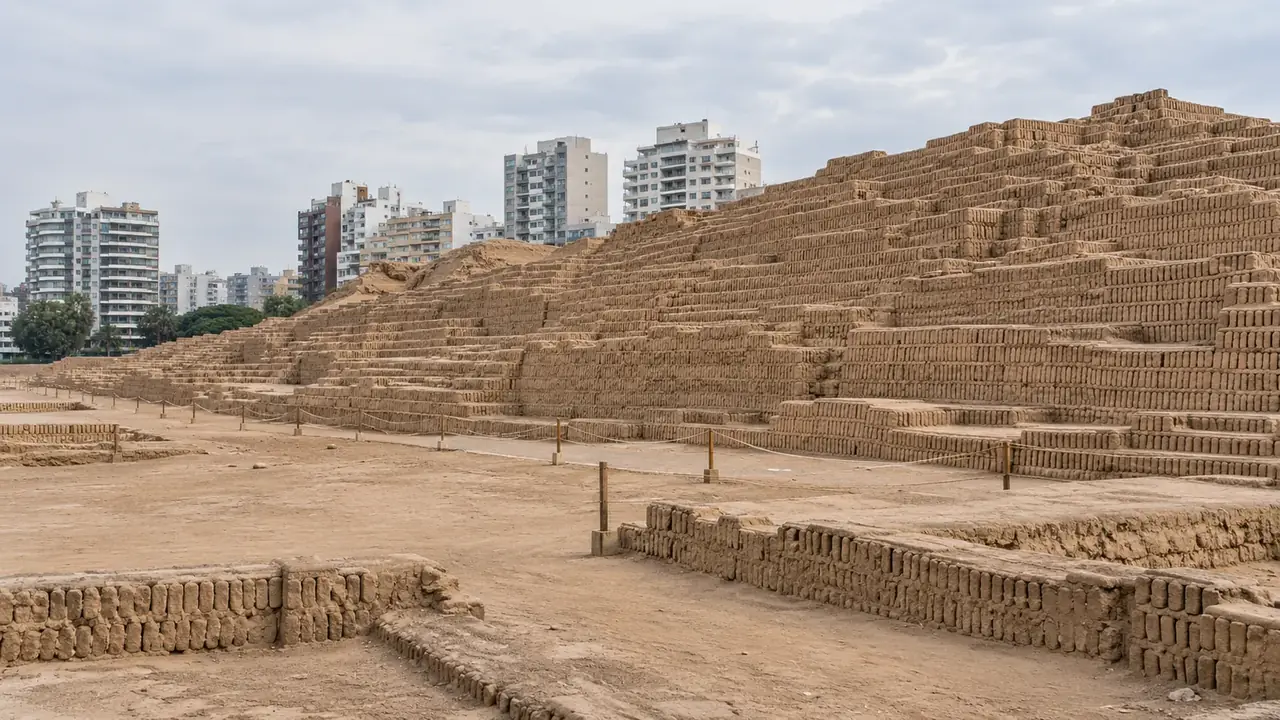
- The Huaca Huantille, built by the Ychsma between 1200 and 1450, before the arrival of the Incas: a central plaza surrounded by benches and a pyramid-shaped façade with walls painted blue, grey and white. Visits: Monday to Friday, from 9:00 to 13:00 and from 14:00 to 17:00.
- The Church of the Heart of Mary, which residents call “La Cúpula”: an octagonal rotunda topped by a dome rising to 50 m, inaugurated in 1957.
- The Magdalena market, one of Lima’s big neighbourhood markets, described in Lima’s markets.
- The Yuyachkani theatre, an experimental theatre company that combines Andean traditions and the performing arts, and craft workshops (azulejo tiles, ceramics, metal sculpture) listed by the municipality.
A morning is enough: the market, the huaca (on weekdays only), a lunch. Come by taxi from Miraflores or San Isidro.
Jesús María
Jesús María, created in 1963, is a residential district organised around large public spaces.
- The Campo de Marte, a former racecourse turned park, declared an inviolable green space in 1968. Here you find the monument to the defenders of the border (the 1941 conflict with Ecuador) and “El Ojo que Llora”, a memorial to the victims of political violence.
- The Parque de los Próceres, inaugurated in 1971 for the 150th anniversary of independence.
- The Natural History Museum of San Marcos University, created in 1918, on Avenida Arenales: collections of the country’s minerals, plants and animals, a good introduction to the diversity of environments before a trip to the Amazon or the Andes.
- The Peruvian-Japanese cultural centre, a reminder of Lima’s large community of Japanese origin, with exhibitions and activities.
- The Residencial San Felipe, a housing complex begun in 1963 to plans by Enrique Ciriani, known to architecture enthusiasts for its duplexes arranged around shared spaces.
Combine Jesús María with Lince or Pueblo Libre, which are close by, rather than with Miraflores.
The Residencial San Felipe and the Peruvian-Japanese cultural centre
The Residencial San Felipe is visited as a neighbourhood, not as a monument: residential buildings around pedestrian paths, large trees that give shade and benches, and a small area of shops and restaurants. The Lima press recommends a few neighbourhood addresses there, including a café, a plant-based kitchen and a Japanese restaurant. The Peruvian-Japanese cultural centre of the Asociación Peruano Japonesa is on its edge, at Avenida Gregorio Escobedo 803; it is home to the restaurant Katana, Japanese and Nikkei cooking. Allow an hour’s walk and a meal; come by day, by taxi from Miraflores or combining it with Lince and Pueblo Libre. The Tanta branch on Avenida Salaverry, in Jesús María, is another nearby option, with a wider menu.
Lince
A small district created in 1936, crossed by Avenida Arequipa and Avenida Petit Thouars, Lince is above all a stop for food lovers: restaurants serving regional cuisines, particularly from the north of the country, have set up here. Parque Mariscal Ramón Castilla is one of the city’s large green spaces. Our address in the neighbourhood: Chulucanas Lima, cooking from Piura. Come for a meal, on the way between Miraflores and the centre or Jesús María.
San Borja
Created in 1983, San Borja is a spacious residential district that brings together several major national cultural institutions around Avenida Javier Prado: the Gran Teatro Nacional, the country’s main performance venue (concerts, ballets, theatre), the National Library of Peru and the Ministry of Culture. The Museo de la Nación building has not housed a permanent exhibition since 2014: it hosts temporary exhibitions, and a large part of the archaeological collections has moved to the new Museo Nacional del Perú, near Pachacámac. The Parque de la Felicidad, with its lagoon and amphitheatre, is popular with families.
People come to San Borja for a specific show or exhibition. Metro Line 1 stops there (La Cultura, San Borja Sur and Angamos stations).
Surco
Santiago de Surco is one of the largest districts in the city. Before the conquest, this territory belonged to the Ychsma domain of Sullco; in colonial times, the village of Santiago de Surco was one of the first Indigenous “reducciones” created by Viceroy Toledo. The district was created in 1929. For a visitor:
- old Surco, around its Plaza de Armas and the Santiago Apóstol parish complex, keeps the look of an old village;
- the Parque de la Amistad, opened in 2001, hosts a pisco sour festival every year;
- large shopping centres, including the Jockey Plaza.
Distances within the district are great: accommodation “in Surco” can be twenty minutes or an hour from Miraflores depending on the area and the time. Do not book on the strength of the name alone.
Chorrillos
South of Barranco, Chorrillos grew out of a fishing village and became a seaside resort in the 19th century. Its name evokes the trickles of fresh water that flowed from the cliffs. It was set on fire by the Chilean army in January 1881, after the Battle of San Juan and Chorrillos, which earned it the title of “heroic city”.
- The Morro Solar, the hill that closes off the bay: a view over the whole coast of Lima, a large illuminated cross, the statue of the Virgin of the Morro, a planetarium and the monument to the unknown soldier. Go up by taxi rather than on foot along the paths.
- The fishing port and its stalls, at the bottom of the hill, where you can watch the fish being landed in the morning and eat a ceviche.
- The Pantanos de Villa, a protected wetland in the south of the district, a refuge for migratory and resident birds. Visits are by organised tour: four tours a day, every day: 8:30, 10:30, 13:30 and 15:30 (two hours each). Bring binoculars.
- The Malecón Grau and Agua Dulce beach, very busy in summer.
Half a day: the Pantanos de Villa in the morning (the best time for birds), a fish lunch, the Morro Solar in the late afternoon.
Rímac
On the other side of the Rímac River, opposite the historic centre, the Rímac district has been part of the World Heritage site since the 1991 extension. You get there over the stone bridge, inaugurated in 1610. Three viceregal ensembles are found there:
- the Alameda de los Descalzos, a promenade laid out in 1611, which leads to the church and convent of the Descalzos;
- the Paseo de Aguas, built between 1770 and 1776 under Viceroy Amat;
- the Acho bullring, inaugurated in 1766.
On the riverbank, the district also includes Cantagallo, Lima’s best-known settlement of Indigenous Amazonian people, where Shipibo-Konibo families from the Ucayali live. You do not go in as you would at a tourist site: you can buy kené embroidery and paintings at events or fairs open to the public, or through associations, with the residents’ agreement.
Good to know: Rímac is visited alongside the historic centre, by day, with a specific route (stone bridge, Alameda, Paseo de Aguas) rather than wandering. The climb up Cerro San Cristóbal is done in an organised vehicle.
La Victoria and Gamarra
La Victoria, east of the centre, is home to Gamarra, the country’s largest textile hub: thousands of workshops and clothing shops in a grid of galleries. It has a page of its own: Gamarra.
In the south-east of the district, towards San Borja, Santa Catalina is a residential area. The guide includes a neighbourhood cebichería there, El Limón, on Avenida del Aire: you go there for lunch, by booked taxi, rather than on a walk.
Carabayllo and the northern lomas
The districts in the north of Lima, such as Carabayllo, are residential areas built on the desert hills that surround the city. There is no reason to make a “tour” of working-class neighbourhoods there. There is, however, a remarkable landscape to discover in season: the lomas, hills that the winter mist covers with vegetation between roughly June and October. The Lomas de Primavera, in Carabayllo, can be explored along a path of about 3.6 km with amancay flowers, shrubs and birds of prey. Visits and walks are organised by a local environmental association: go through them rather than climbing into the hills alone. For a simpler outing, the Lomas de Lachay National Reserve, north of Lima, presents the same ecosystem in a protected area.
Sources and dates
11 sources
Prices, opening hours and rules change: every piece of information cited links to its source, with the date it was consulted.
Figures and rules cited
- Tuesday to Saturday and on the first Sunday of the month, from 9:00 to 17:00; S/ 5 per adult: Huallamarca site museum: opening and adult entry (Avenida Nicolás de Ribera 201, San Isidro)
Official source: Ministry of Culture, register of museums: Museo de sitio Huallamarca (new tab) · consulted on 2 October 2026 - Monday to Friday, from 9:00 to 13:00 and from 14:00 to 17:00: Huaca Huantille: visiting hours (Jirón Castilla 1211, Magdalena del Mar)
Official source: Municipality of Magdalena del Mar, local tourism (new tab) · consulted on 2 October 2026 - four tours a day, every day: 8:30, 10:30, 13:30 and 15:30 (two hours each): Pantanos de Villa: how visits are organised (Pantanos de Villa wildlife refuge, Chorrillos) . Three circuits (Génesis, Tradicional, Marvilla). Price: to be seen on the spot.
Site management: Pantanos de Villa (PROHVILLA, municipality of Lima), official website (new tab) · consulted on 2 October 2026
Sources consulted
- El Comercio, Residencial San Felipe: five addresses in Jesús María (trees, benches, Katana at the Peruvian-Japanese cultural centre; undated article) (new tab) (consulted on 7 October 2026)
- Asociación Peruano Japonesa, premises (cultural centre, Av. Gregorio Escobedo 803) (new tab) (consulted on 7 October 2026)
- UNESCO, Historic Centre of Lima (including Rímac) (new tab) (consulted on 2 October 2026)
- Wikipedia (Spanish), Bosque El Olivar (new tab) (consulted on 2 October 2026)
- Ministry of Culture, register of museums: Huallamarca (new tab) (consulted on 2 October 2026)
- Municipality of Magdalena del Mar, local tourism (new tab) (consulted on 2 October 2026)
- Wikipedia (Spanish), districts of Jesús María, Lince, San Borja, Santiago de Surco, Chorrillos, Rímac (new tab) (consulted on 2 October 2026)
- Wikipedia (English), Museo de la Nación (permanent exhibition closed in 2014) (new tab) (consulted on 2 October 2026)
- Pantanos de Villa (PROHVILLA), official website (new tab) (consulted on 2 October 2026)
- Ministry of Culture, database of Indigenous peoples: Shipibo-Konibo (Cantagallo) (new tab) (consulted on 2 October 2026)
- Conservamos por Naturaleza, lomas around Lima (new tab) (consulted on 2 October 2026)
How we choose and date our information: our method. Has something changed? Let us know.