
In short
Five days from Chachapoyas: Kuélap (cable car from Nuevo Tingo), Gocta (a day’s walk from Cocachimba), Karajía, then the south of the valley with Revash and the Leymebamba museum, ideally with a night in Leimebamba. In three days, keep Kuélap, Gocta and the museum. The rainy season, from November to April, makes the trails muddy: keep a spare day.
The Chachapoyas, a people of the cloud forests
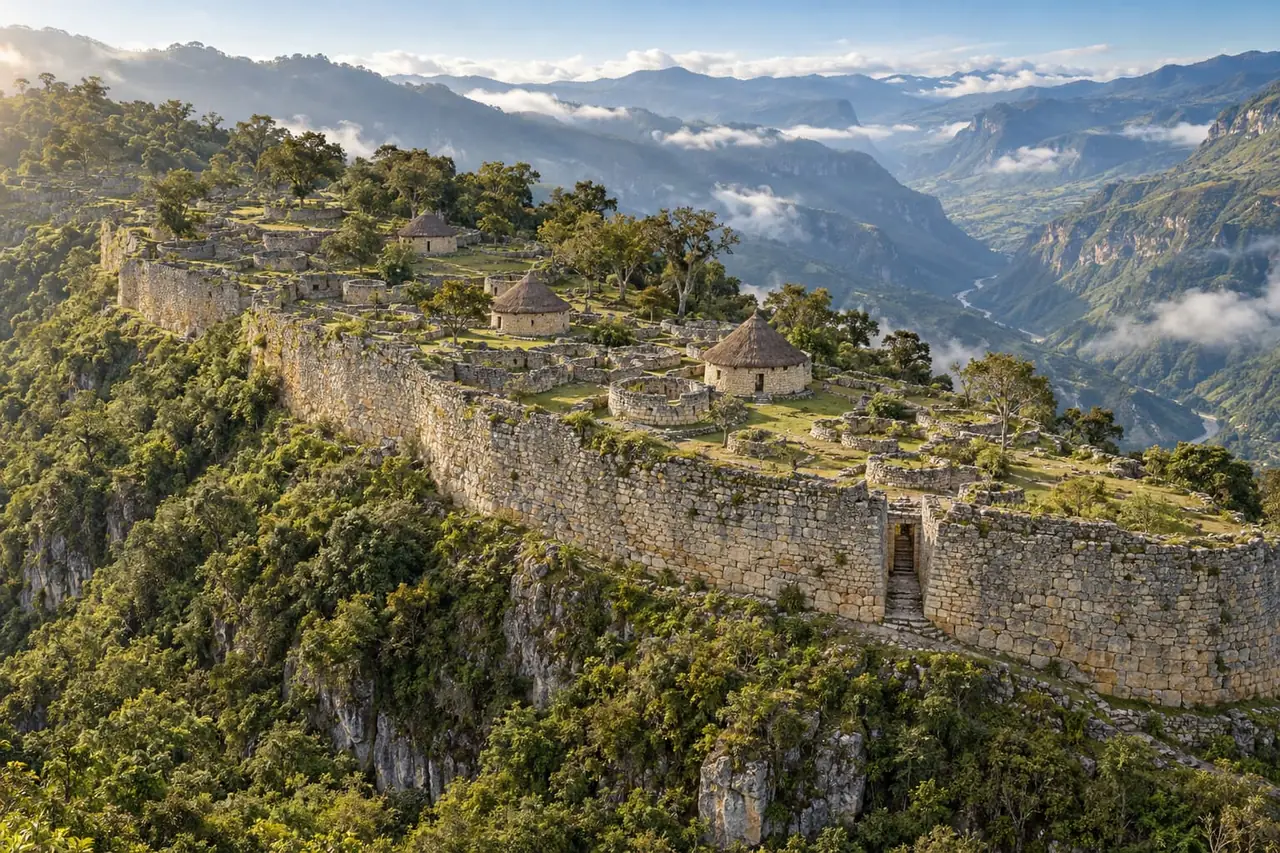
The Amazonas region, in northern Peru, is mountainous, humid and wooded: the clouds coming from the Amazon cling to the slopes between 2,000 and 3,500 metres. From about the 9th century until the Inca conquest, around 1470, the Chachapoyas formed a group of lordships there rather than a unified state. They left hundreds of sites: villages of round stone houses decorated with diamond and zigzag friezes, fortresses on the ridges, and a unique funerary architecture, made up of sarcophagi and mausoleums placed in almost inaccessible cliffs.
The town of Chachapoyas, at about 2,300 to 2,500 m, was founded in 1538 by Alonso de Alvarado; it has kept its Plaza de Armas and its cobbled streets. It is the most practical base for exploring. Distances: Nuevo Tingo (Kuélap cable car) 34 km; Cocachimba (Gocta) 39 km; San Pablo (Gocta) 40 km; Pedro Ruiz 50 km; Santo Tomás (Revash) 71 km; Leimebamba 93 km; Jaén 187 km; Cajamarca 300 km; Tarapoto 363 km.
Kuélap, Gocta and Leymebamba
Kuélap, the fortress on the ridge
Kuélap occupies a limestone ridge at about 3,000 m, above the Utcubamba Valley. It is a fortified city of about six hectares, nearly 600 metres long, surrounded by walls 10 to 20 metres high. It has more than four hundred structures, almost all circular, of which the bases remain; some bear diamond friezes protected by a cornice. You enter through passages that narrow until only one person can pass. Inside, the Pueblo Alto, the Tintero, a building shaped like an inverted cone whose ceremonial (or even astronomical) function remains a hypothesis, and a defensive tower. Most of the buildings date from 900 to 1100; the city is thought to have had some 3,000 inhabitants, before being abandoned in the 16th century.
What has changed. In April 2022, a section of the wall collapsed, after years of instability. The site has reopened gradually: capacity of 864 visitors a day; visits of up to three hours, including Pueblo Alto and Pueblo Bajo; southern wall reopened in June 2026 after the collapse of April 2022.
Getting there. Since 2017, a cable car, operated under a concession, has run from the Nuevo Tingo station, in the valley, to a station close to the site; a short walk then leads to the entrance. A road also lets you get close by car. Book your entry and check the cable car times the day before.
Gocta, the waterfall in the cloud forest
The Gocta waterfall falls in two drops over a total height of 771 metres. Always known to local people, it was measured and revealed to the public in 2006; its world ranking, long announced as third, is disputed depending on the database. It does not matter: it is the landscape, the forest and the walk that count.
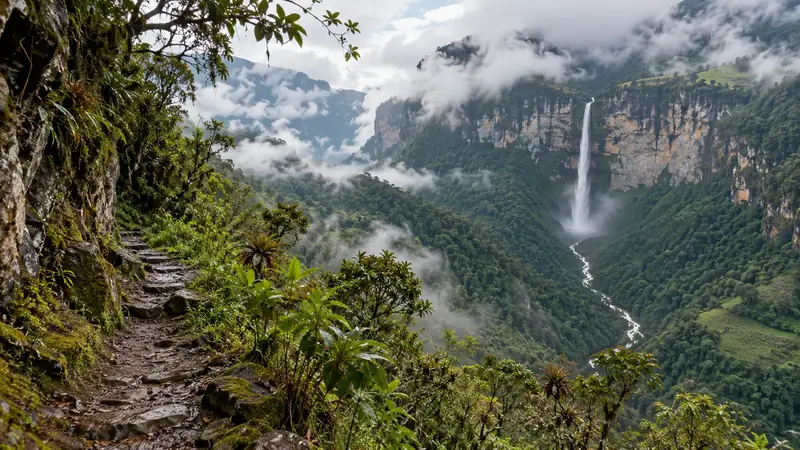
Two starting points. According to PROMPERÚ, the classic walk leaves from the village of Cocachimba, at 1,830 metres, about an hour’s drive from Chachapoyas, on foot or on horseback, to the foot of the falls. Another route links the village of San Pablo with Cocachimba: ask your guide which suits your group. Allow a good part of the day walking, with climbs and descents on often muddy paths. You may see the Andean cock-of-the-rock, Peru’s national bird, and other waterfalls (Golondrina, Lejía, Cajuache) dot the region.
The pace. PROMPERÚ recommends two days and one night: you sleep in Cocachimba and walk in the morning, before the clouds hide the top of the falls.
Leymebamba, the museum of mummies
In the south of the valley, the Leymebamba museum opened in 2000 to conserve the some two hundred funerary bundles rescued in 1997 from the Laguna de los Cóndores, a group of mausoleums in a cliff above a lagoon, looted a few years earlier. Built with traditional techniques and materials (rammed earth, wood, stone, tiles), it presents in three rooms Chachapoya and Inca ceramics, textiles, metals, quipus and objects, and a room devoted to the region’s living traditions.
every day from 10:00 to 16:30; S/ 15 for an adult. Leimebamba is 93 km from Chachapoyas: the visit justifies a night there, combined with Revash.
Karajía and Revash
Both sites are funerary, but very different:
| Karajía | Revash | |
|---|---|---|
| What it is | Sarcophagi modelled in the shape of human figures, standing in a niche in a cliff | Collective mausoleums shaped like small houses with pitched roofs, lined up under a rock overhang |
| Size | Up to 2.50 metres high | “Houses” on one or two levels, with painted decoration |
| Who was buried there | Important figures, one per sarcophagus | Groups, probably powerful lineages |
| Discovery | The intact group was documented in 1985 by the archaeologist Federico Kauffmann Doig | Studied in the 20th century, notably by Henry and Paule Reichlen |
| Where | North-west of Chachapoyas, district of Trita (Luya) | To the south, district of Santo Tomás, at around 2,800 m |
| How you see it | From a viewpoint at the foot of the cliff, after a short walk | From a distance, after an approach walk |
At Karajía, the sarcophagi look out over the valley from a ledge several dozen metres above the ground, which protected them from looting. At Revash, the pitched roofs are purely symbolic, since the rock shelter protected them from the rain; the walls bear painted figures of felines, camelids and people. Keep your distance: you do not approach the sarcophagi or the mausoleums, and you do not climb.
Revash combines naturally with Leimebamba, on the road south; Karajía is better done with Kuélap or as a half-day to the north-west.
Our suggested pace
This programme is a SwissLima composition, not a commercial tour available for booking. Opening days, access, bookings and transfers remain to be fitted to your dates.
| Day | Common thread | The choice that matters |
|---|---|---|
| 1 | Arrive, settle in, discover Chachapoyas | Do not commit to a big excursion based on a theoretical arrival time |
| 2 | Kuélap | Book your entry, confirm the cable car and the open circuits |
| 3 | Gocta, with a night in Cocachimba if possible | Choose the starting point (Cocachimba or San Pablo) according to the group and the weather |
| 4 | Karajía in the morning, a quiet afternoon | Keep an alternative if the previous day’s walk tired you |
| 5 | The road south: Revash, then Leimebamba and its museum, a night there | A night in Leimebamba rather than a late return |
In three days, keep Kuélap, Gocta and Leymebamba, and accept leaving the rest. In rainy weather, favour the Leymebamba museum and Kuélap (cable car and laid-out paths); postpone Gocta and Karajía, whose paths become slippery. The dry season, from May to October, is the most comfortable for walking.
Where to base yourself?
Chachapoyas for everything, with the most services. Cocachimba for Gocta, in accommodation facing the waterfall. Leimebamba for the museum and Revash, in peace and quiet. The right choice is worked out with the exact journeys in the programme, not just with the price difference between two rooms.
The real link with Tarapoto and Cajamarca
Chachapoyas combines with Tarapoto, at the end of a long road that goes down towards the forest (363 km), or with Cajamarca, by a very winding mountain road via Celendín (300 km). Each of these transfers takes a whole day: put it in the schedule as a stage in its own right, and avoid a non-refundable excursion the day after arriving by road. If you only have a week, ask yourself whether two regions will really give you more than one experienced well.
Frequently asked questions
Is Kuélap open?
Yes, with limited capacity and set circuits. Part of the wall collapsed in April 2022; after restoration, the south wall reopened in June 2026. Buy your ticket a few days in advance, checking which circuits are open.
Leymebamba or Leimebamba?
Both spellings exist side by side. The district and the village are most often written Leimebamba; the museum chose Museo Leymebamba. It is the same place.
Should you sleep in Cocachimba for Gocta?
It is not compulsory: Cocachimba is about an hour’s drive from Chachapoyas. A night there lets you set off early, walk without rushing and see the waterfall in the morning, often clearer.
Sources and dates
7 sources
Prices, opening hours and rules change: every piece of information cited links to its source, with the date it was consulted.
Figures and rules cited
- about 2,300 to 2,500 m: Altitude of Chachapoyas (town) (Chachapoyas) . The town and its surroundings spread over several tens of metres of height.
Press or reseller: Wikidata, Chachapoyas (Q757133), altitude (2,483 m) (new tab) · consulted on 2 October 2026 - Nuevo Tingo (Kuélap cable car) 34 km; Cocachimba (Gocta) 39 km; San Pablo (Gocta) 40 km; Pedro Ruiz 50 km; Santo Tomás (Revash) 71 km; Leimebamba 93 km; Jaén 187 km; Cajamarca 300 km; Tarapoto 363 km: Road distances from Chachapoyas (Amazonas) . Winding mountain roads: the Chachapoyas–Cajamarca road via Celendín and the road to Tarapoto each take a whole day.
Press or reseller: Road routes calculated on OpenStreetMap (FOSSGIS routing server) (new tab) · consulted on 2 October 2026 - about 3,000 m: Altitude of the Kuélap fortress (Kuélap, Tingo district)
Press or reseller: Wikipedia (English), Kuelap (new tab) · consulted on 2 October 2026 - capacity of 864 visitors a day; visits of up to three hours, including Pueblo Alto and Pueblo Bajo; southern wall reopened in June 2026 after the collapse of April 2022: Kuélap: visiting conditions in 2026 (Kuélap monumental archaeological complex) . Three visiting circuits since May 2026, according to the Ministry of Culture. Prices and opening hours of the site and the cable car: to be seen on the spot or with your accommodation in Chachapoyas.
Old source: Infobae, reopening of Kuélap’s southern wall (11 June 2026) (new tab) , published on 11 June 2026 · consulted on 2 October 2026 - every day from 10:00 to 16:30; S/ 15 for an adult: Leymebamba museum: opening hours and entry (Avenida Austria, San Miguel, Leimebamba) . Museum run by the Centro Mallqui, opened in June 2000. Students and seniors S/ 8, children S/ 3.
Official source: Ministry of Culture, register of museums: Museo Leymebamba (new tab) · consulted on 2 October 2026
Sources consulted
- Ministry of Culture, register of museums: Museo Leymebamba (new tab) (consulted on 2 October 2026)
- Infobae, reopening of Kuélap’s south wall (11 June 2026) (new tab) (consulted on 2 October 2026)
- Wikipedia (English), Kuelap, Gocta Cataracts, Revash, Chachapoya culture, Laguna de los Cóndores (new tab) (consulted on 2 October 2026)
- Wikipedia (Spanish), Sarcófagos de Karajía, Kuélap, Chachapoyas (new tab) (consulted on 2 October 2026)
- PROMPERÚ, Cocachimba and Gocta (new tab) (consulted on 2 October 2026)
- PROMPERÚ, Kuélap (new tab) (consulted on 25 September 2026)
- PROMPERÚ, Amazonas region (new tab) (consulted on 26 September 2026)
How we choose and date our information: our method. Has something changed? Let us know.