
In short
Allow half a day: the municipal park, the Bridge of Sighs and the Ermita church, the Bajada de Baños down to the sea, then a museum (Pedro de Osma for viceregal art, MAC for contemporary art). Barranco carries on into the evening, around the park and Avenida Grau. To stay there, choose a street a little away from these roads if you are worried about noise.
From a fishing village to an artists’ district
Barranco owes its name to the ravine (barranco) that runs down to the sea and that the Bajada de Baños follows today. First occupied by fishermen, the place became a resort in the 19th century for wealthy Lima families, who had European-style summer houses built there. The railway and then the tram linked it to the city. The district was created by a law of 26 October 1874.
Two disasters marked its history. On 14 January 1881, during the War of the Pacific, Chilean troops set fire to the town, destroying part of the Ermita church and the bridge; and the 1940 earthquake seriously damaged its monumental area. What remains today (the wooden and quincha houses, the large villas, the park) was largely rebuilt or restored after these events. In the 20th century, the neighbourhood attracted writers, musicians and painters and earned its bohemian reputation. It has been declared cultural heritage of the Nation, and its monumental area has been protected since 1972, according to the city council.
In 1896, a double-track hydraulic funicular, built by a merchant of German origin, Rudolf Holtig, carried bathers down to the beach. The Bajada de Baños, for its part, was the old path used by fishermen coming from Surco; once planted with olive and willow trees, it later became lined with ficus trees (Barranco city council).
What gives the neighbourhood its identity
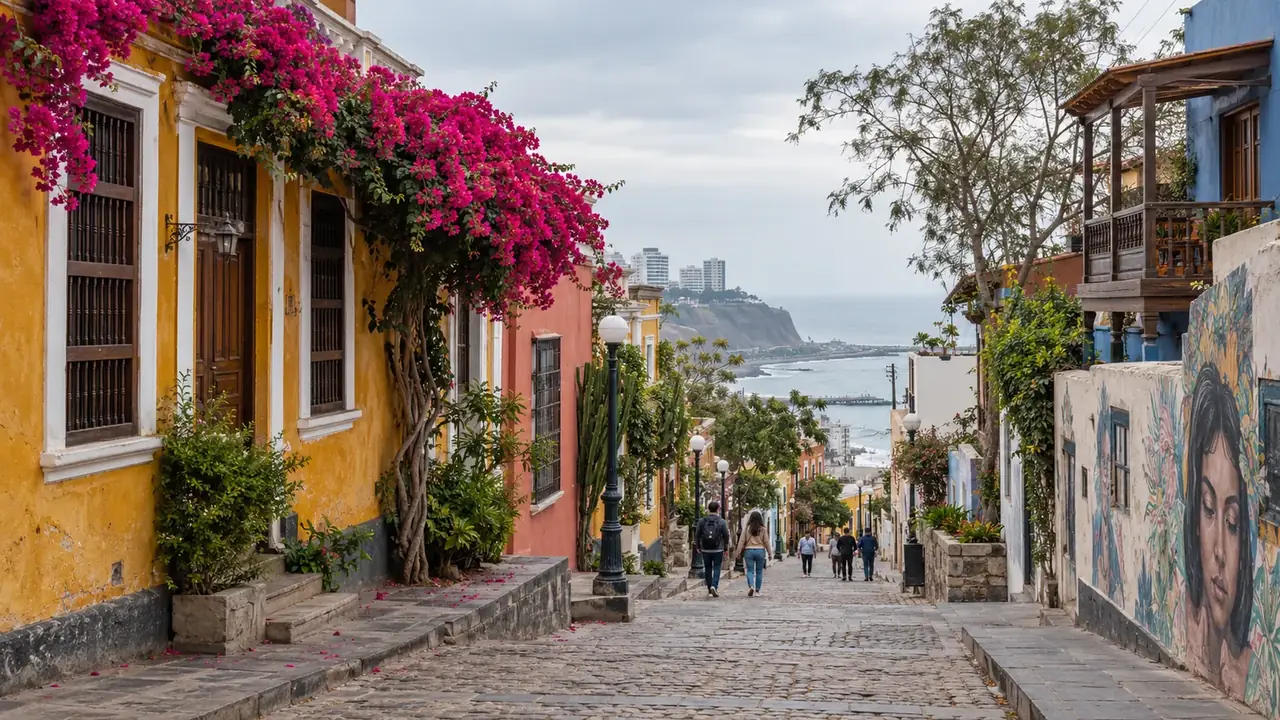
- Seaside-resort architecture: low houses with galleries, villas with ornate balconies, colourful façades. Look up: the details are often on the upper floors.
- The relationship with the sea: the neighbourhood sits on the cliff. From the viewpoint or at the bottom of the Bajada de Baños, you understand how Lima settled above the Pacific.
- Music: Barranco is associated with criollo music, and notably with Chabuca Granda, who gave her name to a street and a small square, opened in 2013; she was born in 1920 in Cotabambas, in the Apurímac region. In the evening, peñas offer music and dancing.
- Art: two museums that are poles apart, and galleries. There are many painted walls; their creators are not always identified, and the works change.
The neighbourhood’s legends
The Bridge of Sighs. The city council records several versions of its name: that of a rejected young man who supposedly heaved a last sigh there for the woman he loved, and other lovers’ stories. Today, people say you should cross it holding your breath for a wish to come true.
The Ermita. According to tradition, fishermen lost in the fog found their way home thanks to a bright light on the cliff; in the 18th century, a baker named Caicedo is said to have built a small adobe and quincha chapel there, to give thanks for his wife’s recovery. Rebuilt after the War of the Pacific and badly damaged by the 1940 earthquake, it was replaced for worship by the Santísima Cruz church, on the park.
Visiting by day, going out in the evening, staying
By day, Barranco is visited by following the route below, then a museum. In the evening, the activity is concentrated around the municipal park and Avenida Grau: bars, restaurants, peñas. It is one of Lima’s liveliest neighbourhoods at night. The FDFA recommends particular caution in Lima at night, staying on well-lit, busy streets and taking booked taxis: plan your way back in advance.
Staying there has its charm, especially in the residential streets south of the centre of the neighbourhood. The drawbacks are the noise at weekends near the bars and the distance from the historic centre: the Metropolitano (Bulevar, Balta and Plaza de Flores stations) helps for journeys to the north. For a very short first stay, Miraflores remains more practical; for a stay that favours walks and evenings out, Barranco suits well. See Where to stay in Lima.
La Feria de Barranco: designers, food and concerts
Two streets north of the municipal park, La Feria occupies a space on Jirón Unión, at number 108 (OpenStreetMap plan). It is not a restaurant, nor one of the district’s occasional municipal fairs: it is a place to wander where small Peruvian brands sell clothes, jewellery, objects and creations, with food counters and entertainment, from concerts to shows, depending on the programme. Its official account presents itself as “the perfect plan in Barranco”, with local brands, food and shows, and claims more than fifteen years of supporting Peruvian entrepreneurs.
When to go. On 7 October 2026, the account announced opening from Wednesday to Sunday; the day’s opening hours and programme are published on the same account. For a concert, check the day’s programme on that account.
Who it suits. For a late afternoon after the walk across the Bridge of Sighs, looking for a gift that is not a standard souvenir, snacking with family or friends. For textile crafts, bear in mind our advice on alpaca and the composition of fibres.
Eating in Barranco
The neighbourhood offers every format: cafés in old houses, criollo tabernas with slow-cooked dishes and portions to share, cevicherías for lunch, chef’s-cuisine restaurants. Our address in the neighbourhood: Isolina, a criollo taberna on Avenida San Martín, some of whose portions are designed for several people. If you feel like plenty of meat, the Rodizio chain has a branch on Avenida República de Panamá. All our addresses are gathered in where to eat in Lima.
Getting there
On foot from Miraflores, the seafront leads to the Bridge of Sighs: 3.6 km, about 50 minutes from Parque Kennedy. By Metropolitano, get off at Bulevar. In the evening, go back by taxi booked through an app.
Frequently asked questions
What is there to see in Barranco?
The municipal park, the Bridge of Sighs and the Ermita, the Bajada de Baños down to the sea, the Catalina Recavarren lookout, then a museum: the Pedro de Osma for viceregal art or the MAC for contemporary art. Half a day is enough.
How do you get from Miraflores to Barranco?
On foot along the seafront: 3.6 km, about 50 minutes from Parque Kennedy to the Bridge of Sighs. Or by Metropolitano, from Benavides to Bulevar.
Is Barranco safe in the evening?
It is one of Lima’s liveliest neighbourhoods at night. The FDFA recommends caution in Lima after dark: stay in well-lit, busy streets, around the park and Avenida Grau, and head home in a booked taxi.
Which days are Barranco’s museums open?
The Museo Pedro de Osma and the MAC close on Mondays; the first closes at 18:00, the second at 19:00.
Barranco or Miraflores to stay in?
Miraflores is more practical for a short first stay; Barranco suits a stay focused on walks and evenings out, on a street a little away from the bars if noise bothers you.
Sources and dates
9 sources
Prices, opening hours and rules change: every piece of information cited links to its source, with the date it was consulted.
Figures and rules cited
- 3.6 km, about 50 minutes: Walking distance and time, Kennedy park (Miraflores)–Bridge of Sighs (Barranco) (Miraflores–Barranco) . Automatic calculation between two points, with no breaks; the seafront route is a little longer.
Press or reseller: Walking route calculated on OpenStreetMap (FOSSGIS routing server, pedestrian profile) (new tab) · consulted on 2 October 2026
Sources consulted
- La Feria, official Instagram account (local brands, food, shows, Wednesday to Sunday) (new tab) (consulted on 7 October 2026)
- Tripadvisor, La Feria (Barranco), listing and visitor reviews (new tab) : read during the audit of 5 October 2026 (address Jirón Unión 108). (consulted on 5 October 2026)
- OpenStreetMap, La Feria Unión de Barranco, Jirón Unión 108 (new tab) (consulted on 7 October 2026)
- Municipality of Barranco, tourist attractions (new tab) (consulted on 2 October 2026)
- Barranco city council, tourist attractions and legends (gob.pe, 28 November 2023, in Spanish) (new tab) (consulted on 13 October 2026)
- Wikipedia (Spanish), Distrito de Barranco (creation, War of the Pacific, 1940 earthquake) (new tab) (consulted on 2 October 2026)
- Museo Pedro de Osma (new tab) (consulted on 2 October 2026)
- MAC Lima (new tab) (consulted on 2 October 2026)
- FDFA, Conseils pour les voyages – Pérou (travel advice, in French: caution in the evening, taxis) (new tab) (consulted on 1 October 2026)
How we choose and date our information: our method. Has something changed? Let us know.