In short
Choose between three trips: culture (Trujillo, Chiclayo, a week), culture and beach (adding Máncora or Los Órganos, two weeks) or surfing (Huanchaco, Chicama, Pacasmayo, Lobitos). The sea is cool as far as Pacasmayo, warmer from Máncora onwards. Fly from Lima to Trujillo, Chiclayo, Piura, Talara or Tumbes rather than spending long nights on buses.
Two cities have their own guide: Trujillo, with Chan Chan and the Moche huacas, and Chiclayo and Lambayeque, with Sipán and their museums. This page presents the coastline and the other stops, from south to north. Distances: Trujillo–Huanchaco 17 km; Trujillo–Chan Chan 12 km; Trujillo–Huaca de la Luna 11 km; Trujillo–El Brujo 46 km; Trujillo–Puerto Malabrigo (Chicama) 70 km; Trujillo–Pacasmayo 90 km; Trujillo–Chiclayo 198 km; Chiclayo–Lambayeque 12 km; Chiclayo–Ferreñafe (Sicán museum) 22 km; Chiclayo–Huaca Rajada 30 km; Chiclayo–Túcume 35 km; Chiclayo–Piura 215 km; Piura–Catacaos 12 km; Piura–Chulucanas 55 km; Piura–Máncora 189 km; Máncora–Los Órganos 20 km; Máncora–Punta Sal 24 km; Máncora–Tumbes 105 km.
The beaches compared
| Place | Water | Atmosphere | Who it suits | Gateway |
|---|---|---|---|---|
| Huanchaco | Cool | A fishing village turned resort, lively at weekends | Surfing (beginners to experienced), culture nearby | Trujillo |
| Chicama (Puerto Malabrigo) | Cool | A small port focused on the wave | Independent surfers, when the swell is there | Trujillo |
| Pacasmayo | Cool | A port town, steady wind | Surfing, kitesurfing, windsurfing | Trujillo or Chiclayo |
| Lobitos | Milder | A surf village, very quiet | Surfers, a long, simple stay | Talara |
| Máncora | Warm | A centre that is lively in the evening, accommodation spread along the coast | Everyone, with a carefully chosen place to stay | Talara, Piura or Tumbes |
| Los Órganos and El Ñuro | Warm | A fishing village, the turtle pier, departures to see the whales | Families, wildlife watching | Talara |
| Vichayito | Warm | Accommodation scattered along a long beach | Couples, rest, no need to go out in the evening | Talara |
| Punta Sal | Warm | A spread-out, quiet resort | A restful end to the trip, families | Tumbes or Talara |
The water gets noticeably warmer from Máncora onwards: according to published readings, 24 to 26 °C from December to May, 21 to 23 °C the rest of the year, whereas further south it rarely exceeds 22 °C, even in summer. A beach holiday, swimming and surfing are three different things: a beautiful beach can be dangerous for swimming when the swell is strong, and a good wave is nothing like a family beach. Ask on the spot every day where it is safe to swim.
Huanchaco
17 km from Trujillo, Huanchaco was the port of Chan Chan, then that of Trujillo until 1870. Its fishermen still use the caballitos de totora, reed boats that are ridden astride to get through the waves, depicted on ceramics for three thousand years and recognised as cultural heritage of the Nation in 2016. The reeds come from the nearby marshes, where you can see the totora being grown. You see the boats drying upright on the beach, in rows.
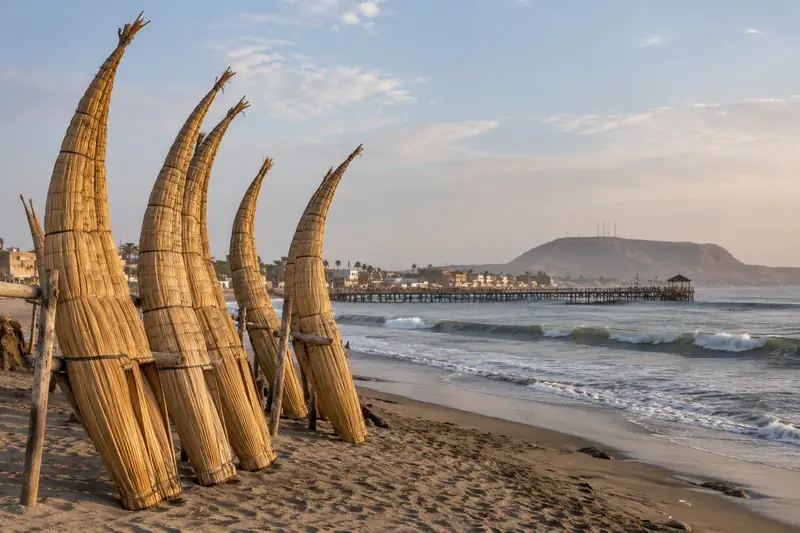
Huanchaco is a World Surfing Reserve, recognised in 2013 by the NGO Save The Waves, for the quality of its waves and for this link between ancient fishing and surfing. For a surfing lesson, ask for instruction suited to the day’s swell and your level. The seafront can be walked as far as the church, on the hill, from where you can see the bay.
Huanchaco makes a good base for visiting the sites of Trujillo, quieter than the city.
Chicama–Puerto Malabrigo
Chicama, some 70 km north of Trujillo, is known for one of the longest left-hand waves in the world, the first wave protected by law. According to published descriptions, the main section runs for about a kilometre, and linking it all the way to the pier, over more than two kilometres, takes a very big swell, which is rare. The wave needs swell to work: in small conditions, it is weak. The best period runs from Holy Week to September, the southern winter; the water is cool (17 to 22 °C).
It is not a destination for beginners. For a companion who does not surf, the port is very quiet: choose accommodation with a pleasant space and plan some outings (El Brujo is less than an hour away).
Pacasmayo
Pacasmayo, 90 km north of Trujillo, was an active port thanks to its great pier of 1871 and the railway that climbed towards the Andes, until it stopped running in 1967; the pier and the station are now historic monuments. Its point, El Faro, offers a very long left-hand wave, and the steady wind attracts kitesurfers and windsurfers. It is a logical stop between Trujillo and Chiclayo for those who practise these sports.
Piura and Catacaos
Piura is the oldest Spanish city in Peru: Francisco Pizarro founded San Miguel in 1532, before marching on Cajamarca; the city then changed location several times. It also claims Admiral Miguel Grau, hero of the War of the Pacific, whose birthplace Piura and the nearby port of Paita both claim. It is hot all year round; people come for a day of city and food, often in transit to the beaches.
Catacaos, 12 km away, is the region’s great craft village, whose monumental area has been protected since 1988. Three crafts dominate: gold and silver filigree jewellery, notably the earrings called dormilonas; toquilla straw hats, woven mainly by women; and the pottery of the neighbouring hamlet of Simbilá. Ask who makes what, with which material and how long it takes: a shop on Calle Comercio sells as many mass-produced objects as pieces by craftspeople. 2 km away, the huaca of Narihualá was the main centre of the Tallanes, the region’s population before the Incas.
Chulucanas, 55 km from Piura, produces ceramics protected by a designation of origin since 2006: oval shapes, black tones and “negative painting” decoration, obtained by smoking the pieces with mango leaves. Most of the workshops are in the village of La Encantada.
At the table: seco de chavelo (green plantain and dried meat), majado de yuca, desserts made with algarrobina; during Holy Week, the “seven dishes”, including malarrabia.
Máncora
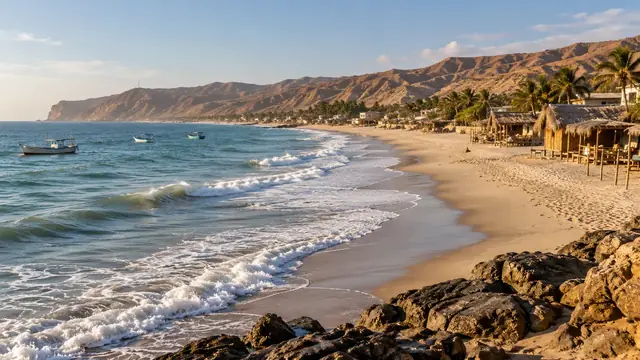
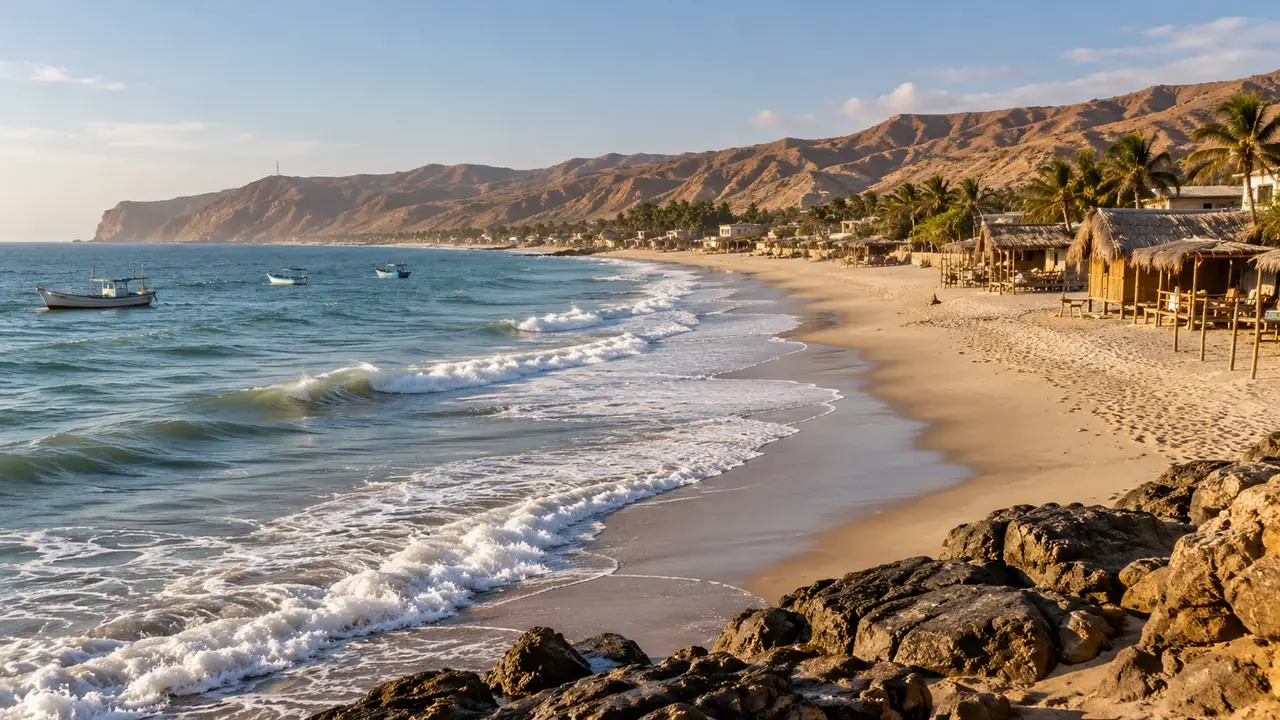
Máncora, on the Pan-American Highway, is the best-known resort in the north: warm water, sunshine almost all year round, waves for surfers and some thirty establishments. The atmosphere changes a great deal depending on where you stay: the centre, along the road, is lively and noisy in the evening; the accommodation to the south, towards Vichayito, is quieter but requires a mototaxi for every outing.
Before booking, ask about night-time noise, beach access, the distance to restaurants and how you will get around in the evening. The months from November to May are the hottest; from June to September, the nights are cooler and windier.
Los Órganos and Vichayito
Los Órganos is a fishing village south of Máncora. Next to it, the El Ñuro pier is known for its green turtles, which come close to the fishing boats. The area is part of the Mar Tropical de Grau National Reserve, created in 2024 to protect four sectors of tropical sea (Foca Island, Cabo Blanco-El Ñuro, the Punta Sal reefs, the Máncora bank). The rules there are simple: you do not touch the turtles, you do not feed them, and on a boat you stay seated in the middle, without making noise.
Humpback whales come to these warm waters to give birth and mate from July to the end of October. The trips leave from Los Órganos, Máncora or Punta Sal. Choose an operator that keeps its distance and cuts the engine near the animals; no sighting is guaranteed.
Vichayito, between Los Órganos and Máncora, lines its accommodation along a long beach, far from everything: ideal for rest, as long as you accept mototaxis for going out and check whether your accommodation serves meals.
Lobitos
Lobitos, in the oil province of Talara, is a small village that has become a surfing destination, with several waves of different levels depending on the swell and the tide. The village is very quiet, with few facilities: people come to surf several days in a row, not to go out. Have your accommodation or school specify the equipment available, the transfers from Talara and the spots that suit your level. Keep a plan for the days without waves: even a surf trip has days when the ocean decides otherwise.
Punta Sal
Punta Sal, in the Tumbes region, is a resort spread along a bay, quieter than Máncora, with scattered accommodation and few independent restaurants: check whether meals are served on site. It suits a restful end to the trip or a family holiday. Its reefs are part of the Mar Tropical de Grau reserve; whale-watching trips also leave from here in season. Swimming conditions should always be checked on the spot.
Tumbes
Tumbes opens up another world, that of the mangroves, almost absent from the rest of the Peruvian coast. The Los Manglares de Tumbes National Sanctuary, near the Ecuadorian border, protects 2,972 hectares of mangrove trees that can reach 25 metres, more than 150 species of birds and the endangered American crocodile. You discover it by boat along the Zarumilla estuary, with a guide.
| Practical details | Detail |
|---|---|
| Opening hours and entry | Monday to Friday, from 8:00 to 13:00 and from 15:00 to 18:00; S/ 30 for a foreign visitor, S/ 11 for a Peruvian adult |
| Access | About 30 minutes by road from Tumbes to the checkpoints |
| Season | From April to December; rain from January to March |
Closer to the city, Puerto Pizarro offers boat trips into the mangroves and the islets of the bay. At the table, cebiche de conchas negras, made with black clams from the mangroves, is the region’s speciality.
To Ecuador. Treat the border crossing as a separate stage, with formalities checked for your situation. The FDFA reports possible border closures and areas that are still mined near military installations: stay on asphalted, busy roads. See borders and documents.
Three possible trips
Culture, in a week. Lima–Trujillo by plane; three days in Trujillo and Huanchaco; the road to Chiclayo; two to three days of museums in Lambayeque; return by plane from Chiclayo.
Culture and the beach, in two weeks. The previous week, then road or flight to Piura (a day in Catacaos), and five to six days in Máncora, Los Órganos or Vichayito; return by plane from Talara, Piura or Tumbes. Between July and October, keep a morning for the whales.
Surfing. Huanchaco, then Chicama and Pacasmayo depending on the swell, then Lobitos; a stay where you move at the pace of the forecasts. See our itinerary northern surf and the surfing guide.
Either way, do not tour every beach: two bases are enough. The FDFA recommends great caution in the La Libertad region (Trujillo) and avoiding travelling after nightfall; prefer the plane to long nights on a bus.
El Niño years. The north coast, normally very dry, is the region of Peru most exposed to the rain of a coastal El Niño. During a marked episode, especially from February to April, choose bookings you can change and check SENAMHI’s warnings and the state of the roads before each journey. See El Niño in Peru.
Frequently asked questions
Where can you swim in warm water?
From Máncora northwards (Los Órganos, Vichayito, Punta Sal, Tumbes), where the water often exceeds 21 °C and reaches 24 to 26 °C from December to May. Further south, in Huanchaco or Pacasmayo, the Humboldt Current keeps it cool all year round.
When can you see the whales?
From July to the end of October, off El Ñuro, Cabo Blanco, Los Órganos and Punta Sal, with no guarantee of a sighting.
Can you swim with the turtles at El Ñuro?
You watch them from the pier or in the water at a distance. The reserve’s rules prohibit touching and feeding them; an operator who hands out food is not respecting these rules.
Sources and dates
10 sources
Prices, opening hours and rules change: every piece of information cited links to its source, with the date it was consulted.
Figures and rules cited
- Trujillo–Huanchaco 17 km; Trujillo–Chan Chan 12 km; Trujillo–Huaca de la Luna 11 km; Trujillo–El Brujo 46 km; Trujillo–Puerto Malabrigo (Chicama) 70 km; Trujillo–Pacasmayo 90 km; Trujillo–Chiclayo 198 km; Chiclayo–Lambayeque 12 km; Chiclayo–Ferreñafe (Sicán museum) 22 km; Chiclayo–Huaca Rajada 30 km; Chiclayo–Túcume 35 km; Chiclayo–Piura 215 km; Piura–Catacaos 12 km; Piura–Chulucanas 55 km; Piura–Máncora 189 km; Máncora–Los Órganos 20 km; Máncora–Punta Sal 24 km; Máncora–Tumbes 105 km: Road distances on the north coast (North coast, from Trujillo to Tumbes) . Centre-to-centre distances or to the site entrance.
Press or reseller: Road routes calculated on OpenStreetMap (FOSSGIS routing server) (new tab) · consulted on 2 October 2026 - from July to the end of October: Humpback whale-watching season on the Piura and Tumbes coast (El Ñuro, Cabo Blanco, Los Órganos (Piura), Punta Sal (Tumbes)) . No sighting is guaranteed.
Press or reseller: Infobae (agencies), whale watching in the Mar Tropical de Grau reserve (25 June 2026) (new tab) , published on 25 June 2026 · consulted on 2 October 2026 - Monday to Friday, from 8:00 to 13:00 and from 15:00 to 18:00; S/ 30 for a foreign visitor, S/ 11 for a Peruvian adult: Los Manglares de Tumbes National Sanctuary: opening hours and entry (Zarumilla province, about 25 km from Tumbes) . Best period from April to December; rainy season from January to March.
Site management: SERNANP, Santuario Nacional Los Manglares de Tumbes (new tab) · consulted on 2 October 2026
Sources consulted
- Wikipedia (English), Huanchaco, Puerto Chicama, Pacasmayo, Máncora, Piura, Caballito de totora (new tab) (consulted on 2 October 2026)
- Wikipedia (Spanish), Catacaos, Narihualá, Chulucanas ceramics, Mar Tropical de Grau reserve (new tab) (consulted on 2 October 2026)
- Save The Waves, Huanchaco World Surfing Reserve (new tab) (consulted on 2 October 2026)
- SERNANP, Santuario Nacional Los Manglares de Tumbes (new tab) (consulted on 2 October 2026)
- Infobae (agencies), whales in the Mar Tropical de Grau reserve (25 June 2026) (new tab) (consulted on 2 October 2026)
- PROMPERÚ (Y tú qué planes), humpback whales in the north (new tab) (consulted on 2 October 2026)
- PROMPERÚ, Máncora, Vichayito and Los Órganos (new tab) (consulted on 2 October 2026)
- PROMPERÚ (Y tú qué planes), destinations in Piura (new tab) (consulted on 26 September 2026)
- PROMPERÚ (Y tú qué planes), destinations in Tumbes (new tab) (consulted on 26 September 2026)
- FDFA, Conseils pour les voyages – Pérou (travel advice, in French: La Libertad, the Ecuadorian border) (new tab) (consulted on 1 October 2026)
How we choose and date our information: our method. Has something changed? Let us know.