In short
Three days are enough for Paracas (the Ballestas Islands in the morning, the reserve in the afternoon) and Ica–Huacachina; five days add Nazca and Palpa; seven allow Chincha, Pisco and a real margin. Book the Ballestas early in the morning and keep a possible second slot: the trip is cancelled when the port is closed. The Nazca Lines can be seen from a plane, but also from the ground (the viewing tower and the hills of Palpa).
The road and the distances
The southern Pan-American Highway links all the stops, from Lima to Nazca. Distances: Lima (Miraflores)–Chincha 189 km; Chincha–El Carmen 16 km; Chincha–Paracas 64 km; Paracas–Pisco 16 km; Pisco–Tambo Colorado 50 km; Paracas–Ica 70 km; Ica–Huacachina 6 km; Ica–Palpa 93 km; Palpa–Nazca 49 km; Nazca–Chauchilla cemetery 28 km. By bus, allow 3 hr 15 min to 4 hr 10 min from Lima to Paracas, 1 hr to 1 hr 30 min from Paracas to Ica, and 7 hr to 8 hr 30 min for most services to get back from Nazca to Lima. The FDFA advises against intercity journeys at night and recommends higher-category bus companies.
Paracas
Paracas brings together two visits that should not be confused.
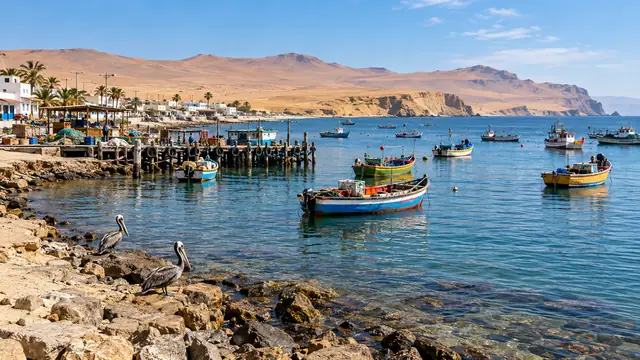
The Ballestas Islands, by boat. A few rocky islets offshore, protected within the national reserve of guano islands, islets and points. You do not land: the boat sails along the cliffs and arches while you watch Humboldt penguins, cormorants, boobies, pelicans, Inca terns, fur seals and sea lions. On the way, you pass the Candelabra, a geoglyph traced on the side of the peninsula, whose origin is still debated. Guano, the accumulated droppings of seabirds, was one of Peru’s great sources of wealth in the 19th century, exported as fertiliser.
| Ballestas | Detail |
|---|---|
| Entry fee | S/ 11 |
| Conditions | Only with an operator authorised by SERNANP, in the morning; life jacket compulsory |
| Length | About two hours by boat |
| If the sea is closed | Trips are cancelled when the port authorities close the sea to boats: keep the next morning in reserve |
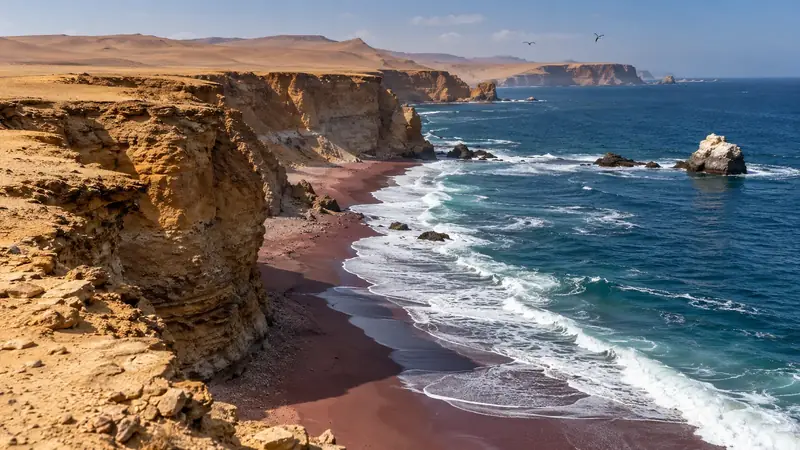
The Paracas National Reserve, by road. It protects 335,000 hectares, nearly two thirds of them at sea: a windswept coastal desert (the “paracas” wind that gives it its name), cliffs, beaches and a bay rich in birds. According to SERNANP, the visit starts from the interpretation centre, 2 km from the entrance, which explains the food chain of the Humboldt Current, then follows viewpoints and beaches: Playa Supay, La Catedral (a cliff arch that collapsed in the earthquake of August 2007), the isthmus, Playa Roja and its red sand, the Lagunillas cove and its fishermen’s restaurants.
| Paracas Reserve | Detail |
|---|---|
| Entry | S/ 11 |
| Rules | Stay on the marked tracks and paths, register at the checkpoint, do not disturb the wildlife, no disposable plastic |
| What to bring | Sun cream, a windproof jacket, water; the wind often picks up in the afternoon |
The Paracas culture, which gave its name to the peninsula, is known for its large embroidered funerary textiles and its deliberately deformed skulls: you see them mainly in the museums of Lima (Museo Larco, National Museum of Archaeology) and at the Ica regional museum.
Ica
Ica is a town in an irrigated valley in the middle of the desert, at about 400 m. People come for three distinct reasons.
The Ica regional museum presents the cultures of the south coast, from Paracas to the colonial period: textiles, Nazca ceramics, deformed skulls of the Paracas elite.
The bodegas. The valley has produced grapes since colonial times, and the neighbouring town of Pisco gave its name to the grape brandy exported through its port. A bodega visit is worth choosing for its content: an explanation of the grape varieties, fermentation and distillation, the difference between “puro”, “acholado” and “mosto verde” pisco, a guided tasting. Distinguish the artisanal bodega, with its jars and its still, from the industrial establishment; and arrange transport, without driving after a tasting.
The desert. PROMPERÚ’s portal mentions the San Fernando National Reserve and the great Cerro Blanco dune, each of which requires an organised outing in an off-road vehicle.
Huacachina
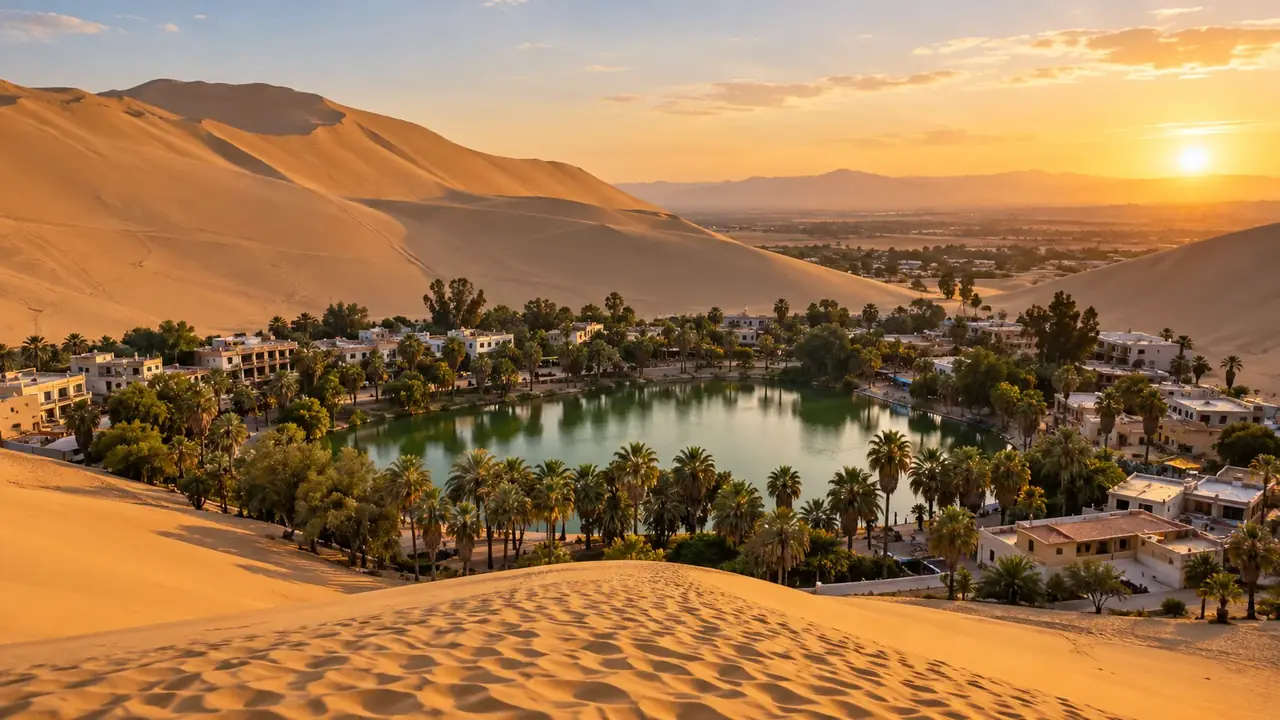
Huacachina is a small village built around a natural lagoon, a few kilometres from Ica, at the foot of very high dunes. The lagoon, originally fed by the water table, has seen its level fall with agricultural pumping; it has been topped up artificially since 2015. It is a fragile and very busy place.
With or without a buggy.
| Option | What it is | Who it suits |
|---|---|---|
| A walk on the dunes | Walking up the nearest ridge, in the late afternoon | Everyone, with good shoes and water |
| Sunset and the lagoon | Staying in the village, with no activity | Those staying the night |
| Buggy (“arenero”) and sandboarding | An outing in a vehicle in the dunes, with descents on a board | Those who like thrills and have no back problems, pregnancy or heart condition |
The FDFA points out that the safety of risky sports, including dune buggies, varies a great deal: look at the condition of the vehicles, the seat belts and the roll bars, and ask how long you will actually spend in the dunes. Sandboarding is most often done lying on the board; have what is offered specified.
Staying in Ica or Huacachina? Huacachina for the setting and the sunset, with the night-time activity of the hostels; Ica for the services, the town and the bodegas.
Nazca
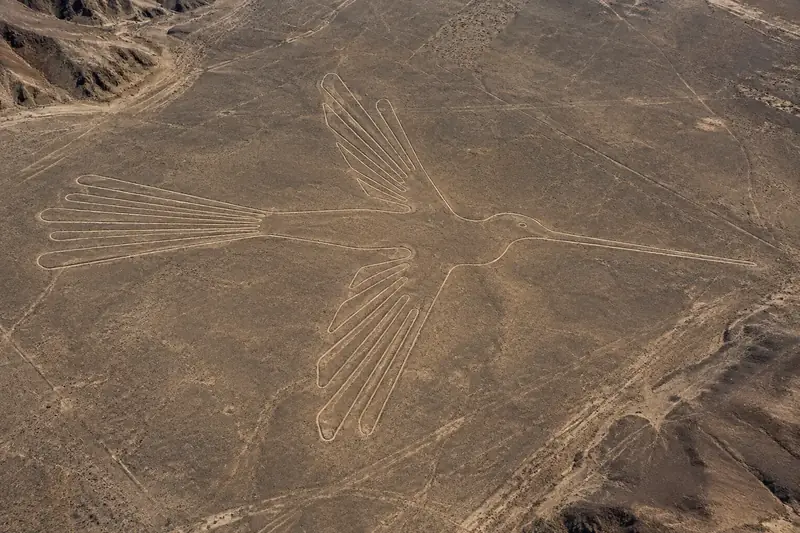
What the lines are. According to UNESCO, the geoglyphs of Nasca and the Pampa de Jumana were traced between 500 BC and AD 500. There are three kinds: figures of animals and plants (hummingbird, monkey, spider, condor, tree), straight lines that sometimes run for several kilometres, and large geometric figures (triangles, trapezoids, spirals). The technique is simple and now well understood: the reddish, oxidised stones on the surface were removed to reveal the lighter ground below, to a depth of about ten centimetres. The very dry, windless climate has preserved them.
Why? That is the real open question. María Reiche, a German mathematician who devoted her life to the lines, argued for an astronomical function; most researchers today attribute a ritual function to them, and among the hypotheses discussed are processions along the lines and rites linked to water, so scarce here. An experiment showed that a small team, with stakes and ropes, could reproduce a large figure in a few days: the “ancient astronaut” hypotheses have no basis whatsoever.
Three ways to see them.
| Overflight | Viewing tower and María Reiche house museum | The hills of Palpa | |
|---|---|---|---|
| What you see | The great figures and the lines, seen from the sky | Two or three figures from a tower beside the road; María Reiche’s life and instruments | Older figures, traced on the slopes |
| Effort and comfort | A small plane, tight turns: nausea is common | None | A short climb |
| Constraints | Weather (mist, wind), passengers’ weight, airport tax | Few figures visible | Access by vehicle |
Before an overflight: check the operator, what the price includes (airport tax extra or not), the postponement conditions in case of bad weather, and take it in the morning, on a light stomach. Do not squeeze it in between two essential connections.
Around Nazca, three sites shed light on the culture that traced the lines: the Chauchilla cemetery, 28 km to the south, where tombs from the Nasca period, long looted and protected since 1997, show bodies preserved by the desert; Cahuachi, a great ceremonial centre and place of pilgrimage with adobe mounds; and the Cantalloc aqueduct, a network of underground galleries and spiral wells that still taps water from the water table.
Palpa
About fifty kilometres north of Nazca, Palpa completes the visit. Its geoglyphs, often traced on the hillsides rather than on the pampa, include older figures, attributed to the Paracas culture; in 2018, drones revealed twenty-five previously unknown geoglyphs there. UNESCO listed the Nasca and Palpa lines together. A viewing tower lets you see some figures without a plane; with a local guide, Palpa can be visited in half a day, on the road between Ica and Nazca.
Chincha and Pisco
Chincha is one of the great centres of Afro-Peruvian culture, the heritage of the enslaved Africans brought to the haciendas of the valley. The district of El Carmen, 16 km from Chincha, is its heart: music, zapateo, and the Christmas dances of the Hatajo de Negritos, inscribed by UNESCO on the intangible heritage list in 2019, and of the Pallitas. The Verano Negro festival takes place in February. At the table: sopa seca (pasta in a basil and ají sauce, despite its name of “dry soup”), carapulcra (a stew of dried potatoes), served together under the name “mancha pecho”, and frejol colado, a sweet bean dessert. The valley also produces wines and piscos. Older still, the huaca of La Centinela, the ceremonial centre of the Chincha kingdom conquered by the Incas around 1460, and the Hacienda San José, a colonial plantation house whose history is linked to slavery, complete the visit.
The festivals and the music are experienced on the dates of the celebrations: do not expect a show on demand, and nothing should be organised in families’ homes without their agreement.
Pisco is a port town, badly hit by the earthquake of 15 August 2007, which gave its name to the region’s brandy. People pass through rather than stay: Paracas, 16 km away, is the more pleasant base. 50 km inland, Tambo Colorado is a remarkably well-preserved Inca adobe complex, with walls still painted red, yellow and white, built after the conquest of the Chincha kingdom.
Three, five or seven days
Three days. Day 1: Lima–Paracas, the reserve in the afternoon. Day 2: the Ballestas at dawn, then Ica (museum or bodega) and a night in Huacachina. Day 3: a free morning, return to Lima. If the Ballestas are cancelled on day 2, move them to day 3 and leave for Ica in the late morning.
Five days. The previous three days without the return, then day 4: Palpa and the viewing tower, a night in Nazca. Day 5: an overflight early in the morning or Chauchilla, then a bus to Arequipa or Lima. See the itinerary The south coast in five days.
Seven days. Start with Chincha and El Carmen (one night), then Paracas (two nights, with a spare morning for the Ballestas), Huacachina, Palpa and Nazca. The seventh day serves as a margin for the sea or the sky; if it has not been needed, devote it to Tambo Colorado or a bodega.
Frequently asked questions
Are the Ballestas and the Paracas Reserve the same thing?
No. The Ballestas Islands are visited by boat, in the morning, with an authorised operator, for the marine wildlife. The Paracas National Reserve is visited by road, for the desert, the cliffs and the beaches. Each has its own entry fee; a combined ticket exists.
Should you fly over the Nazca Lines?
It is not compulsory. The overflight shows the great figures, but it is bumpy and depends on the weather. From the ground, the viewing tower beside the Pan-American Highway, the María Reiche house museum and the hills of Palpa already give a good reading, at a lower cost.
Is Huacachina worth it without a buggy?
Yes, for a night or the end of a day: walking on a dune at sunset, relaxing by the lagoon. The buggy is an intense, bumpy activity, not recommended if you have back problems or are pregnant.
Sources and dates
8 sources
Prices, opening hours and rules change: every piece of information cited links to its source, with the date it was consulted.
Figures and rules cited
- Lima (Miraflores)–Chincha 189 km; Chincha–El Carmen 16 km; Chincha–Paracas 64 km; Paracas–Pisco 16 km; Pisco–Tambo Colorado 50 km; Paracas–Ica 70 km; Ica–Huacachina 6 km; Ica–Palpa 93 km; Palpa–Nazca 49 km; Nazca–Chauchilla cemetery 28 km: Road distances on the south coast (South coast, from Lima to Nazca) . Centre-to-centre distances. Between Palpa and Nazca, the Pan-American Highway crosses the pampa of the lines: the María Reiche house-museum is about 27 km north of Nazca.
Press or reseller: Road routes calculated on OpenStreetMap (FOSSGIS routing server) (new tab) · consulted on 2 October 2026 - 3 hr 15 min to 4 hr 10 min: Length of the bus journey from Lima to Paracas according to the companies’ timetables (Lima terminals (Javier Prado, Plaza Norte, Atocongo…) to Paracas) . Timetable duration, excluding getting to the terminal and the traffic leaving Lima.
Press or reseller: CheckMyBus, Lima–Paracas (timetable aggregator) (new tab) · consulted on 1 October 2026 - 1 hr to 1 hr 30 min: Length of the bus journey from Paracas to Ica (Paracas–Ica)
Press or reseller: CheckMyBus, Paracas–Ica (timetable aggregator) (new tab) · consulted on 1 October 2026 - 7 hr to 8 hr 30 min for most services: Length of the bus journey from Nazca to Lima (Nazca–Lima)
Press or reseller: CheckMyBus, Nazca–Lima (timetable aggregator) (new tab) · consulted on 1 October 2026 - S/ 11: Entry fee for the Ballestas Islands (SIIPG National Reserve), on top of the boat trip (Ballestas Islands, off Paracas) (Adult (published national rate; the general rate is not detailed on the page)) . Visits only with an operator authorised by SERNANP, from 6:00 to 13:00; life jacket compulsory.
Site management: SERNANP, Reserva Nacional SIIPG, islas Ballestas (new tab) · consulted on 1 October 2026 - S/ 11: Entry to the Paracas National Reserve, one day (Paracas National Reserve, Santo Domingo checkpoint) (General rate, adult) . Open every day from 9:00 to 16:00 according to SERNANP. A combined reserve + Ballestas Islands ticket is offered at S/ 17.
Site management: SERNANP, Reserva Nacional de Paracas (new tab) · consulted on 1 October 2026 - about 400 m: Altitude of Ica (town) (Ica)
Press or reseller: Wikidata, Ica (Q840712), altitude (new tab) · consulted on 1 October 2026
Sources consulted
- SERNANP, Reserva Nacional de Paracas (sites, opening hours, prices, rules) (new tab) (consulted on 2 October 2026)
- SERNANP, SIIPG National Reserve, Ballestas Islands (new tab) (consulted on 1 October 2026)
- UNESCO, Lines and Geoglyphs of Nasca and Palpa (new tab) (consulted on 2 October 2026)
- Wikipedia (English), Nazca Lines, Chauchilla Cemetery, Cahuachi, Huacachina, Ica, Tambo Colorado, Pisco (new tab) (consulted on 2 October 2026)
- Andina, elements of Chincha’s cultural identity (25 October 2023) (new tab) (consulted on 2 October 2026)
- PROMPERÚ, sopa seca from Chincha (new tab) (consulted on 2 October 2026)
- PROMPERÚ (Y tú qué planes), destinations in the Ica region (new tab) (consulted on 26 September 2026)
- FDFA, Conseils pour les voyages – Pérou (travel advice, in French: Ica, risky sports) (new tab) (consulted on 1 October 2026)
How we choose and date our information: our method. Has something changed? Let us know.