In short
Allow three days: one for the Huaca de la Luna and its museum (Moche), one for Chan Chan (Chimú) and Huanchaco, one for El Brujo and the Lady of Cao, further north. The Huaca de la Luna and the museums are closed on Mondays. The FDFA recommends great caution in the La Libertad region: get around by booked taxi or with a driver, and do not travel after nightfall.
Moche and Chimú, a few pointers
| Moche (Mochica) | Chimú | |
|---|---|---|
| Period | From about the 1st to the 8th century | From the 10th century to the Inca conquest, around 1470 |
| Organisation | Valley lordships, linked by a shared religion | A kingdom, Chimor, which stretched along the coast as far as Tumbes |
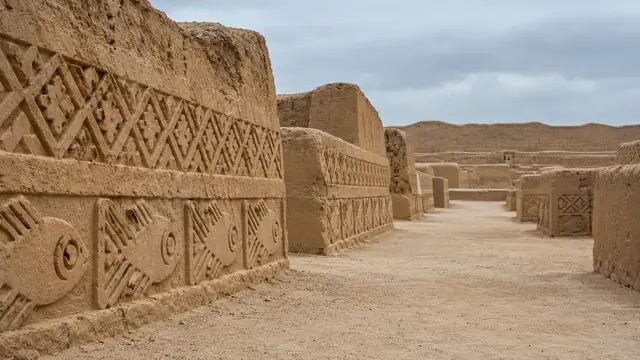
| Architecture | Great adobe pyramids enlarged in successive layers, decorated with religious paintings and reliefs | A capital of mud brick, divided into vast royal enclosures, decorated with marine reliefs |
| What you see of it | Huacas del Sol y de la Luna; Huaca Cao Viejo at El Brujo; the tombs of Sipán (Lambayeque) | Chan Chan; the Arco Iris and Esmeralda huacas |
| Distinctive features | Realistic ceramics (portraits, scenes), a feline-faced deity, sacrificial rituals | Goldwork, textiles, black ceramics, reliefs of fish and birds |
Between the two, the Lambayeque (Sicán) culture dominated the neighbouring valley: see Chiclayo and Lambayeque.
Chan Chan: giving the Chimú their place
A city of earth. Chan Chan, at the mouth of the Moche Valley, was the capital of the Chimú kingdom, from about 900 to 1470. It covered some twenty square kilometres, including a dense centre of six square kilometres occupied by about ten large enclosures known as “ciudadelas”: each brought together plazas, storehouses, reservoirs and a royal funerary platform, behind walls up to about twelve metres high, thicker at the base than at the top. Around them lived craftspeople, fishermen and servants, in quarters of small rooms. Listed by UNESCO in 1986, it has since been on the List of World Heritage in Danger: mud brick does not withstand the rains of the El Niño phenomenon.
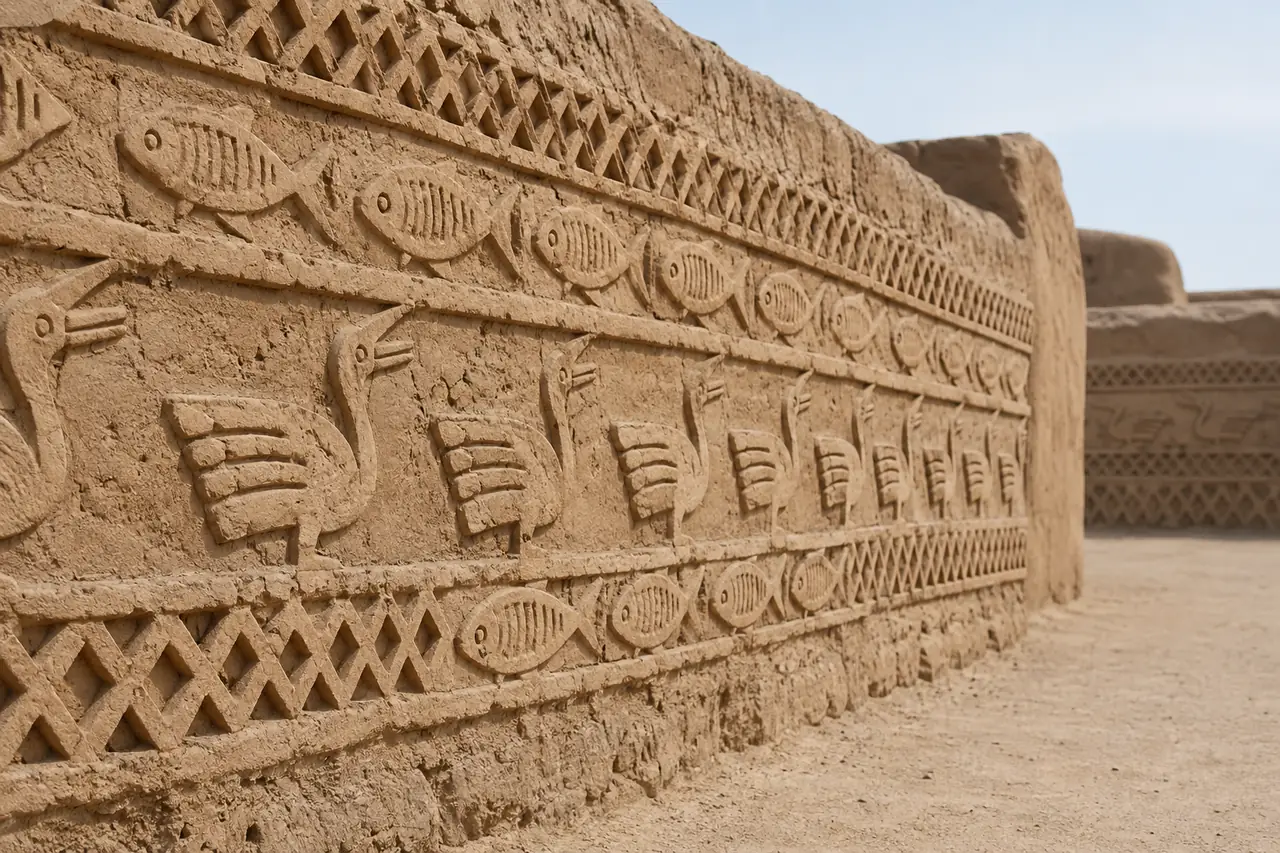
What you visit. Only the enclosure known as the Tschudi palace is open to the public, restored and partly protected by roofs. You follow the great ceremonial courtyards, the corridors and the hall of reliefs: fish facing north and south, seabirds, waves and net patterns, in which some have seen an evocation of the two currents that wash the coast. The walls that look very sharp have often been restored; the guide distinguishes the original relief from the reconstructions.
Practical details. The site museum, at the entrance to the archaeological zone, presents Chimú history: Tuesday to Sunday from 9:00 to 16:00; S/ 10 for an adult. Several huacas (Arco Iris, Esmeralda) can be visited on the outskirts of the city. The visit takes place in the sun, without shade: come in the morning, with a hat and water. Chan Chan is on the road to Huanchaco: the two combine well.
The Huacas del Sol y de la Luna
The Moche capital. At the foot of Cerro Blanco, south of Trujillo, the two pyramids framed a city. The Huaca del Sol was the largest adobe construction in the pre-Hispanic Americas: more than a hundred million bricks, many of which bear makers’ marks suggesting the involvement of about a hundred communities. In the 17th century, colonists diverted the river to loot it; about a third of it remains. It cannot be visited.
The Huaca de la Luna is smaller but much better preserved, because it was spared colonial looting. A religious temple, it was rebuilt on top of itself about every hundred years for six centuries: each new layer covered the previous one, which preserved the interior decoration. The visit goes down into these layers, where you see polychrome friezes of the feline-faced deity and, on the north façade, registers of warriors, prisoners and dancers. The remains of many sacrificial victims were also found there.
The Santiago Uceda Castillo museum, on the same site, presents ceramics, objects and the context of the excavations.
| Practical details | Detail |
|---|---|
| Opening hours and entry | Tuesday to Sunday from 9:00 to 16:00 (last group for the Huaca de la Luna at 15:30); adults S/ 10 for the huaca and S/ 5 for the museum, cash only |
| Access | By taxi from the centre, or by minibus from the Óvalo Grau according to the official website |
| Length | An hour for the huaca, an hour for the museum |
El Brujo and the Museo de Cao
The site. In the Chicama Valley, north of Trujillo, the El Brujo complex sums up thousands of years of occupation: the Huaca Prieta, one of the oldest mounds on the coast; the Huaca Cao Viejo, a great Moche pyramid with polychrome reliefs, with its scenes of prisoners and sacrifice; then traces of the Lambayeque and Chimú cultures, and a colonial church.
The Lady of Cao. In 2006, the team of the archaeologist Régulo Franco uncovered, in the Huaca Cao Viejo, the burial of a young woman who died around 450, at about twenty-five. Her body, covered in tattoos, was wrapped in many layers of fabric, with jewellery and ceremonial weapons. The richness of the tomb and these weapons suggest that she may have governed or held a very high religious office: it is a strong interpretation, but an interpretation. Her discovery called into question the idea of an exclusively male Moche power.
The Cao museum displays her remains in room 6, with a reconstruction of her face, and the objects from the tomb. The “classic route” offered by the site combines the colonial area, the Huaca Cao Viejo and the museum.
| Practical details | Detail |
|---|---|
| Opening hours and entry | every day from 9:00 to 16:00, except 25 December and 1 January; S/ 10 for an adult, Peruvian or foreign, huaca and museum included |
| Access | By the coast road from Trujillo or Huanchaco; by public transport, a bus to Chocope, a colectivo to Magdalena de Cao, then a mototaxi, according to the official website |
| Length | Half a day with the journey; a day if you combine it with Chicama |
The colonial city
Trujillo was founded in 1534 by Diego de Almagro, who named it after Pizarro’s hometown, in Extremadura. The centre has kept its large colonial and republican mansions with colourful façades, wrought-iron grilles and wooden balconies, around a Plaza de Armas dominated by the cathedral and the Freedom Monument. It was here that independence was proclaimed on 29 December 1820, more than six months before Lima; the Casa de la Emancipación, where it was prepared, can be visited.
Trujillo also claims the marinera, a couple dance with handkerchiefs, and the breeding of Peruvian Paso horses. The national marinera contest has been organised for decades by a club from the city, Club Libertad, but it is not necessarily held in Trujillo: the 2026 edition took place in Callao, at the end of January. For a future edition, wait for the organiser’s announcement. A half-day walk around the centre, by day, is enough to get a sense of it.
Huanchaco, the city by the sea
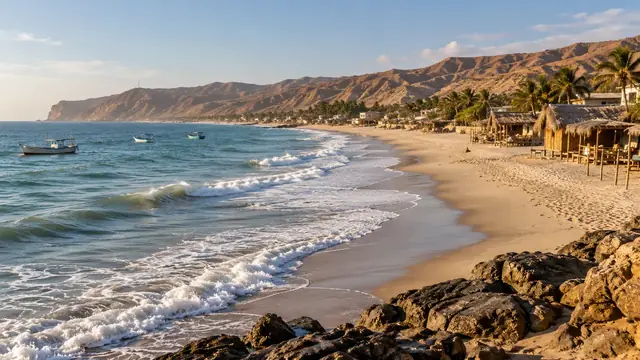
17 km away, Huanchaco was already the port of Chan Chan. The fishermen there still use caballitos de totora, reed boats that are ridden astride to get through the waves, depicted on ceramics for three thousand years; the beach is recognised as a World Surfing Reserve. Many travellers prefer to sleep there rather than in Trujillo: quieter, by the water, with fish restaurants. See Huanchaco.
Two, three or four days
Two days. Day 1: the Huaca de la Luna and its museum in the morning, central Trujillo in the afternoon. Day 2: Chan Chan in the morning, Huanchaco in the afternoon and evening.
Three days. Add El Brujo and the Lady of Cao, half a day with the journey, with lunch in Huanchaco on the way back.
Four days. Add Puerto Malabrigo (Chicama) or Pacasmayo, for the wave or simply for the coast, on the road to Chiclayo.
Watch out for Mondays: the Huaca de la Luna and the Chan Chan museum are closed; keep that day for El Brujo, open every day, or for the road.
Frequently asked questions
Moche or Chimú: what is the difference?
They are two successive civilisations of the same region. The Moche (1st to 8th centuries) built adobe pyramids decorated with religious paintings and reliefs, and very realistic ceramics. The Chimú (10th to 15th centuries) founded a coastal kingdom, Chimor, whose capital Chan Chan is a city of mud brick, decorated with reliefs of fish, birds and waves. The Incas conquered them around 1470.
Can you climb the Huaca del Sol?
No. The Huaca del Sol, badly eroded and looted since colonial times, is seen from outside. The visit takes place at the neighbouring Huaca de la Luna, where the polychrome murals and reliefs have been uncovered, and at the site museum.
Is Trujillo safe?
The FDFA recommends great caution in the La Libertad region, particularly in Trujillo and its outlying neighbourhoods, and avoiding travelling after nightfall. In practice: accommodation in the centre or in Huanchaco, booked taxis, visits by day with a driver or a guide.
Sources and dates
8 sources
Prices, opening hours and rules change: every piece of information cited links to its source, with the date it was consulted.
Figures and rules cited
- Tuesday to Sunday from 9:00 to 16:00; S/ 10 for an adult: Chan Chan site museum: opening hours and entry (Avenida Chan Chan, Huanchaco road) . The record does not say whether this ticket also covers the Tschudi palace and the nearby huacas: ask at the ticket office.
Official source: Ministry of Culture, register of museums: Chan Chan site museum (new tab) · consulted on 2 October 2026 - Tuesday to Sunday from 9:00 to 16:00 (last group for the Huaca de la Luna at 15:30); adults S/ 10 for the huaca and S/ 5 for the museum, cash only: Huacas de Moche (Huaca de la Luna and the Santiago Uceda Castillo museum): opening hours and entry (Campiña de Moche, Trujillo) . Tickets sold at the museum ticket office. Taxi from central Trujillo: about S/ 20 and 20 minutes according to the website.
Site management: Huacas de Moche, opening hours and prices (new tab) · consulted on 2 October 2026 - every day from 9:00 to 16:00, except 25 December and 1 January; S/ 10 for an adult, Peruvian or foreign, huaca and museum included: El Brujo archaeological complex (Huaca Cao Viejo and the Cao museum): opening hours and entry (Magdalena de Cao, Ascope province) . Free entry on the first Sunday of the month.
Site management: El Brujo archaeological complex, opening hours and prices (new tab) · consulted on 2 October 2026
Sources consulted
- IRTP, 2026 National and World Marinera Contest at the Polideportivo del Callao, organised by Club Libertad (3 February 2026) (new tab) (consulted on 7 October 2026)
- UNESCO, Chan Chan Archaeological Zone (new tab) (consulted on 2 October 2026)
- Huacas de Moche, opening hours and prices (new tab) (consulted on 2 October 2026)
- El Brujo archaeological complex, opening hours, classic route, access (new tab) (consulted on 2 October 2026)
- Ministry of Culture, register of museums: Chan Chan site museum (new tab) (consulted on 2 October 2026)
- Wikipedia (English), Chan Chan, Huaca del Sol, Huaca de la Luna, El Brujo, Lady of Cao, Trujillo (new tab) (consulted on 2 October 2026)
- FDFA, Conseils pour les voyages – Pérou (travel advice, in French: La Libertad) (new tab) (consulted on 1 October 2026)
- PROMPERÚ, La Libertad (new tab) (consulted on 25 September 2026)
How we choose and date our information: our method. Has something changed? Let us know.