
In short
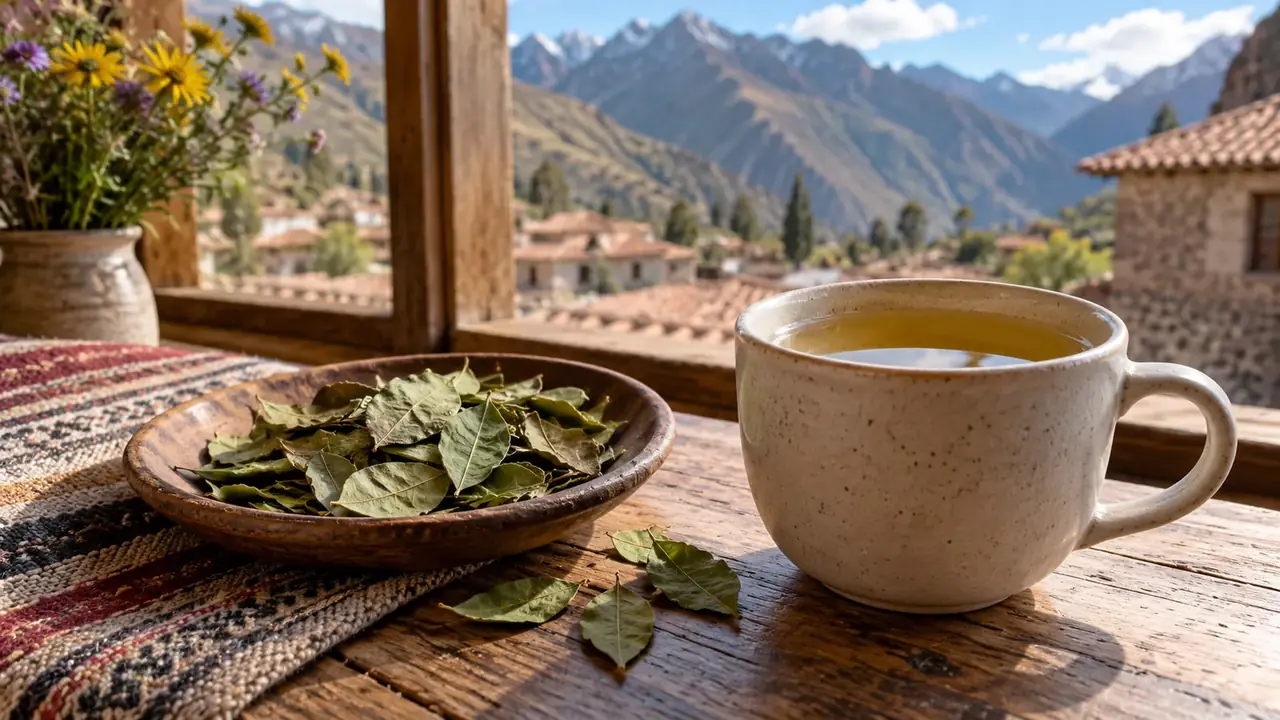
In Peru, the coca leaf is legal, sold under state control, chewed and offered in the Andes for thousands of years, and drunk as an infusion by everyone. Locally, it will be recommended to you almost everywhere against soroche, altitude sickness: many Peruvians and travellers say it helps. Take it as a traditional aid, not as a medicine. Two precautions: it can make a cocaine screening test positive, and importing coca-based products is prohibited in Switzerland: leaves, infusion bags and sweets stay in Peru.
The leaf is not cocaine
Coca is a shrub grown on the humid eastern slopes of the Andes and in the Amazon. Its leaves contain alkaloids, including cocaine, in small proportions: depending on the varieties studied, from 0.25 to 0.77% on average. Cocaine is obtained by chemical extraction from large quantities of leaves. Chewing a leaf or drinking an infusion bears no comparison with the drug.
In Peru, the leaf is legal. Its legal trade falls to a state company created in 1949, ENACO, which holds the marketing monopoly and relies on a register of authorised growers. Cocaine, on the other hand, is severely punished: the FDFA points out that even small quantities of drugs lead to heavy prison sentences.
In international law, the leaf appears, alongside cocaine, in Schedule I of the 1961 Single Convention on Narcotic Drugs. Peru and Bolivia have long defended its traditional use; in 1988, they secured a commitment that another UN convention would take licit traditional uses into account. Where things stand: kept in Schedule I of the 1961 Single Convention: the WHO recommended this in December 2025, and the Commission on Narcotic Drugs confirmed it without a vote in March 2026.
A social and ritual practice that differs from place to place
Chewing coca. It is called chacchado, acullico or, in Cusco Quechua, hallpay. You keep a small ball of leaves between the cheek and the jaw and chew it slowly, with a pinch of an alkaline substance: lime, or llipta, ash of quinoa or other plants pressed into small bars. Traces of this practice, leaves and lime, date back more than 8,000 years in the Nanchoc Valley, in northern Peru; Moche ceramics depict it. Under the Incas, coca was reserved for the nobility and for a few roles; in colonial times, it accompanied work in the mines. Today, long-distance drivers, building workers, miners and students at exam time chew it, to cope better with tiredness, cold or altitude.
Offering before taking. Before putting the leaves in your mouth, it is customary to choose a few fine leaves, the k’intu, and to blow a short prayer over them, the pukuy, addressed to the mountains (the apus) or to the earth (the Pachamama). The number of leaves varies: three among the Aymara of Chucuito, near Puno, and among the Q’ero of Paucartambo, four or five in a ceremony described in Huancavelica. Coca is also part of more elaborate offerings, and of pilgrimages such as Qoyllur Rit’i.
Reading the leaves. In Quechua and Aymara communities, leaves are thrown onto a small cloth to ask a question: a lost animal, a journey, an illness. A specialist, the qhawaq in Cusco or the qatipaq in Ayacucho, interprets the position, the colour and the side of the leaves. In Áncash, the katipa combines chewed coca with tobacco; among the Yanesha of the central Amazon, divination involves a night-long vigil.
Accepting or declining. If you are offered some, you can try it or decline politely, with a simple “gracias”: nobody expects a visitor to perform these gestures.
These are living practices, with their own rules and specialists. A demonstration for tourists gives only an image of them; an explanation by someone who practises them tells you more. See respectful travel.
Leaf, infusion, processed products
| Form | What it is | Where you find it |
|---|---|---|
| Dried leaves | Whole leaves, to chew or to infuse | Andean markets, bags from ENACO and other brands |
| Mate de coca in a tea bag | An infusion of about one gram of leaves; a cup contains about 4 mg of alkaloids | Supermarkets, hotels, restaurants, everywhere in Peru |
| Whole-leaf infusion | Fresh or dried leaves in a teapot | Reception of many hotels in Cusco and in the Andes |
| Sweets, flour, liqueurs, cosmetics | Processed products, with variable content | Souvenir shops |
| Cocaine | A drug extracted chemically, illegal in Peru as elsewhere | No place in a trip: heavy prison sentences |
This table describes what you come across locally. If you are pregnant, are taking medication or have a heart problem, ask a doctor’s advice before drinking a preparation whose composition you do not know.
Against the altitude: what you will be told locally
- In Cusco, you will be offered it everywhere: leaves or bags of mate at the reception of many hotels, a cup at the restaurant, leaves at the market. Guides, drivers and residents recommend it against soroche, altitude sickness.
- What people say about it: a cup of mate or a few chewed leaves are said to help you breathe more easily, feel the headache and the tiredness less, and digest after a meal. Many travellers say they felt better; others do not notice much.
- With caution: it is a traditional aid, not a medicine. It replaces neither two quiet first days nor going back down if you feel unwell and it gets worse. See altitude.
- Drug tests: coca can make a test for cocaine metabolites positive, sometimes after a single cup.
Not to be confused. Ceremonies with hallucinogenic drinks, such as ayahuasca, have nothing to do with coca. The FDFA advises against taking part in them, because of serious health risks.
Borders: nothing goes home in your suitcase
The FDFA is clear: prohibited, as in many other countries. This applies to leaves, bags of mate, sweets and flour, even if bought legally in Peru. Outside South America, most countries make no distinction between the leaf and cocaine; within South America itself, Brazil and Paraguay prohibit it. Also check the rules of the countries where you have a stopover.
Drink an infusion locally if you wish, and leave without it. See borders and documents.
Frequently asked questions
Does mate de coca help against altitude sickness?
Locally, almost everyone will tell you it does: many hotels in Cusco serve it on arrival, and many travellers say they feel better after a cup or a few chewed leaves. Take it with caution, as a traditional aid: what counts is still climbing gradually, and going back down and seeing a doctor if you feel unwell and it gets worse.
Can a cup of mate de coca make a drug test positive?
Yes, it is possible: the leaf contains small quantities of alkaloids, including cocaine, and a test can detect them. If you are subject to testing, in sport or at work, abstain.
Can you take bags of mate de coca back to Switzerland?
No. The FDFA points out that importing coca-based products is prohibited in Switzerland, and in many other countries. This applies to leaves, tea bags, sweets and flour.
Sources and dates
5 sources
Prices, opening hours and rules change: every piece of information cited links to its source, with the date it was consulted.
Figures and rules cited
- kept in Schedule I of the 1961 Single Convention: the WHO recommended this in December 2025, and the Commission on Narcotic Drugs confirmed it without a vote in March 2026: International status of the coca leaf (United Nations) . The WHO considers that traditional chewing and infusion do not pose a major public health risk, with little long-term data; national exemptions for traditional use do not change.
Site management: WHO, the expert committee concludes its review of the coca leaf (10 December 2025) (new tab) , published on 23 April 2026 · consulted on 2 October 2026 - prohibited, as in many other countries: Importing coca-based products into Switzerland (leaves, infusions, sweets, flour) (Switzerland) . According to the FDFA, this import is “interdite en Suisse” (prohibited in Switzerland), as in many other countries.
Official source: FDFA, Conseils pour les voyages – Pérou (travel advice, in French; published on 2 March 2026, valid on 2 October 2026) (new tab) , published on 2 March 2026 · consulted on 2 October 2026
Sources consulted
- CDC Yellow Book, complementary and integrative health approaches (coca and altitude, drug tests) (new tab) (consulted on 2 October 2026)
- WHO, expert committee concludes critical review of coca leaf (10 December 2025) (new tab) (consulted on 2 October 2026)
- FDFA, Conseils pour les voyages – Pérou (travel advice, in French; valid on 2 October 2026) (new tab) : the FDFA states that importing coca-based products is “prohibited in Switzerland” (our translation). (consulted on 2 October 2026)
- Wikipedia (Spanish), Chacchado, Kintu, Lectura de hojas de coca, Hoja de coca, ENACO (new tab) (consulted on 2 October 2026)
- Wikipedia (English), Coca, Coca tea (new tab) (consulted on 2 October 2026)
How we choose and date our information: our method. Has something changed? Let us know.