
In short
Many drivers, guides and small businesses work through recommendations and WhatsApp. Ask for a written summary (price, time, what is included), confirm the day before, follow up politely. Displayed prices are not negotiable, those at craft markets sometimes are; tipping is optional. Lunch, the main meal of the day, is eaten between 13:00 and 15:00, and you always greet people before asking for anything.
WhatsApp, recommendation, website: three ways of working
Drivers, guides and small businesses work mainly through recommendations, by phone or on WhatsApp. Some have a website; others prefer to reply directly. Not having a website proves neither quality nor a lack of seriousness. What matters is knowing who you are dealing with and what has been agreed.
That does not make booking websites useless: some tickets are easy to buy, and sometimes cheaper, on the official website. The Museo Larco, for example, shows a lower price online than at the ticket office. The right channel depends on the case.
Two examples of a request and a confirmation
A driver for the airport. Your first message, short and complete:
Hello, I’m looking for a transfer from Lima airport to Miraflores on 12 March, flight at 23:40, two people and two suitcases. What is the total price, and how do we find you at the exit?
The reply gives a price. Before saying yes, have it confirmed in writing: the total price (per vehicle or per person), the currency, payment (cash, card, on arrival or in advance), the driver’s name and the number plate, the meeting point, and what happens if the flight is late. The day before, a message: “Confirming tomorrow 23:40, flight arriving on time.”
A day excursion. Ask for the written programme: departure time and place, return time, places visited, time spent there, entry fees included or not, meals, the guide’s language, group size, cancellation conditions. A “yes, everything is included” is not enough: have “everything” listed. See the confirmation template.
Appointments, punctuality, following up
A meeting time is agreed, and confirmed. What varies is not how reliable people are, but the habit of reconfirming: a confirmation the day before, then a message the same morning, are normal and well received. Lima’s traffic jams also make some delays unavoidable; a driver who warns you about running late is doing their job well.
If you get no reply, follow up politely, once, then call. A delay that has been announced is not the same as someone you cannot reach: in the second case, look for an alternative without waiting.
Fixed prices, bargaining, tipping
| Situation | Custom |
|---|---|
| Shops, supermarkets, restaurants, hotels, site entry fees | Displayed price, not negotiable |
| Taxi without a meter | Price agreed before getting in |
| Craft markets, street vendors | A courteous discussion is possible, especially for several items |
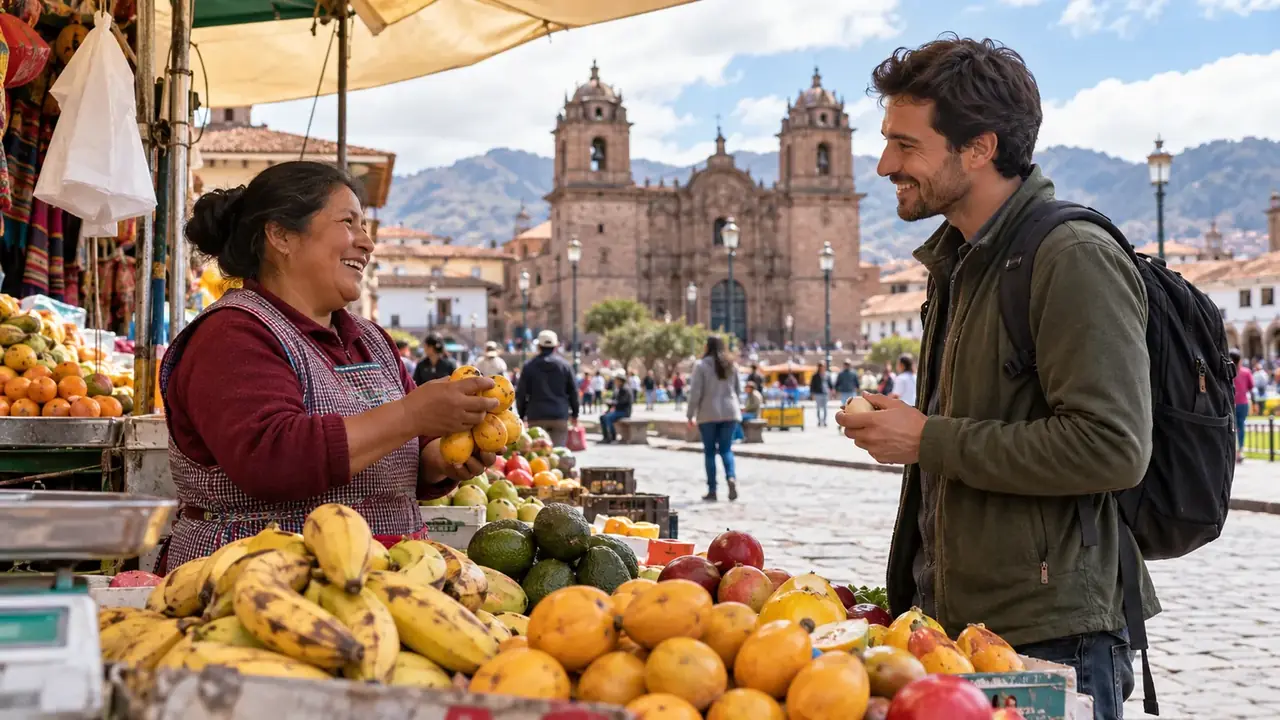
| Food markets | Price per kilo or per item; there is little haggling, but you can ask for a “yapa”, a little extra, when you are a regular customer |
| Restaurant | Check whether a “servicio” appears on the bill; if not, tipping is optional |
| Guide, driver, trek porter | A tip is appreciated for good work, at your discretion |
A respectful negotiation obliges no one to accept a price that does not suit them, neither you nor the person in front of you. And a few soles of difference often matter more to the artisan than to the traveller.
Mealtimes and formats
- Lunch is the main meal, roughly between 13:00 and 15:00. The lunchtime menú (starter, main course and drink at a fixed price) is the simplest and cheapest way to eat well.
- Cevicherías serve mainly at lunchtime: raw fish is eaten fresh, at lunchtime.
- Dinner starts late, rarely before 20:00, and is often lighter at home; restaurants in tourist neighbourhoods serve earlier.
- Breakfast in hotels is generally simple; at the market, juices and soups are served from the morning.
See reading the menu and where to eat in Lima.
Greetings and languages
Greet before asking. “Buenos días”, “buenas tardes”, “buenas noches” open any conversation, at a ticket counter as in a taxi; “por favor” and “gracias” do the rest. In Lima, people often greet each other with a kiss on the cheek between women, and between men and women who know each other; a handshake is enough in a professional setting.
Languages. Spanish is the everyday language. Quechua, spoken by about 14% of the population, and Aymara, around Lake Titicaca, are official languages in the regions where they predominate, under article 48 of the Constitution. In the Andes, an older person may speak Quechua better than Spanish: a smile and a word of Quechua (“allillanchu”, “sulpayki” for thank you) are always well received.
Regional differences. The pace, the vocabulary and the way people welcome you change between Lima, the Andes, the north coast and the Amazon. Keep your curiosity rather than a preconceived idea.
When a formal document is needed
WhatsApp is enough for a transfer or a day excursion. For a bigger commitment, ask for a proper document:
- a large deposit or a tour of several days: a signed quote or contract, with the name of the company;
- renting accommodation for several weeks: a contract with a deposit and an inventory;
- any payment: a boleta or a factura, proof of payment. Indecopi points out the right to clear information on prices and to proof of payment, and the obligation for businesses to keep a complaints register (libro de reclamaciones).
See what to book before you go.
You don’t need to become an expert on Peru before you leave. A few good pointers, some time and the right people can already change your trip.
Frequently asked questions
Should you leave a tip?
It is not compulsory. First check whether a “servicio” is already counted on the bill. For a guide or a driver who has done a good job, a tip is appreciated; the amount is up to you.
Can you bargain?
Not in shops, restaurants or hotels, or for displayed prices. At craft markets and with some street vendors, a courteous discussion is possible, especially for several items. It stops when the price no longer suits one of the two sides, without insisting.
Do Peruvians speak English?
In hotels, agencies and restaurants in tourist areas, often; elsewhere, little. A few phrases of Spanish make a big difference to your exchanges. In the Andes, many people speak Quechua or Aymara, official languages in the regions where they predominate.
Sources and dates
3 sources
Prices, opening hours and rules change: every piece of information cited links to its source, with the date it was consulted.
Sources consulted
- Wikipedia (English), Languages of Peru (official languages, article 48 of the Constitution) (new tab) (consulted on 2 October 2026)
- Indecopi, rights of users of tourist services (information on prices, proof of payment, complaints) (new tab) (consulted on 2 October 2026)
- Museo Larco, prices at the ticket office and online (new tab) (consulted on 2 October 2026)
How we choose and date our information: our method. Has something changed? Let us know.