
In short
Half a day: the Museo Larco in the morning, then about twenty minutes on foot (1.5 km) to Plaza Bolívar, the Magdalena church and the National Museum of Archaeology, Anthropology and History (free). Have lunch or a drink at the Antigua Taberna Queirolo, on the square. Come by taxi from Miraflores; no fast network links the two neighbourhoods.
A village that became a “free people”
Before the conquest, the territory of Pueblo Libre was part of the lordship of Maranga, whose huacas still survive in the surrounding area. After the founding of Lima, the Franciscans established a “reducción” there, that is, a village where Indigenous populations were grouped together: Santa María Magdalena. The church, begun in 1557, dates from that period.
The present name comes from independence. On 8 July 1821, José de San Martín, who had just liberated Lima, renamed the village “Pueblo Libre” (free people) to honour the patriotism of its inhabitants; a decree of 10 April 1822 made the change official. San Martín and then Simón Bolívar stayed in the Magdalena palace, which now houses the National Museum of Archaeology, Anthropology and History. The museum itself was created by San Martín on 2 April 1822.
What sets the neighbourhood apart
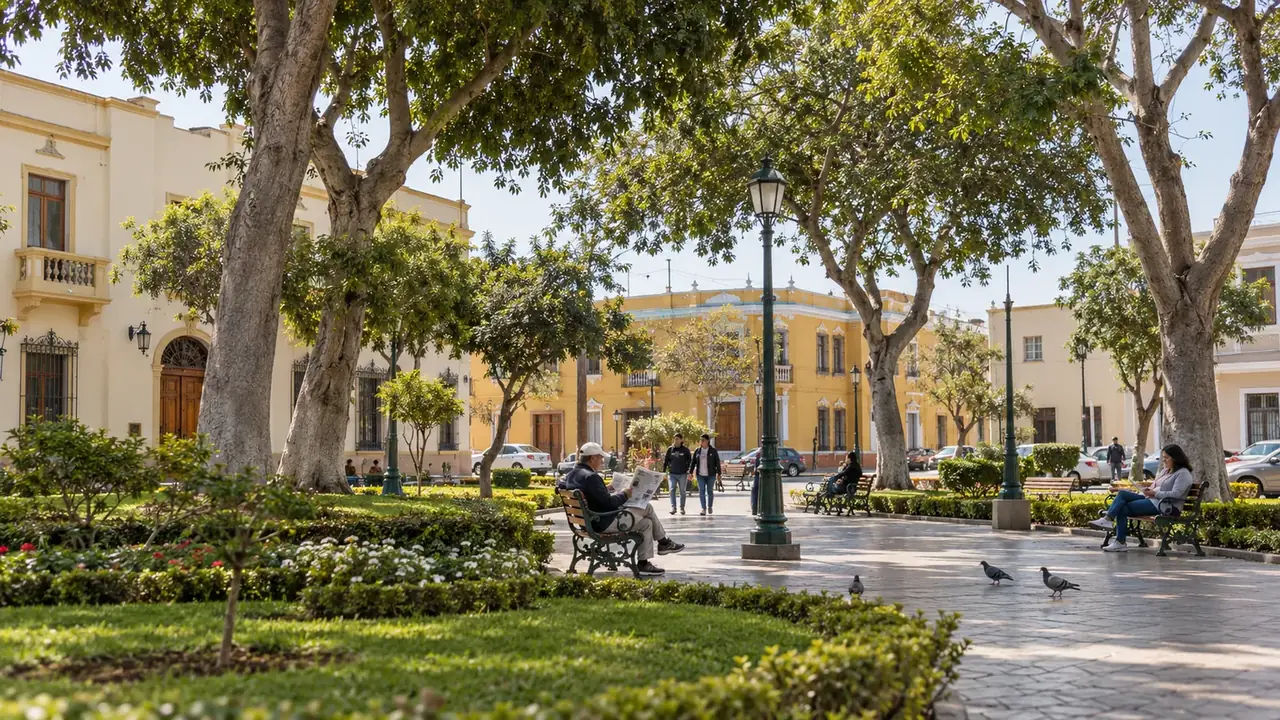
Pueblo Libre has neither a seafront nor great monuments: it is a residential neighbourhood, with its parks, its low houses and a square that still looks like a village square. For a traveller, it brings together two complementary museums: the Larco for the pre-Columbian cultures, the national museum for the history of the country up to independence. As you wander the streets, the Cruz del Viajero, a cross set up by the Franciscans in 1672, recalls the old road to Lima.
The Larco and the rest of the neighbourhood: two different visits
Many travellers make the round trip to the Museo Larco by taxi without seeing the neighbourhood. That is a pity: Plaza Bolívar and the national museum are 1.5 km from the Larco, about twenty minutes on foot, and the afternoon in the neighbourhood is quieter than in the centre. If you are short of time, at least keep the square and the church.
A full day
Add a second visit in the afternoon to the route below: the rest of the national museum or, a short taxi ride away, the MALI in the Parque de la Exposición. For dinner, head back to your neighbourhood before the evening traffic jams.
Getting there
From Miraflores, the journey is about 10 km by road; no fast line links the two neighbourhoods. A taxi booked through an app, in the morning, is the simplest solution. From the historic centre, the journey is shorter. The AeroDirecto South route leaves from Pueblo Libre (Brasil galleries) for the airport: an option if you are leaving from there, with little luggage.
Sources and dates
5 sources
Prices, opening hours and rules change: every piece of information cited links to its source, with the date it was consulted.
Figures and rules cited
- about 10 km: Distance by road, Kennedy park–Museo Larco (Pueblo Libre) (Miraflores–Pueblo Libre) . Distance only: the actual time depends on the traffic.
Press or reseller: Route calculated on OpenStreetMap (FOSSGIS routing server, car profile) (new tab) · consulted on 2 October 2026
Sources consulted
- Wikipedia (Spanish), Distrito de Pueblo Libre (history, monuments) (new tab) (consulted on 2 October 2026)
- Ministry of Culture, register of museums: MNAAHP (new tab) (consulted on 2 October 2026)
- Museo Larco, opening hours and admission (new tab) (consulted on 2 October 2026)
- Walking route calculated on OpenStreetMap (Museo Larco–Plaza Bolívar) (new tab) (consulted on 2 October 2026)
- Municipality of Pueblo Libre, Ruta del Libertador (new tab) (consulted on 1 October 2026)
How we choose and date our information: our method. Has something changed? Let us know.