
In short
Go on a weekday morning, by Metro Line 1 (Gamarra station) or by taxi, with a specific goal: clothes at retail prices, fabric, or an order. Stay on the main shopping streets (Jirón Gamarra, Avenida Aviación), go into two or three galleries, ask for the composition and the retail price, and keep the receipt. Leave jewellery and valuables at your accommodation: the crowds are dense.
A neighbourhood, an industry
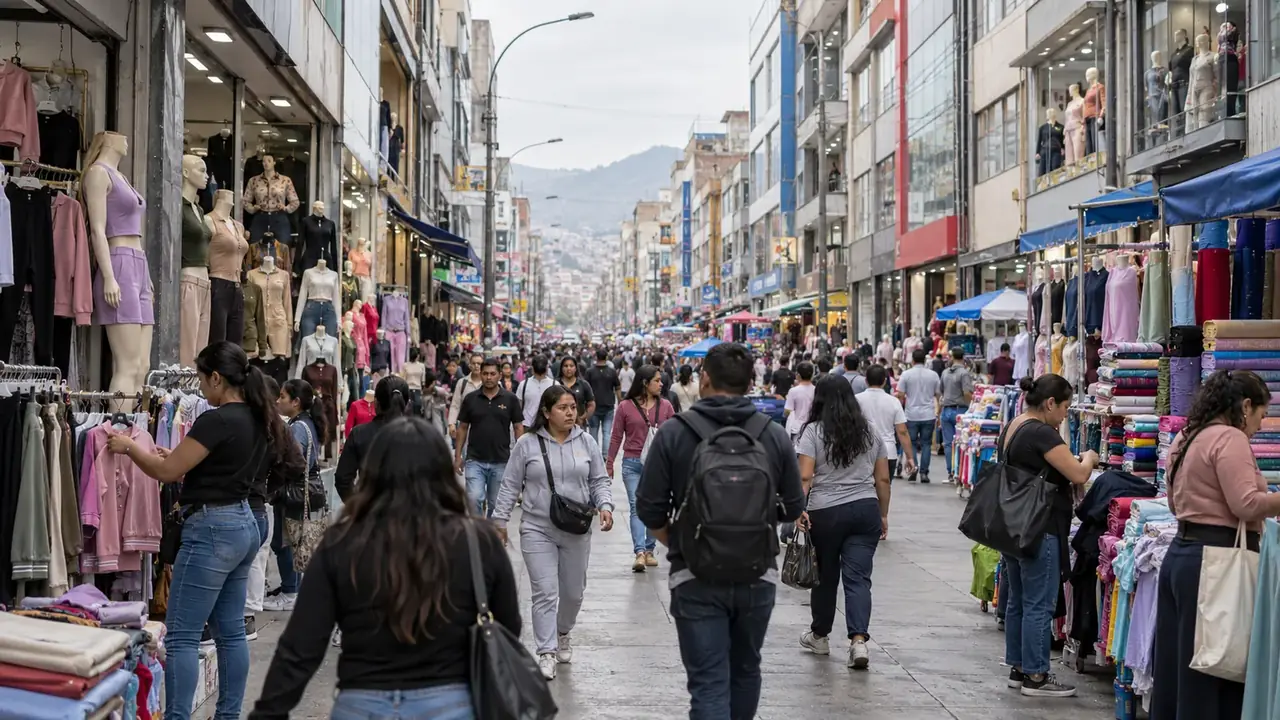
Gamarra covers several dozen blocks in the district of La Victoria, east of the historic centre, around Jirón Gamarra and Avenida Aviación. According to common estimates, it has about forty thousand businesses and some eighty thousand workers: manufacturers, dressmakers, embroiderers, printers, sellers of fabric and supplies, retailers and wholesalers. It is often described as the largest fashion trading hub in Latin America.
Its history is linked to the district’s textile industry: a large mill, the Santa Catalina fabric factory, set up there at the end of the 19th century. The Gamarra shopping district came later. At the end of the 1950s, a trader rented premises on the seventh cuadra (block) of Jirón Gamarra; others followed, and the area took off in the 1960s. It then grew with the small family businesses that made garment-making one of the engines of Lima’s economy.
How Gamarra is organised
- The galleries (galerías): multi-storey buildings, each filled with dozens or hundreds of small shops. The lower floors often sell retail, the upper floors to resellers.
- Wholesale and retail: many shops display a “por mayor” price (from a dozen or a batch) and a “por menor” price (per item). Always ask for the price per item.
- The suppliers: streets of fabric by the metre, thread, buttons, zips, labels.
- The services: embroidery, textile printing, alterations, made-to-order garments.
Before you go: choose a goal
| Goal | Where to look | What you need to know |
|---|---|---|
| Buying clothes | Galleries on the main streets, lower floors | Retail prices, trying on not always possible, ask about exchanges before buying |
| Buying fabric | Shops selling fabric by the metre | Width of the roll, composition, price per metre or per kilo |
| Having something made | Garment or embroidery workshops | Lead time, deposit, fitting, receipt; difficult in a stay of a few days |
| Understanding the neighbourhood | The main streets, two or three galleries | A morning is enough; do not try to see everything |
Cotton, alpaca, blends: reading what you buy
Peru grows renowned cottons (such as pima, a long-staple cotton) and produces alpaca wool. But a garment sold “in alpaca” at a low price may be a blend with synthetic fibres, and “pima cotton” is not always pure. Without expertise, three habits help:
- read the composition label (composición): percentages of cotton, alpaca, polyester, acrylic;
- compare the feel and the price of two similar items in two shops;
- ask: “¿Es cien por ciento algodón?”, “¿Cuánto por ciento de alpaca tiene?”.
The habits for buying an alpaca garment, and what not to believe (the feel, the flame test), are brought together in alpaca or not: the composition before the price. For a major alpaca purchase, a specialist shop in a tourist neighbourhood or a recognised brand offers more guarantees than a gallery in Gamarra, where people come rather for cotton and everyday garments.
Receipt, exchange and complaints
Ask for a boleta (till receipt): it is your proof of purchase. Indecopi, the consumer protection authority, points out that customers are entitled to clear information on the price and to proof of payment, and that shops must keep a libro de reclamaciones, a register in which you can record a complaint. For an exchange, ask before paying: “¿Puedo cambiarlo si no me queda?” (can I exchange it if it doesn’t fit?). A gallery does not always exchange items, and the rule must be agreed at the time of purchase.
Visiting with peace of mind
The FDFA reports frequent pickpocketing in the big cities: in Gamarra, the crowds are dense, especially at weekends and before the end-of-year holidays. Come on a weekday morning, with a closed bag carried in front of you, small notes and a single card. Agree on a meeting point that is easy to find if there are several of you. Do not photograph the inside of a workshop without being invited.
Getting there
Metro Line 1 stops at Gamarra station, on Avenida Aviación, in the heart of the neighbourhood; from the historic centre, Miguel Grau station is two stops away. From Miraflores, the taxi journey crosses several districts: leave early. Combine Gamarra with a morning in the centre rather than with Miraflores.
Sources and dates
4 sources
Prices, opening hours and rules change: every piece of information cited links to its source, with the date it was consulted.
Sources consulted
- Wikipedia (Spanish), Emporio Comercial de Gamarra (new tab) (consulted on 2 October 2026)
- PROMPERÚ, an office in Gamarra for textile SMEs (new tab) (consulted on 25 September 2026)
- Indecopi, rights of service users (3 August 2022) (new tab) (consulted on 2 October 2026)
- FDFA, Conseils pour les voyages – Pérou (travel advice, in French: theft, valuables) (new tab) (consulted on 1 October 2026)
How we choose and date our information: our method. Has something changed? Let us know.