
In short
Always greet people before asking (“buenos días”, “buenas tardes”). For a price, ask for the unit and the total. Prices are often written “S/ 12.50” and said “doce cincuenta”. For an allergy, say “soy alérgico (alérgica) a…” and show a written card. Remember a few Peruvian words: chifa (Peruvian Chinese restaurant), yapa (the little extra), casero (the regular customer or seller), al toque (right away).
Greet before you ask
| Spanish | Meaning | When |
|---|---|---|
| Buenos días | Good morning | In the morning |
| Buenas tardes | Good afternoon | From midday until nightfall |
| Buenas noches | Good evening, good night | In the evening, when arriving as well as when leaving |
| Disculpe | Excuse me | To attract someone’s attention politely |
| Por favor / Gracias | Please / Thank you | Always |
| Con permiso | Excuse me, may I get past | To make your way through, to leave a table |
| No entiendo. ¿Puede hablar más despacio? | I don’t understand. Can you speak more slowly? | As soon as the answer comes too fast |
Numbers, prices and times
Prices. The currency is the sol, abbreviated S/. On price tags, the decimals often come after a point: “S/ 12.50” is said “doce soles con cincuenta”, or simply “doce cincuenta”. “Un sol”, “dos soles”, “cincuenta céntimos”.
| Number | Spanish | Number | Spanish |
|---|---|---|---|
| 1 | uno, un sol | 20 | veinte |
| 2 | dos | 30 | treinta |
| 3 | tres | 40 | cuarenta |
| 5 | cinco | 50 | cincuenta |
| 10 | diez | 100 | cien |
| 12 | doce | 150 | ciento cincuenta |
| 15 | quince | 200 | doscientos |
| 16 | dieciséis | 500 | quinientos |
Watch out for pairs that sound alike: seis (6) and siete (7), trece (13) and treinta (30), quince (15) and cincuenta (50). If in doubt, ask for the amount to be written down: “¿Me lo puede escribir?”
Change. Sencillo: small change; vuelto: the change you are given back. “¿Tiene sencillo?” (do you have change?), “No tengo sencillo” (I don’t have any change), “Quédese con el vuelto” (keep the change).
Times. In speech, people often use the 12-hour clock: “a las ocho de la mañana” (8:00), “a las tres de la tarde” (15:00), “a las nueve de la noche” (21:00), “al mediodía” (midday). “Y media”: half past; “y cuarto”: quarter past; “menos cuarto”: quarter to. Bus and plane tickets generally show the time on the 24-hour clock.
| Question | Possible answer |
|---|---|
| ¿A qué hora sale? (What time does it leave?) | A las ocho y media de la noche. (At 20:30.) |
| ¿Cuánto demora? (How long does it take?) | Más o menos tres horas. (About three hours.) |
| ¿A qué hora llega? (What time does it arrive?) | Depende del tráfico. (It depends on the traffic.) |
Four short dialogues
Booking by message.
You: Buenos días. Quisiera reservar un traslado del aeropuerto a Miraflores el 12 de marzo, vuelo de las 23:40, para dos personas con dos maletas. ¿Cuál es el precio total?
Provider: Buenos días. Son 80 soles por el carro.
You: ¿El precio incluye todo? ¿Cómo se llama el conductor y dónde nos encontramos?
Provider: Sí, todo incluido. Le envío el nombre y la placa el día anterior.
(Good morning. I would like to book a transfer… What is the total price? / It’s 80 soles for the car. / Does the price include everything? What is the driver’s name and where do we meet? / Yes, everything included. I’ll send you the name and the number plate the day before.) The amount is a dialogue example, not a reference price. See local customs.
Taking a taxi without a meter.
You: Buenas noches. ¿Cuánto me cobra hasta el Parque Kennedy?
Driver: Quince soles.
You: Bueno, vamos. ¿Acepta tarjeta o solo efectivo?
Driver: Solo efectivo.
(How much will you charge me to Parque Kennedy? / Fifteen soles. / All right, let’s go. Do you take cards or only cash? / Only cash.) The price is agreed before you get in; the amount in the dialogue is an example.
Ordering the menú.
You: Buenas tardes. ¿Tiene menú?
Waiter: Sí. De entrada hay sopa o papa a la huancaína; de segundo, lomo saltado o pescado frito. Viene con refresco.
You: Para mí la sopa y el pescado, por favor. ¿El pescado lleva algo de mariscos?
Waiter: No, solo pescado.
(Do you have a menú? / Yes. To start, soup or papa a la huancaína; for the main course, lomo saltado or fried fish. It comes with a drink. / The soup and the fish for me, please. Does the fish contain any seafood? / No, only fish.) See reading the menu.
Buying a bus ticket.
You: Buenos días. Un pasaje a Paracas para mañana, por favor. ¿A qué hora hay?
Ticket office: A las siete y a las diez. ¿Piso uno o piso dos?
You: A las siete, piso uno. ¿De qué terminal sale?
(A ticket to Paracas for tomorrow. What times are there? / At 7:00 and at 10:00. Lower deck or upper deck? / At 7:00, lower deck. Which terminal does it leave from?) The big buses have two decks: the seats and the prices may differ from one to the other, so ask before choosing. See transport.
Allergies and health
| Situation | Spanish | Meaning |
|---|---|---|
| Stating an allergy | Soy alérgico (alérgica) al maní. | I am allergic to peanuts. |
| Other allergens | … a las nueces, a los mariscos, al huevo, a la leche | … to nuts, to seafood, to egg, to milk |
| Insisting | Es una alergia grave, no una preferencia. | It is a serious allergy, not a preference. |
| Checking a dish | ¿Este plato lleva maní, nueces o leche? | Does this dish contain peanuts, nuts or milk? |
| Traces | ¿Se prepara con el mismo aceite o en la misma olla? | Is it prepared with the same oil or in the same pan? |
| Gluten | Soy celíaco (celíaca). No puedo comer trigo, ni pan, ni harina. | I am coeliac. I cannot eat wheat, bread or flour. |
| No meat | No como carne. ¿Lleva caldo de carne o de pollo? | I don’t eat meat. Is there meat or chicken stock in it? |
| The pharmacy | ¿Dónde hay una farmacia? | Where is there a pharmacy? |
| Altitude sickness | Me siento mal por la altura. Tengo soroche. | I feel unwell because of the altitude. |
| Emergencies | Necesito un médico. Llame a una ambulancia, por favor. | I need a doctor. Call an ambulance, please. |
Where peanuts and nuts hide. Several Peruvian sauces contain them: ocopa and carapulcra are made with peanuts, ají de gallina often with walnuts, and some versions of rocotos rellenos add peanuts. Always ask, even for a dish you think you know.
A written allergy card in Spanish, with the food in large letters, is easier to show than a phrase spoken in a noisy restaurant. These phrases help you make yourself understood; they replace neither vigilance nor the emergency treatment prescribed by your doctor. See health.
At the market and the restaurant
| Situation | Spanish | Meaning |
|---|---|---|
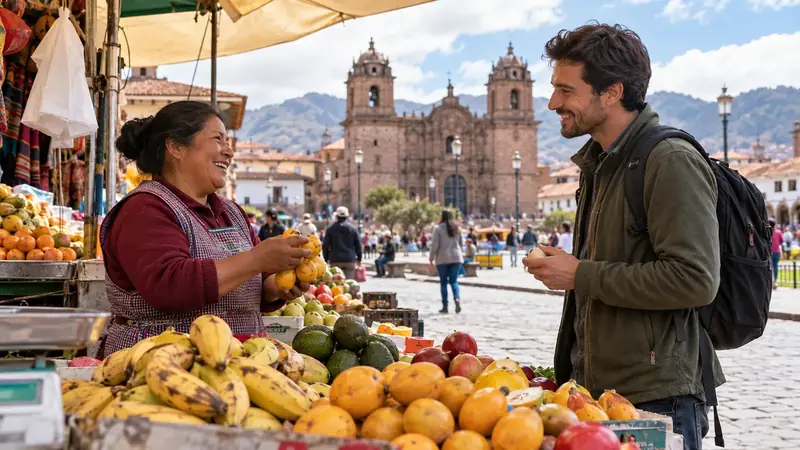
| Price per kilo | ¿A cuánto está el kilo? | How much is a kilo? |
| Unit of sale | ¿Se vende por kilo o por unidad? | By the kilo or by the piece? |
| Ripe for today | ¿Está para comer hoy? | Is it ready to eat today? |
| Tasting | ¿Puedo probar? | Can I taste it? |
| Understanding the unit of a service | ¿Es por persona o por grupo? | Per person or per group? |
| The total | ¿Cuánto es en total, con todo incluido? | How much in total, everything included? |
| What is included | ¿Qué incluye exactamente? | What exactly is included? |
| An extra charge | ¿Hay algún costo adicional? | Is there any extra charge? |
| Not too spicy | Poco picante, por favor. | Not too spicy, please. |
| Sauce on the side | La salsa aparte, por favor. | The sauce on the side. |
| For sharing | ¿Es para compartir? | Is it for sharing? |
| To take away | Para llevar, por favor. | To take away. |
| The bill | La cuenta, por favor. | The bill, please. |
| Paying by card | ¿Puedo pagar con tarjeta? | Can I pay by card? |
| The receipt | ¿Me da una boleta, por favor? | Can you give me a receipt? |
| Thinking it over | Gracias, lo voy a pensar. | Thank you, I’ll think about it. |
Words specific to Peru
These words have a particular meaning in Peru, or in a few South American countries, according to the dictionary of the Real Academia Española:
- Chifa: a Peruvian-style Chinese restaurant, and the food served there; the word comes from the Chinese for “to eat rice”.
- Yapa: the little extra the seller throws in, at the market in particular.
- Casero, casera: a shop’s regular customer, or a customer’s regular seller. At the market, you often hear people call out “¡caserito!”, “¡caserita!”.
- Al toque: right away. “Llego al toque”: I’ll be there right away.
- Paradero: the bus stop.
- Sencillo, vuelto: small change, the change you are given back.
- Palta, choclo, camote, cancha: avocado, the tender corn cob, sweet potato, toasted corn. See ingredients.
- Soroche: altitude sickness, from a Quechua word.
- Boleta, factura: the till receipt, the invoice. Both are proof of payment.
Does a phrase seem awkward to you, or rarely used in Peru? Let us know.
Frequently asked questions
Do you need to speak Spanish?
No, but a few phrases make a big difference to your exchanges, especially outside hotels and agencies. For an important activity, confirm the language actually spoken by the person who will be with you, not just the one used to sell the service.
How do you say you have an allergy?
“Soy alérgico” (for a man) or “soy alérgica” (for a woman), followed by the food: “al maní” for peanuts, “a los mariscos” for seafood. Add “es una alergia grave” and show a card written in Spanish. These phrases help you make yourself understood; they do not guarantee that there are no traces.
Sources and dates
2 sources
Prices, opening hours and rules change: every piece of information cited links to its source, with the date it was consulted.
Sources consulted
- Real Academia Española, Diccionario de la lengua española (chifa, yapa, casero, al toque, paradero, sencillo, vuelto, palta, choclo, cancha, camote, soroche) (new tab) (consulted on 2 October 2026)
- Indecopi, rights of users of tourist services (boleta, price information) (new tab) (consulted on 2 October 2026)
How we choose and date our information: our method. Has something changed? Let us know.