
First trip
A first trip to Peru: a 15-day itinerary
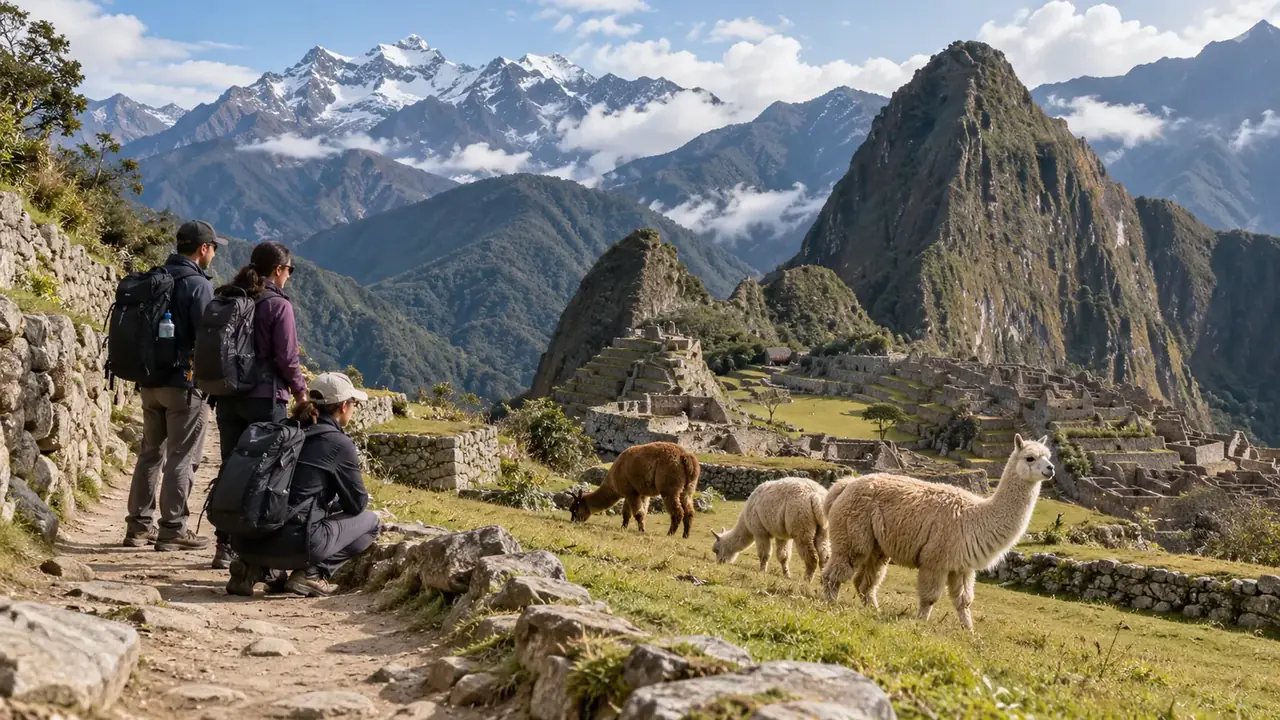
Fifteen days for a first trip to Peru: Lima, the coast of Paracas and Huacachina, the Sacred Valley, Machu Picchu and Cusco. Only three regions, a gradual climb in altitude and a spare day before the return flight. With three weeks, look instead at the southern classic, which adds Arequipa, the Colca and Titicaca.
- Length
- 15 days, 14 nights
- In the country
- 15 days, 14 nights, including 3 transfer days
- Pace
- Moderate: seven changes of accommodation, short sightseeing days on arrival at altitude
- Regions
- Lima and around · South coast · Cusco and the Sacred Valley
Who is it for? A first two-week trip, as a couple or as a family with children used to travelling, preferring fewer stops and more time in each place.
The trip in three parts
- Days 1 to 3
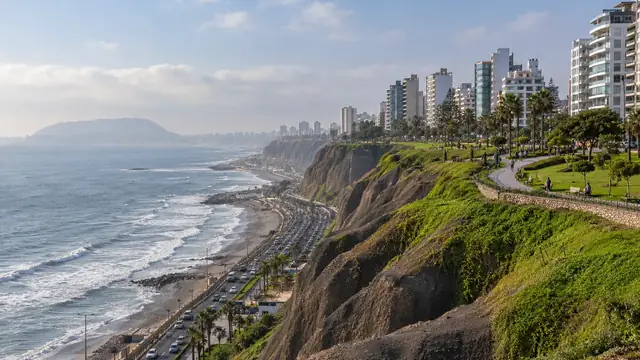
Lima and around
Lima
- Days 4 to 6
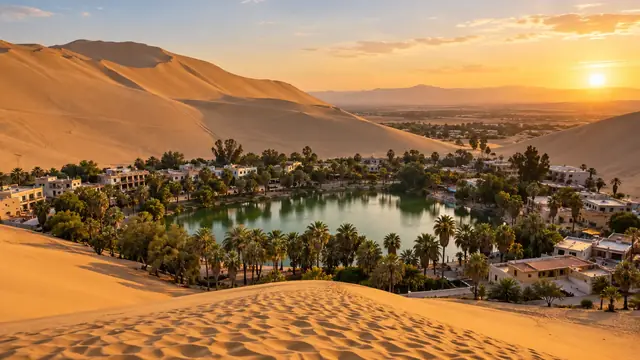
South coast
Paracas · Ica · Huacachina
- Days 8 to 13
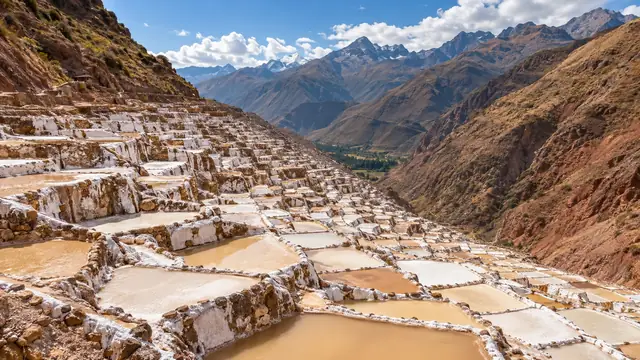
Cusco and the Sacred Valley
Cusco · Urubamba · Pisac · Chinchero · Moray · Maras · Ollantaytambo · Machu Picchu
Day 7: back to Lima; Days 14 and 15: back to Lima. Each day is detailed below.
A route to adapt to your dates, excluding international flights. Keep a day in hand before your flight home.
Day by day
ArrivalSightseeingMixed dayTransferBuffer
-
Day 1
Lima Arrival
International arrival, journey to Miraflores or Barranco, a simple dinner near your accommodation
Night: Lima
-
Day 2
Lima, historic centre Sightseeing
The colonial and republican city: Plaza Mayor, San Francisco monastery, Jirón de la Unión, Plaza San Martín
Night: Lima
-
Day 3
Lima, Pueblo Libre and the coast Sightseeing
The Museo Larco to understand the cultures before seeing them in the field, then the Miraflores malecón or Barranco
Night: Lima
-
Day 4
Paracas Mixed day
Bus in the morning (3 hr 15 min to 4 hr 10 min depending on the company), then the land reserve in the afternoon
Night: Paracas
-
Day 5
Ballestas Islands, then Ica Mixed day
Boat trip in the morning, journey to Ica (1 hr to 1 hr 30 min), a visit to a pisco bodega at the end of the day
Night: Ica or Huacachina
-
Day 6
Ica and Huacachina Sightseeing
Ica regional museum in the morning, the oasis and the dunes in the late afternoon, with or without a buggy
Night: Ica or Huacachina
-
Day 7
Lima Transfer
Return by bus (4 hr to 5 hr 30 min by the timetable), a night near the airport or in your Lima neighbourhood
Night: Lima
-
Day 8
Cusco, then the Sacred Valley Transfer
Flight to Cusco (about 1 hr 25 min), then straight down to Urubamba: no visits that day
Night: Sacred Valley, Urubamba (about 2,870 m)
-
Day 9
Sacred Valley, Pisac Sightseeing
A short day: the village and market of Pisac, then the hilltop site if you feel well
Night: Sacred Valley, Urubamba
-
Day 10
Chinchero, Moray and Maras Sightseeing
The plateau: weaving in Chinchero, the circular terraces of Moray, the Maras salt pans
Night: Sacred Valley, Urubamba
-
Day 11
Ollantaytambo, then Machu Picchu Pueblo Mixed day
The Ollantaytambo site in the morning, train in the afternoon (about 1 hr 30 min)
Night: Machu Picchu Pueblo (about 2,040 m)
-
Day 12
Machu Picchu, then Cusco Mixed day
Morning entry according to the ticket booked, afternoon train, road to Cusco
Night: Cusco (about 3,400 m)
-
Day 13
Cusco Sightseeing
The Inca city beneath the colonial city: Qorikancha, Hatun Rumiyuq, San Blas, San Pedro market
Night: Cusco
-
Day 14
Lima Transfer
Return flight to Lima in the morning, a free afternoon by the sea
Night: Lima
-
Day 15
Lima Buffer
A buffer before the international flight: nothing essential is planned that day
Why this order works
The route follows the logic of altitude before the logic of distance. The first seven days stay at or near sea level: Lima is on the coast, Paracas on the edge of the Pacific and Ica at about 400 m. This time is used to recover from jet lag, to pick up your first bearings in Spanish and to understand the country’s history in a museum before finding it again at the sites.
On day 8, the plane arrives in Cusco, at about 3,400 m. Instead of sleeping there, this programme heads straight down to the Sacred Valley and spends three nights in Urubamba, at about 2,870 m. The valley visits take place between the valley floor and the Chinchero plateau (about 3,750 m), then you reach Machu Picchu, lower still (about 2,430 m). Cusco comes last, when your body has already spent several days at altitude. This progression avoids starting with the highest night of the trip; it does not, however, protect you from altitude sickness. The signs that mean you must go down or see a doctor are detailed in the Altitude guide.
The return to Lima takes place on day 14 and not day 15: a delayed or cancelled domestic flight will then not make you miss the international flight.
The three transfer days
This schedule includes three transfer days, not two as an earlier version of this page said:
- Day 7, Ica → Lima. The companies’ timetables give 4 hr to 5 hr 30 min, to which you add the journey to the bus terminal and crossing Lima on arrival. Leave in the morning and plan nothing other than dinner.
- Day 8, Lima → Cusco → Urubamba. The flight takes about 1 hr 25 min; the road from Cusco to Urubamba, about 1 hr by car, 1 hr 30 min by bus, for some 45 km. With the time spent at Lima airport, it is a full day, even if the journeys themselves seem short.
- Day 14, Cusco → Lima. A morning flight frees up the afternoon, but the day is still built around the airport.
Two other days include a journey without being transfer days: day 4 (Lima–Paracas, 3 hr 15 min to 4 hr 10 min) and day 5 (Paracas–Ica, 1 hr to 1 hr 30 min), because a visit takes up the rest of the day. Day 12 strings together the visit to Machu Picchu, the train and the road: it is the longest day of the trip.
Where you sleep, and at what altitude
| Nights | Base | Sleeping altitude | Why here |
|---|---|---|---|
| 1 to 3, then 7 | Lima (Miraflores or Barranco) | sea level | Recovering, sightseeing, preparing what comes next |
| 4 | Paracas | sea level | Being on the spot for the morning boat trip |
| 5 and 6 | Ica or Huacachina | about 400 m | Museum, bodegas and dunes without going back and forth |
| 8 to 10 | Urubamba | about 2,870 m | First nights at altitude, in the centre of the valley |
| 11 | Machu Picchu Pueblo | about 2,040 m | Entering the site in the morning without a dawn train |
| 12 and 13 | Cusco | about 3,400 m | Visiting the city after several days of adjustment |
| 14 | Lima | sea level | Being close to the international flight |
Total: fourteen nights. The first seven are spent at or near sea level, the next six at altitude, the last one in Lima again.
Day by day: what each stage brings
Days 1 to 3: Lima, to understand before you see
The first evening has only one goal: getting to your accommodation without complications. The Arriving in Lima guide compares the ways of leaving the airport.
Day 2 is devoted to the historic centre, a UNESCO World Heritage site. The Plaza Mayor brings together the powers of the colonial city: the cathedral, the Government Palace and the city hall. A few streets away, the San Francisco monastery can be visited with its library and catacombs. The pedestrian Jirón de la Unión leads to the Plaza San Martín, built at the beginning of the 20th century and lined with buildings from the Republic. The detailed route, with what can be visited inside and what is admired from the street, is on the Historic centre page.
Day 3 begins at the Museo Larco, in Pueblo Libre. Its galleries present the cultures that succeeded one another or lived side by side on Peruvian territory over thousands of years: Paracas and Nasca on the south coast you will see in two days, Moche and Chimú in the north, Inca in the Andes. Seeing Paracas textiles and Nasca ceramics on day 3 gives meaning to the visit to Paracas on day 4 and to the Ica museum on day 6. In the afternoon, the Miraflores malecón, the clifftop promenade, or the Barranco neighbourhood let you finish facing the Pacific.
Days 4 to 6: the desert coast, between cold sea and dunes
On day 4, the bus leaves Lima in the morning. In the afternoon, the Paracas National Reserve shows a desert that falls into the sea: cliffs, red-sand beaches and abundant wildlife, fed by the cold, rich waters of the Humboldt Current. Entry costs S/ 11 per adult. The name of the peninsula also refers to a pre-Hispanic culture, known for its embroidered funerary textiles.
Day 5 begins with the boat trip to the Ballestas Islands, which takes place in the morning. You do not land: you sail along islands where sea lions, Humboldt penguins and seabirds live. On the way, the boat passes the Candelabra, a large figure traced in the sand of a hillside. On top of the price of the boat, the islands belong to a national reserve that charges an entry fee (S/ 11 in the published rate). After lunch, the road leads to Ica, an oasis town in the middle of an irrigated valley. A late afternoon at a bodega lets you understand how pisco is made, a grape brandy distilled without ageing in casks.
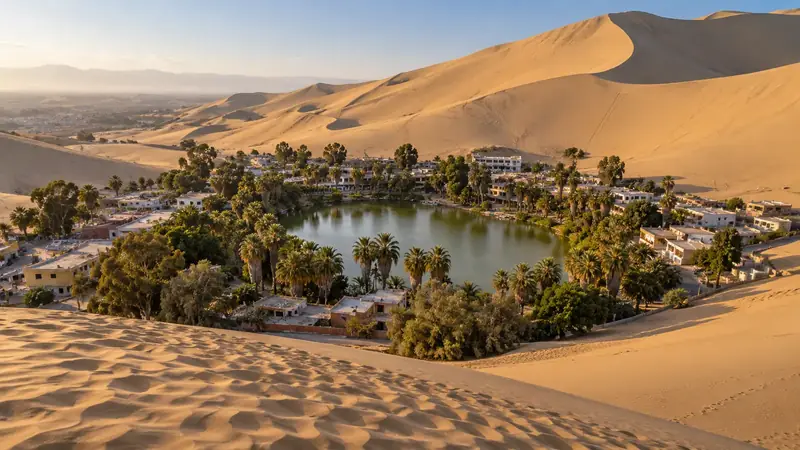
Day 6 is divided between the Ica regional museum, which holds Paracas and Nasca collections, and the Huacachina oasis, a few kilometres from the centre. Buggy rides in the dunes are common but not compulsory: you can walk up a dune at sunset, more slowly, or look at the landscape from the lagoon. The FDFA reports that the safety of risky sports, including buggies, varies greatly from one company to another: check the seat belts, the roll bar and the condition of the vehicle before getting in.
Day 7: back to Lima
The bus to Lima leaves in the morning. Choose where to spend the night according to the next day’s flight: a hotel near the airport if the flight is very early, your usual neighbourhood otherwise.
Days 8 to 10: the Sacred Valley, sleeping lower than Cusco
On day 8, the plane lands in Cusco. A car or a booked transfer goes straight down to Urubamba, at the bottom of the Urubamba Valley (the river bears the name of the town). No visits that day: a slow walk, a light meal, an early night.
Day 9 is deliberately kept short. Pisac is both a village by the river, with a market for crafts and farm produce, and a large Inca site perched on the mountain. The agricultural terraces that climb the slope show how the Incas farmed very steep hillsides. If you feel headaches or unusual breathlessness, keep the village and leave the site for another trip.
Day 10 climbs onto the plateau. In Chinchero (about 3,750 m), the colonial church was built on Inca foundations; workshops demonstrate spinning, natural dyeing and weaving, with direct sales. Moray has terraces arranged in concentric circles in natural hollows: the most frequently put forward hypothesis is that of a place for agricultural experiments, but it remains an interpretation. Finally, the Maras salt pans are hundreds of pools fed by a salt spring, worked by families from the community: you look at them from the authorised paths, without walking on the pools. Moray and Pisac are covered by circuit III of the Boleto Turístico (S/ 70); the salt pans have a separate ticket.
Days 11 and 12: Machu Picchu, without a dawn train
Day 11 begins in Ollantaytambo, downstream from Urubamba, where the train leaves. The village has kept its Inca layout, with its streets and water channels; above it, the site combines terraces and a group of huge stone blocks. The afternoon train goes down to Machu Picchu Pueblo in about 1 hr 30 min. Take a small bag for the night: PeruRail allows one 8 kg backpack (100 cm, sum of the three sides) or one 12 kg piece of hand luggage (115 cm), Inca Rail one 8 kg piece of hand luggage (118 cm, sum of the three sides). Big suitcases stay at the hotel in Urubamba or in left luggage at the station, and you collect them on the way back up.
On day 12, the shuttle bus goes up to the site (about USD 24 (foreign visitor) return according to the press in January 2026; the service is operating on a provisional basis). The choice of circuit determines what you will see: circuit 2, recommended for a first visit, combines an overall view (from the lower terrace on route 2-B, from the agricultural sector on 2-A) and a walk through several sectors of the city, depending on what is open that day; the view from the upper terraces belongs to circuit 1. The Machu Picchu page describes the three circuits and the ten routes. After the visit, the afternoon train to Ollantaytambo, then the road to Cusco.
Day 13: Cusco, the Inca city beneath the colonial city
The centre of Cusco keeps the layout and many walls of the former Inca capital. The Santo Domingo convent was built on the Qorikancha, the city’s main temple, whose walls of fitted stone remain visible. Hatun Rumiyuq street has a wall famous for its twelve-angled stone. The San Blas neighbourhood climbs in steep alleys; San Pedro market lets you have lunch at the counter and see Andean produce. Watch out: the Qorikancha temple and the site museum of the same name are not the same visit or the same ticket. The Cusco page explains this point in detail.
Days 14 and 15: return and buffer
The flight on day 14 takes you back to Lima early in the day. The afternoon is free. Day 15 serves as a buffer: a meal, a last market, nothing that cannot be dropped if a flight has been moved.
Around the Machu Picchu ticket: three scenarios
The Machu Picchu ticket is booked for a date, a circuit and an entry time, with a tolerance of 30 minutes in low season, 45 minutes in high season. It is the ticket that sets days 11 and 12.
| What you get | What you change |
|---|---|
| Entry on the morning of day 12 (the planned case) | Nothing: train on the afternoon of day 11, a night in Machu Picchu Pueblo |
| Entry on the afternoon of day 11 only | Morning train on day 11 from Ollantaytambo, visit in the afternoon, a night on the spot, return on the morning of day 12: you gain half a day in Cusco |
| No places on circuit 2 on either date | A circuit 1 (overall view from the upper terraces) or 3 (lower sector and “royal” complexes) rather than moving the whole trip; if nothing is available, Ollantaytambo, Pisac and Cusco are still a complete trip |
Book the ticket before the trains, then the trains before the nights. Doing it the other way round often means paying for changes.
Budget: the items to add up
This table lists what this route costs, item by item. The amounts shown are official or published rates, dated; the other items depend on your dates and your quotes.
| Item | Basis of calculation | Known amount |
|---|---|---|
| Domestic flights | 2 flights per person (Lima–Cusco, Cusco–Lima) | Variable depending on the date of purchase: your quote |
| Coast buses | Lima–Paracas, Paracas–Ica, Ica–Lima, per person | Variable depending on the company and the class |
| Accommodation | 14 nights, per room (or per person in a dormitory) | Your quote |
| Paracas Reserve | Per adult | S/ 11 |
| Ballestas Islands | Boat (operator) + the reserve’s entry fee | S/ 11 entry fee, plus the price of the boat |
| Boleto Turístico del Cusco | Circuit III, per adult | S/ 70 |
| Machu Picchu | Ticket + SERNANP fee, per foreign adult | S/ 152 + S/ 11 |
| Site shuttle bus | Return, per person | USD 24 (foreign visitor) |
| Trains | Outward and return, per person | Variable depending on the time and the class |
| Private transfers in Cusco | Per vehicle | Published references below |
| Meals, local transport, margin | Per person and per day, plus a percentage | Your choice |
Enter these items in the budget calculator: it separates nights from days and rooms from travellers.
Arequipa and Colca variant, without the south coast
This variant replaces Paracas and Ica with Arequipa and the Colca Canyon. The trip gains a gradual climb (Arequipa is at about 2,335 m), but the Colca involves crossing a pass at about 4,900 m and a night in Chivay (about 3,600 m), about 1,300 metres higher than Arequipa: this jump exceeds what the CDC advises, and the nights in Arequipa do not make up for it. It is not a “low” stage.
| Day | Stage | Type | Night |
|---|---|---|---|
| 1 to 3 | Lima, as above | arrival then sightseeing | Lima |
| 4 | Lima–Arequipa flight (about 1 hr 30 min), historic centre in the afternoon | mixed | Arequipa |
| 5 | Santa Catalina monastery, Yanahuara, a picantería | sightseeing | Arequipa |
| 6 | Road to the Colca (about 3 hr to 3 hr 30 min for some 160 km) via the Patapampa Pass | mixed | Chivay |
| 7 | Cruz del Cóndor viewpoint early in the morning, back to Arequipa | mixed | Arequipa |
| 8 | Arequipa–Cusco flight (about 1 hr), down to Urubamba | transfer | Urubamba |
| 9 and 10 | Pisac, then Chinchero, Moray and Maras | sightseeing | Urubamba |
| 11 | Ollantaytambo, train to Machu Picchu Pueblo | mixed | Machu Picchu Pueblo |
| 12 | Machu Picchu, train and road to Cusco | mixed | Cusco |
| 13 | Cusco | sightseeing | Cusco |
| 14 | Cusco–Lima flight | transfer | Lima |
| 15 | Buffer and departure | buffer | none (departure) |
Total: fourteen nights and only two transfer days, since the flights replace the long coast bus. There are fewer direct Arequipa–Cusco flights than from Lima: look at the timetables before choosing this variant. Arequipa and the Colca are detailed in Arequipa and the far south.
Nazca variant: one more day on the bus
To see the Nazca geoglyphs, this variant keeps the south coast but replaces the second day in Ica with a night in Nazca. The price to pay is the return journey: 7 hr to 8 hr 30 min for most services by bus to Lima.
| Day | Stage | Type | Night |
|---|---|---|---|
| 1 to 3 | Lima | arrival then sightseeing | Lima |
| 4 | Lima–Paracas, the reserve in the afternoon | mixed | Paracas |
| 5 | Ballestas Islands, road to Ica, Huacachina at the end of the day | mixed | Ica or Huacachina |
| 6 | Road to Nazca, overflight or viewing tower for the lines | mixed | Nazca |
| 7 | Nazca–Lima by bus | transfer | Lima |
| 8 to 15 | As in the main route | see above | see above |
The total remains fourteen nights and three transfer days, but the day at the Ica museum disappears and day 6 becomes busy. An overflight in a small plane and viewing from the ground-level towers are two different experiences, compared in The south coast.
What to arrange in advance
- Machu Picchu first: ticket, circuit and entry time on the official ticketing site, before the trains and the nights in Machu Picchu Pueblo. The site welcomes 5,600 visitors a day in high season, 4,500 in low season.
- The trains Ollantaytambo–Machu Picchu Pueblo (outward on day 11) and back to Ollantaytambo or Poroy (day 12), with the company’s luggage limit.
- The two domestic flights Lima–Cusco (day 8) and Cusco–Lima (day 14), preferably on the same ticket or with known change conditions.
- The trip to the Ballestas Islands (day 5) with an operator authorised by SERNANP, knowing that it may be cancelled if the harbour authority closes the sea.
- The Boleto Turístico del Cusco: circuit III covers Pisac, Ollantaytambo, Chinchero and Moray; it is bought on site.
What this route leaves out
- Arequipa, the Colca Canyon and Lake Titicaca: another trip or the Arequipa variant.
- Nazca and its geoglyphs: see the Nazca variant.
- The north (Trujillo, Chiclayo, beaches), the mountains of Huaraz and the Amazon.
- The big hikes (Inca Trail, Salkantay) and Vinicunca, the Mountain of 7 Colours, which require a longer period of acclimatisation beforehand.
- Santa Teresa and the Cocalmayo hot springs, beyond the Abra Málaga pass: at least two more days, see Santa Teresa and Cocalmayo.
Variations
-
If Nazca is a priority
A night in Nazca replaces the second day in Ica, at the cost of a return bus journey of 7 hr to 8 hr 30 min for most services. Full schedule below.
-
If you prefer Arequipa
Arequipa and the Colca replace the south coast: the trip becomes more Andean and climbs in stages before Cusco. Full schedule below.
A few prices along this route
Prices shown online are for guidance only. Our partners on the ground charge far less (Vinicunca: S/ 650 online, 70 soles per person with our partner, meals included): write to us before you book.
-
Cusco → Urubamba
S/ 180 ≈ US$52.37 per vehicle, up to 4 passengers according to the provider
Private transfer and driver.
Travel Inkas Route (indicative prices) · recorded on 26 September 2026 · source: Travel Inkas Route, indicative prices (new tab)
-
Cusco → Ollantaytambo station
S/ 220 ≈ US$64.01 per vehicle, up to 4 passengers according to the provider
Private transfer and driver.
Travel Inkas Route (indicative prices) · recorded on 26 September 2026 · source: Travel Inkas Route, indicative prices (new tab)
Dollars at the rate of 30 September 2026 (1 USD = 3.437 PEN). All prices in Peru.
For the full budget of your trip, add up your quotes in the budget calculator.
Sources and dates
7 sources
Prices, opening hours and rules change: every piece of information cited links to its source, with the date it was consulted.
Figures and rules cited
- 3 hr 15 min to 4 hr 10 min: Length of the bus journey from Lima to Paracas according to the companies’ timetables (Lima terminals (Javier Prado, Plaza Norte, Atocongo…) to Paracas) . Timetable duration, excluding getting to the terminal and the traffic leaving Lima.
Press or reseller: CheckMyBus, Lima–Paracas (timetable aggregator) (new tab) · consulted on 1 October 2026 - 1 hr to 1 hr 30 min: Length of the bus journey from Paracas to Ica (Paracas–Ica)
Press or reseller: CheckMyBus, Paracas–Ica (timetable aggregator) (new tab) · consulted on 1 October 2026 - 4 hr to 5 hr 30 min: Length of the bus journey from Ica to Lima (Ica–Lima) . Timetable duration; getting into Lima often adds time.
Press or reseller: CheckMyBus, Ica–Lima (timetable aggregator) (new tab) · consulted on 1 October 2026 - about 1 hr 25 min: Length of a direct Lima–Cusco flight (Jorge Chávez (Lima) and Velasco Astete (Cusco) airports) . Direct flights operated by LATAM, Sky and JetSMART among others.
Press or reseller: KAYAK, Lima–Cusco flights (average length of direct flights) (new tab) · consulted on 1 October 2026 - about 2,870 m: Altitude of Urubamba (town) (Urubamba, Sacred Valley)
Press or reseller: Wikidata, Urubamba (Q2304483), altitude (new tab) · consulted on 1 October 2026 - about 1 hr 30 min: Length of the train journey from Ollantaytambo to Machu Picchu Pueblo (Ollantaytambo station)
Site management: PeruRail, frequently asked questions (new tab) · consulted on 1 October 2026 - about 2,040 m: Altitude of Machu Picchu Pueblo (Aguas Calientes), at the bottom of the valley (Machu Picchu Pueblo)
Old source: Wikipedia, Aguas Calientes (Peru) (new tab) · consulted on 1 October 2026 - about 3,400 m: Altitude of Cusco (centre) (Cusco) . Wikidata gives 3,399 m, the CDC about 3,350 m: the city spreads over several tens of metres of height.
Press or reseller: Wikidata, Cuzco (Q5582862), altitude (new tab) · consulted on 1 October 2026 - 5,600 visitors a day in high season, 4,500 in low season: Daily capacity of the site (Llaqta de Machu Picchu)
Press or reseller: PeruRail, Tickets to Machu Picchu and New Visit Circuits 2026 (new tab) · consulted on 1 October 2026 - 7 hr to 8 hr 30 min for most services: Length of the bus journey from Nazca to Lima (Nazca–Lima)
Press or reseller: CheckMyBus, Nazca–Lima (timetable aggregator) (new tab) · consulted on 1 October 2026 - about 400 m: Altitude of Ica (town) (Ica)
Press or reseller: Wikidata, Ica (Q840712), altitude (new tab) · consulted on 1 October 2026 - about 3,750 m: Altitude of Chinchero (village, on the plateau) (Chinchero)
Official source: Cusco Directorate of Culture, Chinchero archaeological park (average altitude 3,750 m) (new tab) · consulted on 7 October 2026 - about 2,430 m: Altitude of the Machu Picchu site (Machu Picchu)
Press or reseller: Wikidata, Machu Picchu (Q676203), altitude (new tab) · consulted on 1 October 2026 - about 1 hr by car, 1 hr 30 min by bus, for some 45 km: Length of the road journey from Cusco to Urubamba (Sacred Valley) (Cusco–Urubamba road)
Press or reseller: Rome2rio, Cusco–Urubamba (new tab) · consulted on 1 October 2026 - S/ 11: Entry to the Paracas National Reserve, one day (Paracas National Reserve, Santo Domingo checkpoint) (General rate, adult) . Open every day from 9:00 to 16:00 according to SERNANP. A combined reserve + Ballestas Islands ticket is offered at S/ 17.
Site management: SERNANP, Reserva Nacional de Paracas (new tab) · consulted on 1 October 2026 - S/ 11: Entry fee for the Ballestas Islands (SIIPG National Reserve), on top of the boat trip (Ballestas Islands, off Paracas) (Adult (published national rate; the general rate is not detailed on the page)) . Visits only with an operator authorised by SERNANP, from 6:00 to 13:00; life jacket compulsory.
Site management: SERNANP, Reserva Nacional SIIPG, islas Ballestas (new tab) · consulted on 1 October 2026 - S/ 70: Partial Boleto Turístico del Cusco (one circuit), foreign adult visitor (Cusco and the Sacred Valley) (Foreign adult) . Circuit I: four sites above Cusco, 1 day. Circuit II: eight museums and sites including Tipón and Pikillaqta, 2 days. Circuit III: Pisac, Ollantaytambo, Chinchero and Moray, 2 days.
Site management: COSITUC, Boleto Turístico del Cusco (new tab) · consulted on 1 October 2026 - one 8 kg backpack (100 cm, sum of the three sides) or one 12 kg piece of hand luggage (115 cm): Luggage allowance per passenger, PeruRail, Machu Picchu line (PeruRail Expedition, Vistadome, Vistadome Observatory, Hiram Bingham trains) . Free left-luggage at Ollantaytambo and Machu Picchu stations.
Site management: PeruRail, luggage policy (new tab) · consulted on 1 October 2026 - one 8 kg piece of hand luggage (118 cm, sum of the three sides): Luggage allowance per passenger, Inca Rail (Inca Rail trains) . Check in at the station at least 30 minutes before departure; passport and ticket required.
Site management: Inca Rail, conditions of carriage (new tab) · consulted on 1 October 2026 - USD 24 (foreign visitor): Shuttle between Machu Picchu Pueblo and the site entrance, return (Hiram Bingham road, Machu Picchu) (Foreign visitor (USD 15 for a Peruvian visitor)) . The service changed operator in 2025: the price and the point of sale may still change.
Old source: Infobae, “Consettur seguirá cobrando tarifas de entre 15 y 24 dólares” (6 January 2026) (new tab) , published on 6 January 2026 · consulted on 1 October 2026 - 30 minutes in low season, 45 minutes in high season: Grace period after the entry time printed on the ticket (Llaqta de Machu Picchu) . After that, entry may be refused except in justified cases of force majeure.
Press or reseller: PeruRail, Tickets to Machu Picchu and New Visit Circuits 2026 (new tab) · consulted on 1 October 2026 - S/ 152: Basic entry ticket, foreign adult (circuits without a mountain) (Llaqta de Machu Picchu) (Foreign adult, from outside the Andean Community ; excludes: SERNANP entry fee for the Historic Sanctuary, Bus and train) . The price varies with the circuit; routes that include climbing a mountain cost more. The official ticket office (tuboleto.cultura.pe) shows the exact amount at the time of purchase.
Press or reseller: Infobae, “Suben tarifas de ingreso a Machu Picchu” (9 February 2026) (new tab) , published on 9 February 2026 · consulted on 1 October 2026 - S/ 11: Entry fee for the Historic Sanctuary (SERNANP), on top of the ticket, foreign visitor, since 1 May 2026 (Historic Sanctuary of Machu Picchu) (Foreign visitor (S/ 5 for a Peruvian visitor)) . The amount and how to pay it are shown when you buy the ticket.
Press or reseller: Infobae, SERNANP entry fee (5 February 2026), Resolución Directoral N° 000006-2026-SERNANP/DUSRN (new tab) , published on 5 February 2026 · consulted on 1 October 2026 - about 2,335 m: Altitude of Arequipa (centre) (Arequipa)
Press or reseller: Wikidata, Arequipa (Q159273), altitude (new tab) · consulted on 1 October 2026 - about 4,900 m: Altitude of the Patapampa pass, the highest point of the Arequipa–Chivay road (Arequipa–Chivay road)
Old source: Arequipa.com, Colca Canyon Travel Guide 2026 (pass “near 4,910 m”) (new tab) · consulted on 1 October 2026 - about 3,600 m: Altitude of Chivay (the main town of the Colca valley) (Chivay)
Press or reseller: Wikipedia (English), Chivay (new tab) · consulted on 1 October 2026 - about 1 hr 30 min: Length of a direct Lima–Arequipa flight (Jorge Chávez (Lima) and Rodríguez Ballón (Arequipa) airports) . Direct flights operated by LATAM, Sky and JetSMART among others.
Press or reseller: KAYAK, Lima–Arequipa flights (average length of direct flights) (new tab) · consulted on 1 October 2026 - about 3 hr to 3 hr 30 min for some 160 km: Length of the road journey from Arequipa to Chivay (Colca valley) (Arequipa–Chivay road via the Patapampa pass)
Press or reseller: Rome2rio, Arequipa–Chivay (bus and car) (new tab) · consulted on 1 October 2026 - about 1 hr: Length of a direct Arequipa–Cusco flight (Rodríguez Ballón (Arequipa) and Velasco Astete (Cusco) airports) . Direct flights found with LATAM only: fewer departures than from Lima.
Press or reseller: KAYAK, Arequipa–Cusco flights (new tab) · consulted on 1 October 2026
Sources consulted
- Ministry of Culture, Machupicchu: visiting circuits and routes (new tab) (consulted on 1 October 2026)
- PeruRail, frequently asked questions (journey times, bus-and-train service) (new tab) (consulted on 1 October 2026)
- SERNANP, Reserva Nacional de Paracas (new tab) (consulted on 1 October 2026)
- COSITUC, Boleto Turístico del Cusco (new tab) (consulted on 1 October 2026)
- CDC Yellow Book, High-Altitude Travel and Altitude Illness (new tab) (consulted on 1 October 2026)
- UNESCO, Historic Centre of Lima (new tab) (consulted on 1 October 2026)
- FDFA, Conseils pour les voyages – Pérou (travel advice, in French) (new tab) (consulted on 1 October 2026)
How we choose and date our information: our method. Has something changed? Let us know.