
Northern Amazon
Iquitos and the rainforest in seven days
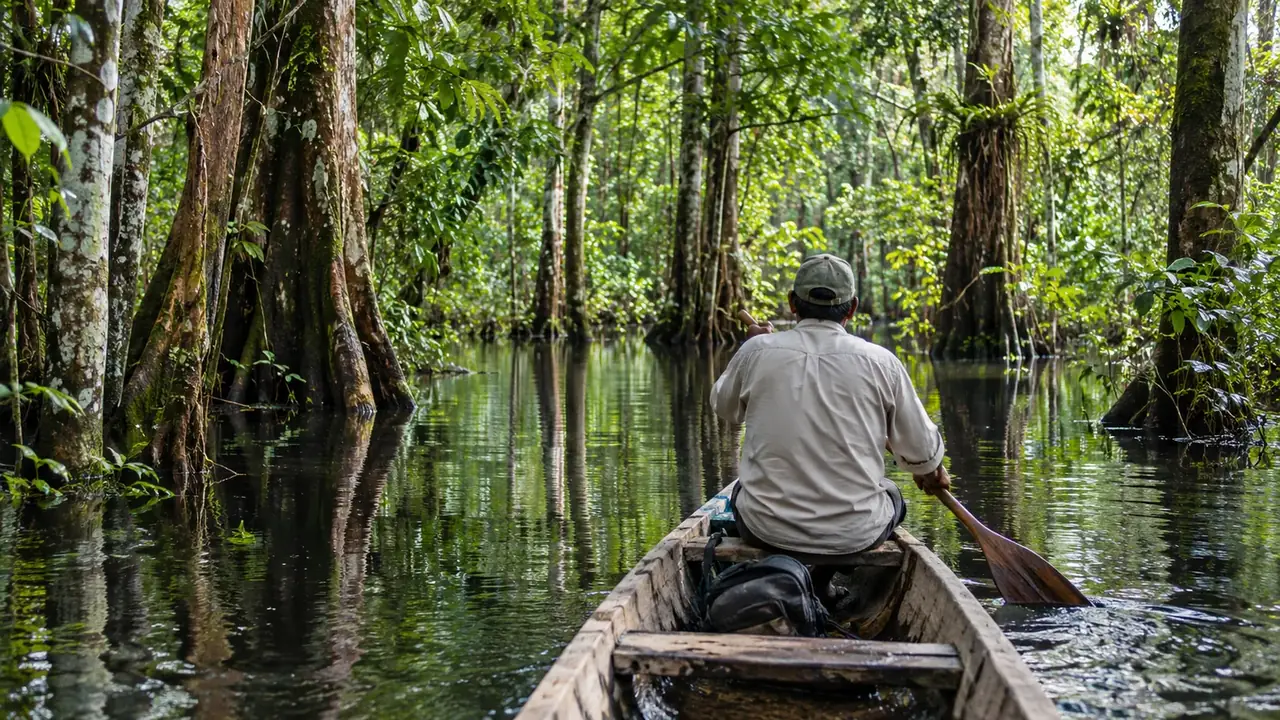
Iquitos can only be reached by plane or by boat: the whole trip takes place in the city and the forest around it. This programme gives the rubber city a proper day, three nights in a lodge on the river, and keeps a night in town before the return flight.
- Length
- 7 days, 6 nights
- In the country
- 7 days, 6 nights
- Pace
- Unhurried: two changes of accommodation, no full transfer day, time in the forest at the centre
- Regions
- Northern Amazon
Who is it for? Those who want to experience the world of the river, as a family or as a couple, without an expedition or a long journey.
A route to adapt to your dates, excluding international flights. Keep a day in hand before your flight home.
Day by day
ArrivalSightseeingMixed dayBuffer
-
Day 1
Iquitos Arrival
Flight from Lima, settling in, a first walk along the malecón at sunset
Night: Iquitos
-
Day 2
Iquitos, the city Sightseeing
Belén market in the morning, the Plaza de Armas, the Casa de Fierro, the malecón and its rubber-boom houses; an Amazonian lunch
Night: Iquitos
-
Day 3
The river, then the lodge Mixed day
Morning boat to the lodge, settling in, a first outing in the late afternoon
Night: Lodge on the Amazon
-
Day 4
Forest: cocha and dry land Sightseeing
A typical day: canoe on a cocha at dawn, a walk in the forest, a siesta, the river at dusk, a night outing
Night: Lodge on the Amazon
-
Day 5
Forest: depending on the season Sightseeing
Canoeing in the flooded forest at high water, more walking at low water; an agreed visit to a riverside community if the lodge offers one
Night: Lodge on the Amazon
-
Day 6
Back to Iquitos Mixed day
A last outing at dawn, boat to Iquitos, the afternoon at Lake Quistococha or resting
Night: Iquitos
-
Day 7
Departure Buffer
A free morning, return flight to Lima
The city, a nearby lodge or Nauta: three different things
| The city | A nearby lodge | Nauta and Pacaya Samiria | |
|---|---|---|---|
| How | On foot and by mototaxi | One to a few hours by boat from Iquitos | The only road out of Iquitos, to Nauta (103 km), then the boat |
| What you see | The history of rubber, Belén, the river | The forest along the Amazon or a tributary, more or less preserved depending on the distance | The great flooded forest of a national reserve |
| In this programme | Days 1, 2 and 6 | Days 3 to 6 | Nine-day variant |
This programme does not name a lodge: none has been visited or checked by us. It describes what a three-night stay allows, and what you need to ask.
Day by day
Days 1 and 2: the rubber city, without embellishing it
On the first evening, the Malecón Tarapacá above the river is enough. On day 2, Belén market is visited in the morning: river fish, forest fruit such as aguaje, medicinal plants. The lower part of the neighbourhood, on stilts and with floating houses, is seen with a local guide who knows the residents. Then the Plaza de Armas, the Iglesia Matriz and the Casa de Fierro, a metal house that legend attributes to Eiffel without proof, and the malecón lined with houses covered in azulejo tiles.
These façades tell the story of the rubber boom, from 1880 to 1914, and its dark side: raids against Indigenous peoples to force them to collect latex, up to the Putumayo crimes denounced in 1913. See the rubber city.
At midday, Amazonian cooking: juane, rice and chicken cooked in a leaf, tacacho con cecina, plantain balls and dried pork, river fish. See the cooking of the Amazon.
Days 3 to 6: three nights in a lodge
The boat leaves in the morning; you arrive for lunch, and the first outing takes place in the late afternoon. Two full days follow, then a last outing at dawn before the return.
A typical day in the forest:
| Time | Outing | What you see, with a little luck |
|---|---|---|
| Dawn | Canoe on a cocha, a lake formed from an old meander | Birds, monkeys waking up, sometimes otters |
| Morning | A walk in dry-land forest | Big trees, insects, tracks |
| Midday | Lunch, siesta: it is hot | |
| Late afternoon | A boat on the river, sunset | Pink river dolphins, riverbank birds |
| Night | An outing on foot or by boat, by torchlight | Frogs, insects, the eyes of caimans |
Depending on the season. The river rises and falls by several metres over the year. At high water, you travel by canoe between the trunks of the flooded forest; at low water, the trails and beaches reappear, and you walk more. No season is perfect: it rains all year round. See high and low water.
A community visit, if the lodge offers one: ask who organises it, who is paid, and what can be photographed. See meeting people.
On day 6, back to the city in the late morning. In the afternoon, Lake Quistococha and its park, or rest.
Day 7: a buffer before the flight
The night of day 6 in the city means the flight does not depend on the morning boat: a delay on the river does not make you miss the plane.
Health before you leave
The CDC recommends the yellow fever vaccine for Loreto, and malaria is present below 2,500 metres east of the Andes: see a travel medicine centre several weeks beforehand. Protect yourself from mosquitoes day and night. See health.
Budget: the items to add up
| Item | Basis of calculation | Known amount |
|---|---|---|
| Lima–Iquitos flights | Outward and return, per person | Your quote |
| Hotel in Iquitos | 3 nights, per room | Your quote |
| Lodge | 3 nights, generally with meals, boat and outings included | Your quote: have what is included specified |
| Visits in the city | A Belén guide, mototaxis, entry fees | On site |
Pacaya Samiria variant, via Nauta
For the great flooded forest, the Pacaya Samiria National Reserve: S/ 30 a day for a foreign visitor (S/ 15 for a Peruvian adult); every day from 6:00 to 17:00; visits only with an authorised operator. You enter from Nauta, then by boat, from a few hours to two days depending on the sector; the most accessible, Yanayacu-Pucate, has around twenty lakes. SERNANP advises visiting from May to September.
| Day | Programme | Night |
|---|---|---|
| 1 | Flight to Iquitos | Iquitos |
| 2 | The city and Belén | Iquitos |
| 3 | Road to Nauta, boat to the reserve | Reserve |
| 4 to 6 | Pacaya Samiria with an authorised operator: lakes, flooded forest, Kukama communities | Reserve |
| 7 | Boat to Nauta, road to Iquitos | Iquitos |
| 8 | Rest or Quistococha | Iquitos |
| 9 | Return flight |
Ask the operator about the sector, the boat times, the type of accommodation and what the price includes. See Pacaya Samiria.
What to arrange in advance
- The lodge: its real location and boat time from Iquitos, outings included, language and group size, mosquito nets, electricity, what happens if a flight is delayed. Write down the answers in the comparison tool.
- The flights Lima–Iquitos and back: there is no road to Iquitos, and a missed flight cannot be made up by bus.
- Pacaya Samiria, if you choose the variant: an operator authorised by SERNANP, compulsory.
What this route leaves out
- The river journey to the tri-border area: a separate briefing, in an area the FDFA advises against.
- Tarapoto and San Martín, which are not linked to Iquitos by road: another trip, by plane (Star Perú publishes a Tarapoto–Iquitos connection) or with a connection via Lima.
Variations
-
Pacaya Samiria, via Nauta
Nine days: the road to Nauta, then the boat to the reserve, for four nights in the great flooded forest. Schedule below.
-
One more night in the forest
Four nights in a lodge instead of three: one more full day, and a margin if rain cancels an outing.
Sources and dates
4 sources
Prices, opening hours and rules change: every piece of information cited links to its source, with the date it was consulted.
Figures and rules cited
- S/ 30 a day for a foreign visitor (S/ 15 for a Peruvian adult); every day from 6:00 to 17:00; visits only with an authorised operator: Pacaya Samiria National Reserve: entry, opening hours and the rule on operators (Pacaya Samiria National Reserve, Loreto) . Sectors: Yanayacu-Pucate (one to three days, the most accessible, some twenty cochas), Pacaya, Samiria (Kukama communities), Tibilo (two to three days, from Lagunas). Access from Nauta, then 3 to 48 hours by boat depending on the sector. Do not disturb nesting turtles (July to September).
Site management: SERNANP, Reserva Nacional Pacaya Samiria (new tab) · consulted on 2 October 2026
Sources consulted
- SERNANP, Reserva Nacional Pacaya Samiria (sectors, access, operators, season) (new tab) (consulted on 2 October 2026)
- PROMPERÚ, Loreto (new tab) (consulted on 25 September 2026)
- CDC Yellow Book, Peru (yellow fever, malaria) (new tab) (consulted on 2 October 2026)
- Road routes calculated on OpenStreetMap (Iquitos–Nauta) (new tab) (consulted on 2 October 2026)
How we choose and date our information: our method. Has something changed? Let us know.