In short
Choose the format according to what you want to learn: a market for the produce, a class for the techniques, a picantería for a living regional cuisine, a producer for a supply chain (cocoa, pisco), a tasting for a first overview. Before booking, have them spell out: hands-on or demonstration, number of dishes and quantities, drinks included, adaptations for allergies, and the total price.
Five formats compared
| Format | What you learn | Hands-on? | Usual length | Going further |
|---|---|---|---|---|
| The market explained | The produce: potatoes, corn, chillies, fruit, fish | You taste, you do not cook | One to two hours, in the morning | Markets; causa recipe |
| The cooking class | The techniques: chopping, marinating, stir-frying, making a sauce | Depending on the class: hands-on or demonstration | Half a day, often with the market and the meal | Ceviche and lomo saltado recipes |
| The picantería (Arequipa) | A living regional cuisine, its dish of the day, its chicha | No: you eat | A lunch, from midday to 15:00 | The picanterías; rocotos rellenos, ocopa |
| The producer | A supply chain: cocoa and coffee in Tarapoto, wines and piscos in Ica | You follow a stage, sometimes you do it | Half a day | Cocoa and coffee, Ica |
| Tasting in small portions | An overview of a city in a few stops | No: you taste | A few hours | Lima for food lovers |
Three sequences for learning
These are typical outlines, to show what a good class should contain; they do not describe a class we have taken.
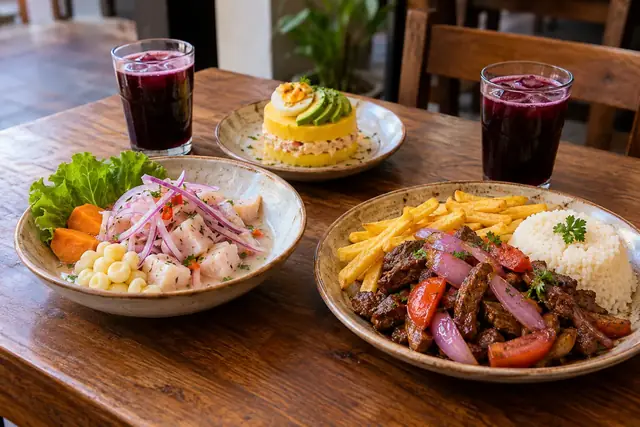
Ceviche, from the fish to the leche de tigre. Choose a fish sold for eating raw, kept very cold; cut it into cubes; marinate it for a few minutes in the juice of small limes, with salt, chilli and red onion. Understand that the acid changes the texture without cooking the fish or making it safe; taste the leche de tigre, the marinade juice, which has become an aperitif in its own right. See the recipe and eating out.
Lomo saltado and chifa. Sear meat, onion and tomato over a very high heat in a wok, with soy sauce and vinegar: saltado is a technique brought by Chinese cooks who settled in Peru, which also gave birth to chifa, Chinese-Peruvian cooking. See the recipes for lomo saltado and arroz chaufa.
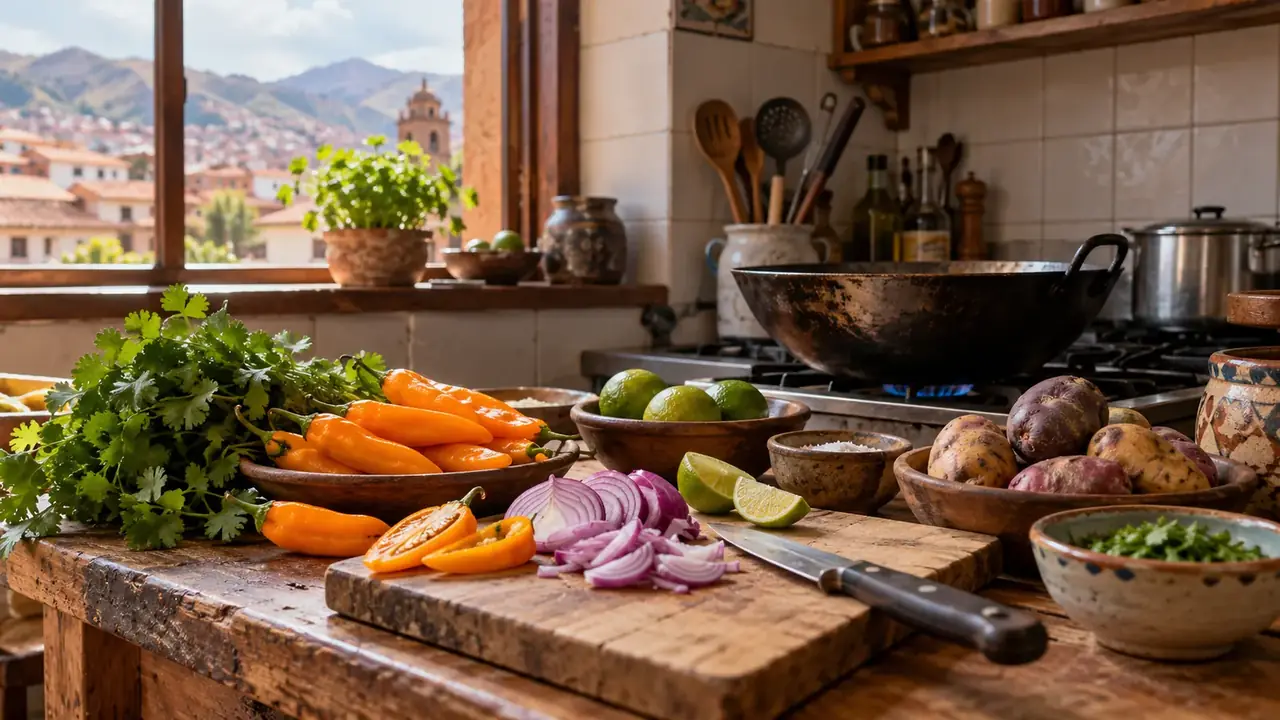
Potatoes and their sauces. Taste three varieties and see which is used for what; make a yellow chilli sauce for papa a la huancaína, a huacatay and peanut sauce for ocopa, a pressed purée for causa. In Arequipa, grinding is still done on the batán, a polished stone.
Techniques and ingredients to discover
- The acid marinade: ceviche and tiradito, made with lime.
- Saltado: quick cooking in a wok, inherited from Chinese immigration.
- The batán: the Andean grinding stone, for chillies and sauces.
- Pachamanca and huatia: cooking meats, potatoes and broad beans underground, in contact with heated stones.
- Cooking in leaves: juane (rice and chicken wrapped in a leaf, then cooked) and patarashca (fish grilled in leaves) in the Amazon.
- Chichas: fermented chicha de jora, Arequipa’s chicha de guiñapo, made with sprouted black corn, and chicha morada, a non-alcoholic purple corn drink.
Lima, Arequipa, the north, the Amazon
| Region | What sets it apart | Dishes to look for |
|---|---|---|
| Lima | African, indigenous and Chinese influences, plus nikkei cooking, born of Japanese immigration | Ceviche, tiradito, anticuchos, causa, ají de gallina, arroz chaufa, lomo saltado |
| Arequipa | The picanterías, a soup for each day of the week, the batán | Rocoto relleno, ocopa, solterito, chupe de camarones, Monday’s chaque, cuy chactado |
| The north (Lambayeque, Trujillo, Piura) | Generous lunchtime cooking, built around rice, duck and kid goat | Arroz con pato, cabrito |
| The Amazon | Plantains, cassava, river fish, cooking in leaves | Juane, tacacho con cecina, patarashca, inchicapi (hen with cassava and peanuts) |
See regional cuisines.
Before booking: what to have spelled out
| To ask | Why |
|---|---|
| Hands-on or demonstration? | Watching and cooking are not the same experience |
| How many dishes, and what quantities? | A tasting does not always replace a meal |
| Is the market included, and the produce bought there? | Some classes charge for the ingredients separately |
| Drinks included, with or without alcohol? | The pisco sour is not always included |
| Adaptations: allergies, vegetarian, chilli | To be stated in writing, with the specific food |
| Language and group size | The price does not tell you whether the group suits you |
| Total price, transport and tip included or not | A “tour” should not hide three stops where everyone pays for their own meal |
For allergies, several Peruvian sauces contain peanuts or nuts: see allergies and health.
Frequently asked questions
A cooking class: hands-on or demonstration?
Both exist. In a hands-on class, you chop, mix and taste; in a demonstration, you watch and taste. Ask which it is, how many dishes, and whether the trip to the market is included.
Can you take part in a culinary experience with an allergy?
Often, provided you say so when booking, in writing, with the specific food. Several Peruvian sauces contain peanuts or nuts. What the kitchen can guarantee regarding traces must be asked beforehand, not on the spot.
Sources and dates
4 sources
Prices, opening hours and rules change: every piece of information cited links to its source, with the date it was consulted.
Sources consulted
- PROMPERÚ, Lima’s cuisine (African, indigenous and Chinese influences) (new tab) (consulted on 2 October 2026)
- PROMPERÚ (peru.info), the cuisine of Arequipa (new tab) (consulted on 2 October 2026)
- PROMPERÚ, the cuisine of the Amazon (new tab) (consulted on 2 October 2026)
- Wikipedia (Spanish), Leche de tigre, Pachamanca, Cocina nikkei (new tab) (consulted on 2 October 2026)
How we choose and date our information: our method. Has something changed? Let us know.