
In short
Choose a half-day “on land” (Real Felipe fortress, Callao Monumental, La Punta promenade) or a morning at sea to the Palomino Islands with an authorised operator, followed by a fish lunch in La Punta. Come by taxi from Miraflores or Barranco and leave before nightfall.
Lima’s port since the 16th century
Lima was founded inland, on the Rímac; it needed a port. That port was Callao, through which the silver from the Andean mines and the goods of the viceroyalty passed. Exposed to attacks by privateers and to tsunamis, it was fortified and rebuilt several times. Today, Callao forms a separate province, with its own regional government, and is home to the country’s main port as well as the airport.
The territory is vast and full of contrasts: a port and industrial zone, working-class neighbourhoods, an old centre being restored, and, at the tip, the residential peninsula of La Punta. The FDFA reports high crime in the urban areas; in Callao as elsewhere, the practical rule is to travel by taxi from one place to another rather than crossing areas you do not know on foot.
The Real Felipe fortress
Ordered in 1747, the year after the 1746 earthquake and tsunami that had devastated the port, the fortress was not completed until 1776. Its pentagonal plan, with its bastions and towers, was intended to protect Lima from attacks from the sea. It played a part in the battle of 2 May 1866 against the Spanish squadron. Today it houses the Army Museum: heavy weapons and cannons, uniforms, medals, and the spaces of the fortress itself (towers, squares, passages, cells). Opening hours: Tuesday to Sunday, from 9:00 to 16:00.
Callao Monumental and Chucuito
In the port’s old centre, some of the large houses have been turned into galleries, workshops and cafés: this is the project known as Callao Monumental, where the painted façades and the exhibitions attract a local crowd at weekends. Next door, the Chucuito neighbourhood keeps brightly coloured houses of wood, quincha and adobe, and the small Plaza Santa Rosa, with a replica cannon that recalls the defence of 1866.
La Punta: the promenade facing the open sea
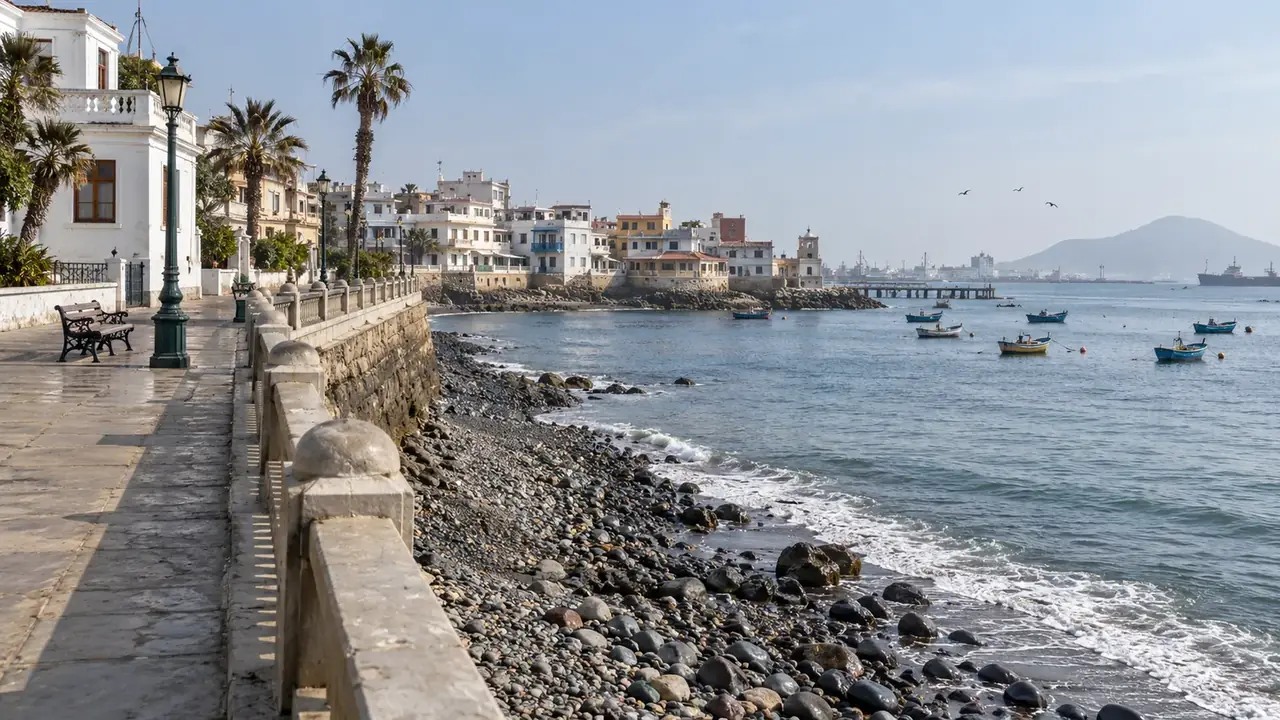
At the tip of the peninsula, La Punta is a former bathing resort that has become a residential neighbourhood. Its promenade runs along a pebbly sea, past republican-era houses and sailing clubs, and looks out to the islands of San Lorenzo and El Frontón. People come to walk, have a fish and seafood lunch and, in the southern summer, swim in water that is cold but calm. The peninsula is low-lying and exposed in the event of a tsunami: look out for the evacuation signs when you arrive, and see what to know about tsunamis.
At sea: the Palomino Islands
Off Callao, the Palomino Islands and the Cavinzas Islands are part of a national reserve managed by SERNANP. About 5,000 South American sea lions live there, along with Humboldt penguins, boobies, pelicans, cormorants and other seabirds. The outing, a morning by boat, must be made with an operator authorised by SERNANP, between 7:00 and 14:30. The reserve’s entry fee, S/ 11, is added to the price of the boat.
The reserve’s rules are precise: a life jacket worn at all times, a minimum distance of 30 m from the edge of the islands, watching limited to 20 minutes, no feeding and no noise to attract the animals. Some operators offer to let you get into the water near the sea lions: ask before booking how the activity respects these rules, and give it up if the sea is rough. The water is cold all year round: ask whether a wetsuit is provided.
Two ways to spend the day
| Version | Morning | Afternoon |
|---|---|---|
| Land | Real Felipe fortress (the museum closes at 16:00) | Callao Monumental, then a walk and a late lunch in La Punta |
| Sea | Boat trip to the Palomino Islands from the quay | Lunch in La Punta, a walk, return |
Getting there
From Miraflores or Barranco, you have to cross the city: a taxi booked through an app is the simplest option, from one point to the next (fortress, Callao Monumental, La Punta). For the boat trip, the operator tells you the boarding point; some offer pick-up from your hotel. Leave before nightfall.
Sources and dates
4 sources
Prices, opening hours and rules change: every piece of information cited links to its source, with the date it was consulted.
Figures and rules cited
- Tuesday to Sunday, from 9:00 to 16:00: Opening hours of the Museo del Ejército, Real Felipe fortress (Real Felipe fortress, Plaza Independencia, Callao) . Prices not published by this source; guides give S/ 10 to S/ 15 depending on the category.
Official source: Ministry of Culture, register of museums: Museo del Ejército Fortaleza Real Felipe (new tab) · consulted on 2 October 2026 - S/ 11: Entry fee for the reserve (Cavinzas islands and Palomino islets), on top of the boat (Palomino islets, off Callao) (General rate, adult) . Visits from 7:00 to 14:30 with an operator authorised by SERNANP; life jacket compulsory; minimum distance of 30 m from the edge of the islands; observation limited to 20 minutes.
Site management: SERNANP, Reserva Nacional SIIPG, islas Cavinzas e islotes Palomino (new tab) · consulted on 2 October 2026
Sources consulted
- PROMPERÚ, Callao: five tourist sites (new tab) (consulted on 2 October 2026)
- Ministry of Culture, register of museums: Museo del Ejército Fortaleza Real Felipe (new tab) (consulted on 2 October 2026)
- SERNANP, Reserva Nacional SIIPG, islas Cavinzas e islotes Palomino (new tab) (consulted on 2 October 2026)
- FDFA, Conseils pour les voyages – Pérou (travel advice, in French) (new tab) (consulted on 1 October 2026)
How we choose and date our information: our method. Has something changed? Let us know.