
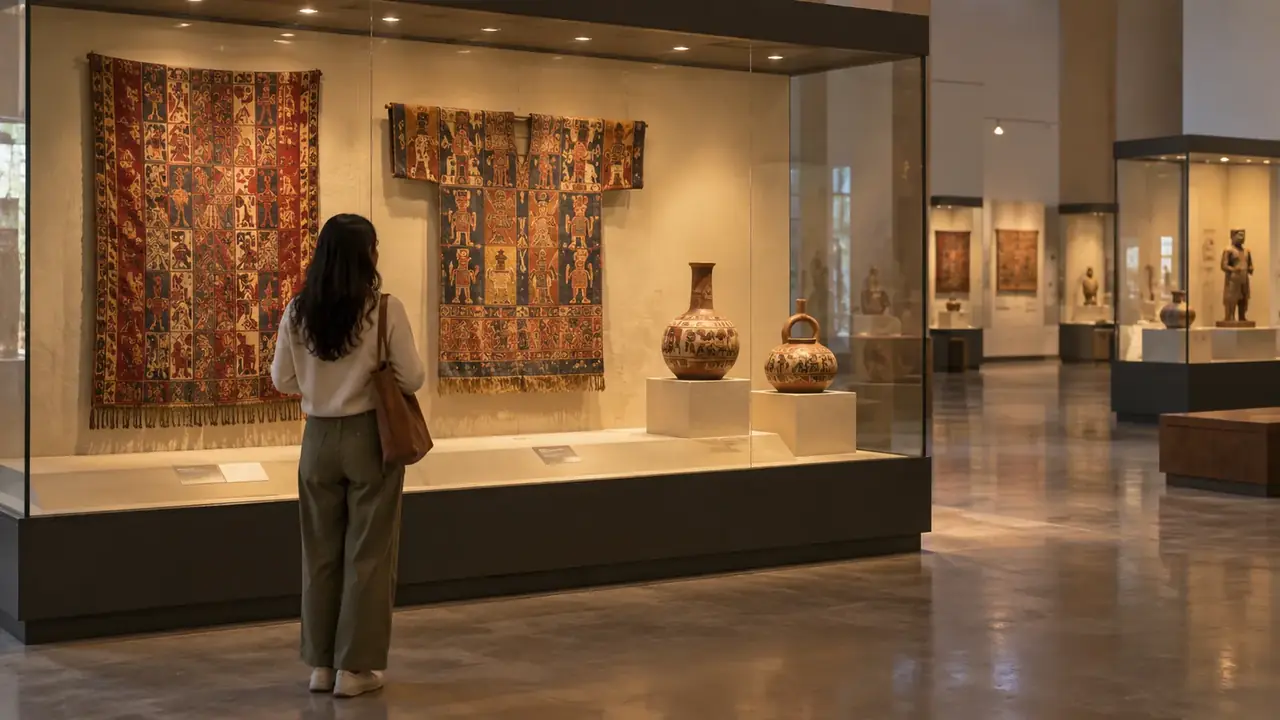
A museum that tells three thousand years of Peruvian art
The Museo de Arte de Lima presents the art produced on Peruvian territory from the pre-Columbian era to the middle of the 20th century, then contemporary art in its exhibitions. Its collection exceeds 21,000 works; the permanent exhibition, rearranged and reopened in September 2015, shows more than 1,200 of them over 4,500 m². The difference between these two figures matters: a work “from the MALI collection” is not necessarily on view on the day of your visit.
The collection was born in 1955, when the Patronato de las Artes began acquiring works; the first acquisition was the most complete existing group of works by the Peruvian painter Carlos Baca-Flor. The permanent galleries opened on 10 March 1961, thanks in particular to the “Memoria Prado” donation, made in the name of the Prado and Peña Prado families.
The building: a world’s fair palace
The museum occupies the Palacio de la Exposición, built in 1870-1871 to plans by the Italian architect Antonio Leonardi for the Lima International Exhibition, inaugurated on 1 July 1872 to mark the fiftieth anniversary of independence. President José Balta had ordered its construction in 1869. The style mixes French-style neoclassicism and neo-Renaissance; inside, great cast-iron columns run through both floors, a structure attributed to the Eiffel workshops.
The building had many lives before the museum: home to a fine arts society, a hospital during the War of the Pacific, barracks for Chilean troops during the occupation of Lima, then an archaeology museum from 1905 and public offices. Looking at the building is part of the visit.
Reading the route in one hour
The exhibition follows chronological order. Rather than seeing everything, keep one question for each major period:
| Period | What you see | The question to ask |
|---|---|---|
| Pre-Columbian | Ceramics, textiles, metalwork from several ancient cultures | How were these objects used: offering, clothing, sign of rank? |
| Viceroyalty (16th-18th centuries) | Religious painting, sculpture, silverware; paintings of the Cusco School | How did Andean artists adapt European models: gilding, local vegetation, costumes? |
| Republic (19th century) | Portraits of the new elite, scenes of everyday life | What does a newly born country want to show? |
| 20th century | Modern movements, including indigenism; the Baca-Flor collection | How do artists look at the Andes and indigenous peoples? |
The viceroyalty refers to the period when Peru was governed by a viceroy in the name of the King of Spain, from the middle of the 16th century to the early 19th century. The Cusco School is a style of religious painting born in that city, recognisable by its backgrounds rich in gilding and the inclusion of Andean elements in European subjects. The Museo Pedro de Osma, in Barranco, lets you explore this period in more depth.
Collections and temporary exhibitions
The ticket includes the permanent collection and the current temporary exhibitions, often devoted to contemporary art, photography or a single artist. Check the programme before you come: if an exhibition particularly interests you, set aside time for it, then choose only two or three periods in the collection.
Practical information
- Opening: Tuesday to Sunday, from 10:00 to 18:00 (17:00 on Saturdays). Also closed on 1 January, 1 May, 21 August, and 24, 25 and 31 December.
- Admission: S/ 40 for a foreign visitor, S/ 15 for a Peruvian or resident with proof; half price for students, teachers and over-65s; free under 8.
- Getting there: Avenida 9 de Diciembre (also known as Paseo Colón), gates 3 and 3A for pedestrians. The Estación Central stop on the Metropolitano is very close.
- Accessibility: wheelchairs, ramps, lifts and adapted toilets.
- On site: coin-operated lockers (S/ 1); photography without flash allowed for personal use, without a tripod or selfie stick.
Combining with the historic centre
The Parque de la Exposición, where the museum stands, is on the southern edge of the historic centre. Plaza San Martín is 1.5 km, about twenty minutes on foot, to the north. A good day combines the museum in the morning, lunch, then a walk around the centre in the afternoon, as suggested on the historic centre page. Avoid following the MALI with another major museum on the same day: tiredness wipes out the second one.
Our suggestion
An hour and a half for the permanent collection, following the chronological order, then the Parque de la Exposición. Plaza San Martín is 1.5 km, about twenty minutes on foot, to the north: go on foot or by a short taxi ride, but not on the same day as another major museum.
What to ask before you go
- The temporary exhibitions on at your date: they change several times a year.
- The guided tours and activities of the day, announced on the website.
Have the opening hours, a dish or a price changed? Let us know and we will correct this page.
Sources and dates
3 sources
Prices, opening hours and rules change: every piece of information cited links to its source, with the date it was consulted.
Figures and rules cited
- Tuesday to Sunday, from 10:00 to 18:00 (17:00 on Saturdays): Opening hours of the MALI (MALI, Parque de la Exposición, avenida 9 de Diciembre 125, Lima) . Closed on Mondays and on some public holidays; access until 15 minutes before closing.
Site management: MALI, visits (new tab) · consulted on 2 October 2026 - S/ 40 per admission: MALI: general admission, non-resident foreigner (Museo de Arte de Lima (MALI), Lima) (Non-resident foreigner)
Price recorded: MALI, visits (new tab) · consulted on 2 October 2026 - S/ 15 per admission: MALI: general admission, Peruvian or resident (Museo de Arte de Lima (MALI), Lima) (Peruvian or resident, with proof) . A resident rate does not apply automatically to a foreign traveller: the lowest amount is not always the one you are entitled to.
Price recorded: MALI, visits (new tab) · consulted on 2 October 2026 - 1.5 km, about twenty minutes: Walking distance and time, MALI–Plaza San Martín (Cercado de Lima)
Press or reseller: Walking route calculated on OpenStreetMap (FOSSGIS routing server, pedestrian profile) (new tab) · consulted on 2 October 2026
Sources consulted
- MALI, visits (opening hours, prices, getting there, services) (new tab) (consulted on 2 October 2026)
- MALI, the collection (new tab) (consulted on 2 October 2026)
- Wikipedia (Spanish), Palacio de la Exposición (new tab) (consulted on 2 October 2026)
How we choose and date our information: our method. Has something changed? Let us know.