
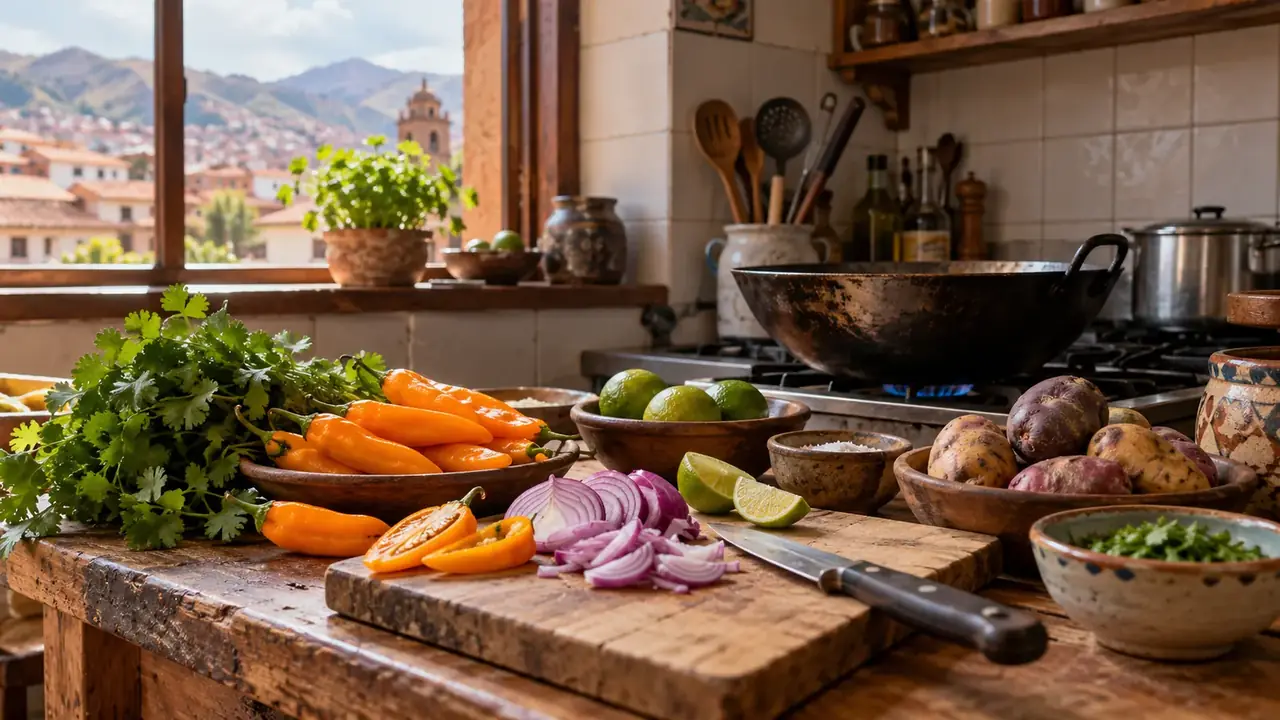
Chillies: four characters
In Peru, “ají” means chilli, and sometimes the chilli sauce put on the table. The four you will come across most often:
| Chilli | Shape and colour | Taste | Fresh, dried, paste | In which dishes |
|---|---|---|---|---|
| Ají amarillo | Long, tapering, orange-yellow | Fruity, moderate heat | Fresh, frozen, as a paste; dried in the sun, it becomes ají mirasol | Ají de gallina, causa, papa a la huancaína, ocopa |
| Ají panca | Dark red, almost brown, wrinkled once dried | Mild, earthy, hardly hot | Mostly dried, as a powder or paste | Anticuchos, adobo, marinades |
| Ají limo | Small, in various colours (yellow, red, green, purple) | Very aromatic, hot | Fresh | Ceviche, tiradito |
| Rocoto | Round like a small apple, red or yellow, black seeds | Very hot, juicy | Fresh, as a paste, as a sauce | Rocoto relleno, table sauces |
According to Wikipedia, ají amarillo is the most widely eaten chilli in the country, a variety of Capsicum baccatum; rocoto is another species, Capsicum pubescens, whose name comes from the Quechua rukutu. Ají limo has been grown in the north since ancient times and is used mainly for ceviche.
The heat of rocoto is concentrated in the seeds and the white membranes: for rocoto relleno, they are removed, and many recipes blanch the chilli to soften it.
In a restaurant, ask for the sauce on the side so you can taste it first, or say what you can handle: “No como picante”. See reading the menu.
Huacatay, a herb, not a chilli
Huacatay (Tagetes minuta), an aromatic herb from the Andes, has a powerful and distinctive scent. According to Wikipedia, it is essential to ocopa (a sauce of mirasol chilli, peanut and cheese served over potatoes), to the huacatay cream put on the table, to pachamanca and to the marinade for pollo a la brasa. At the market, it is sold in fresh bunches; abroad, it is more often found as a paste, in a jar.
The other herbs to recognise: culantro (coriander, everywhere, notably in seco and arroz con pato), muña (an Andean mint, as an infusion), chincho, another pachamanca herb.
Potatoes, chuño and papa seca
Peru grows a very large number of potato varieties. Three names come up on menus:
- Papa amarilla (Solanum phureja): yellow, floury and creamy once mashed; it is the potato of causa and of purées.
- Papa blanca: the ordinary potato, which holds its shape when cooked; chips and lomo saltado.
- Papas nativas: Andean varieties of every shape and colour, served boiled with a sauce.
Two preserved potatoes:
- Chuño: a potato dried by the night frost and the sun of the high plateaus, a technique that lets it keep for months, even years, according to Wikipedia. Black (chuño) or white (tunta), it is found in Andean soups such as chairo.
- Papa seca: potato that has been cooked, dried and crushed, the base of carapulcra. Replacing it with fresh potato gives a different dish.
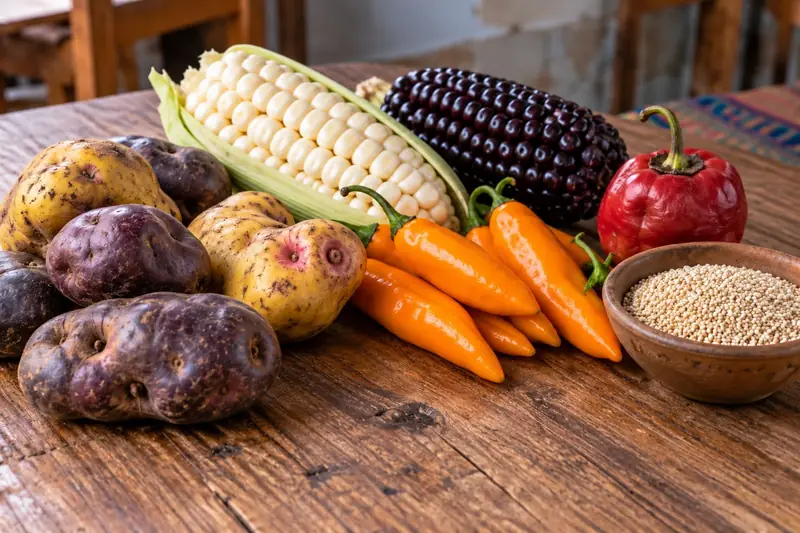
Corn, in all its forms
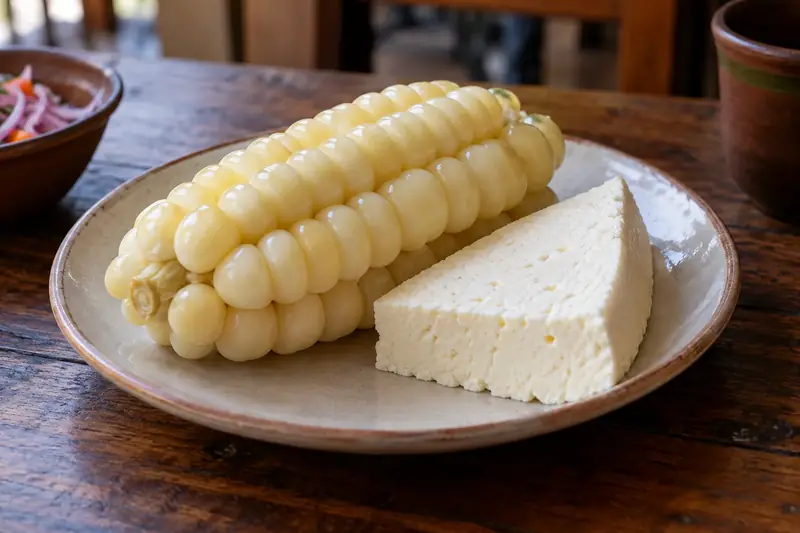
- Choclo: the tender ear of corn, with large white kernels, served on the cob with cheese (choclo con queso) or as kernels in ceviche.
- Cancha: corn kernels toasted dry, crunchy and salty, served as a nibble with ceviche.
- Mote: corn kernels dried and then boiled, in soups and chanfainita.
- Purple corn (maíz morado): the base of chicha morada and mazamorra morada.
- Jora: sprouted corn, dried and ground, for chicha de jora.
Quinoa and pulses
- Quinoa and kiwicha (amaranth): Andean seeds, in soup, in salad, as a drink.
- Tarwi or chocho (Lupinus mutabilis): an Andean lupin very rich in protein. Its raw seeds contain bitter, toxic alkaloids: they must be debittered before being eaten. Taste it prepared (in a salad or as a “ceviche de chocho”) rather than buying dried seeds to treat yourself.
- Pallar (lima bean): a large, flat white bean.
- Zarandaja (Lablab purpureus): a bean from the north coast, served with ceviche or cabrito. Its pods contain compounds that require careful cooking.
- Frejol canario: a pale yellow bean, the one used in tacu tacu and seco.
Fruit: the part you eat
| Fruit | How to recognise it | What you eat | How |
|---|---|---|---|
| Granadilla | Orange, hard smooth shell | The grey jelly-like pulp and its black seeds | Crack the shell, scoop out with a spoon, seeds and all |
| Lúcuma | Green skin, orange-yellow flesh | The flesh, dry and floury, with a distinctive taste | Mainly in ice cream, desserts, as dried flour |
| Chirimoya | Green scaly skin, white flesh | The creamy, sweet flesh | With a spoon, ripe and soft to the touch; do not bite into the black seeds, which are toxic if crushed |
| Aguaymanto | Small orange berry in a papery husk | The berry, tart | Remove the husk; raw, as jam |
| Cocona | Orange-yellow Amazonian fruit | The tart pulp | As juice, as jam, sometimes raw |
| Camu camu | Small red berry from the Amazon | The pulp, very sour | As a sweetened juice |
| Pacay | Large green pod | The cottony, sweet white pulp around the seeds | Open the pod, suck the pulp, spit out the seeds |
| Maracuyá | Yellow passion fruit | The pulp and its seeds | As juice, in a cocktail, in a dessert |
Ripe or not? Ask “¿Está maduro para hoy?” (is it ripe for today?) or “¿Para comer cuándo?” (to eat when?). A chirimoya or a lúcuma that is not ripe does not get any better if you open it early.
To start without worry, choose fruit that you peel yourself after washing it in drinking water: granadilla, mandarin, banana, chirimoya. Do not buy three kilos of an unknown fruit: a first try is enough.
A few words to recognise
| Word | Meaning |
|---|---|
| Palta | Avocado |
| Camote | Sweet potato (fried, with ceviche or chicharrón) |
| Yuca | Cassava |
| Sillao | Soy sauce, inherited from Chinese cooking |
| Culantro | Coriander |
| Chancaca | Unrefined cane sugar, in blocks |
| Menestra | Pulse or dish of pulses |
| Aderezo | Base of onion, garlic and chilli fried together |
| Leche de tigre | Ceviche’s marinade juice |
Finding them at home, and what a substitution changes
Outside Peru, these ingredients are found mainly as pastes, in jars or dried (ají amarillo, ají panca, rocoto or huacatay pastes, purple corn, papa seca, chuño), in Latin American grocery shops or online. Read the list of ingredients: some pastes contain oil, salt or preservatives, and their intensity varies from one brand to another. Add them gradually and taste.
If you cannot find the ingredient, a substitution gives an adaptation, to be presented as such:
| Ingredient | Possible substitution | What changes |
|---|---|---|
| Ají amarillo paste | Roasted yellow pepper and a little fresh chilli | The colour stays, the typical fruity scent disappears |
| Rocoto | Small peppers (mild version) or hot chilli | No equivalent: the juicy flesh and the heat of rocoto do not come together anywhere else |
| Huacatay | Mixture of mint and coriander | The sauce changes taste: it is no longer an ocopa |
| Papa amarilla | Floury potato (such as Bintje) | Causa less yellow, less creamy |
| Choclo | Sweetcorn on the cob | Sweeter, smaller kernels, less floury texture |
| Ají limo | Fruity fresh chilli | Ceviche loses its lemony scent |
Several of our recipes specify their adaptations.
Sources and dates
9 sources
Prices, opening hours and rules change: every piece of information cited links to its source, with the date it was consulted.
Sources consulted
- Wikipedia (Spanish), Capsicum baccatum var. pendulum (ají amarillo, ají mirasol) (new tab) (consulted on 3 October 2026)
- Wikipedia (Spanish), Ají panca, Ají limo, Capsicum pubescens (rocoto) (new tab) (consulted on 3 October 2026)
- Wikipedia (Spanish), Tagetes minuta (huacatay) (new tab) (consulted on 3 October 2026)
- Wikipedia (Spanish), Solanum phureja (papa amarilla) and Chuño (new tab) (consulted on 3 October 2026)
- Wikipedia (Spanish), Lupinus mutabilis (tarwi) and Lablab purpureus (zarandaja) (new tab) (consulted on 3 October 2026)
- Wikipedia (Spanish), Lucuma bifera, Passiflora ligularis, Physalis peruviana, Inga feuilleei, Myrciaria dubia (new tab) (consulted on 3 October 2026)
- Wikipedia (English), Cherimoya (inedible seeds) (new tab) (consulted on 3 October 2026)
- Marca Perú (PROMPERÚ), the cuisine of Arequipa (ocopa, rocoto relleno) (new tab) (consulted on 3 October 2026)
- PROMPERÚ, Lima’s cuisine (new tab) (consulted on 3 October 2026)
How we choose and date our information: our method. Has something changed? Let us know.