In short
For three nights, choose a lodge on the lower Tambopata or the Madre de Dios, with an outing to Lake Sandoval. For four to five nights, aim for the middle or upper Tambopata, further away by boat, for the isolated lakes and the macaw collpas. Manu is another trip: six days or more, by road from Cusco and then by boat. In every case, entry to the reserve is made with an authorised operator.
Four environments not to confuse
| Environment | What it is | What you see there |
|---|---|---|
| The lake (cocha) | An old, cut-off river meander with calm water, such as Sandoval or Cocococha | Giant otters, black caimans, waterbirds, fish; you explore it by boat, in silence |
| The collpa | A clay bank or cliff where birds and mammals come to eat soil rich in mineral salts | Macaws and parrots early in the morning, sometimes tapirs at night at the mammal collpas |
| The dry-land forest | A forest that is never flooded, with very tall trees (including the Brazil nut tree, the castaña) | Monkeys, birds, insects; you explore it on foot, on trails |
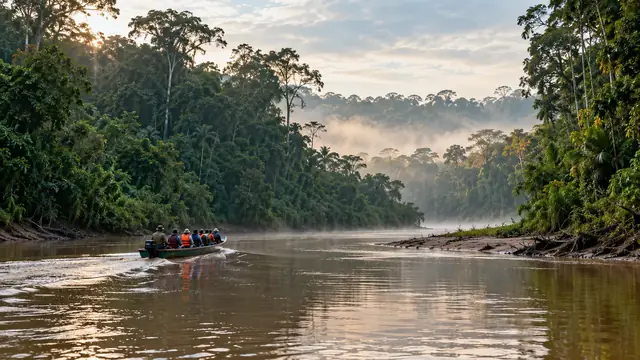
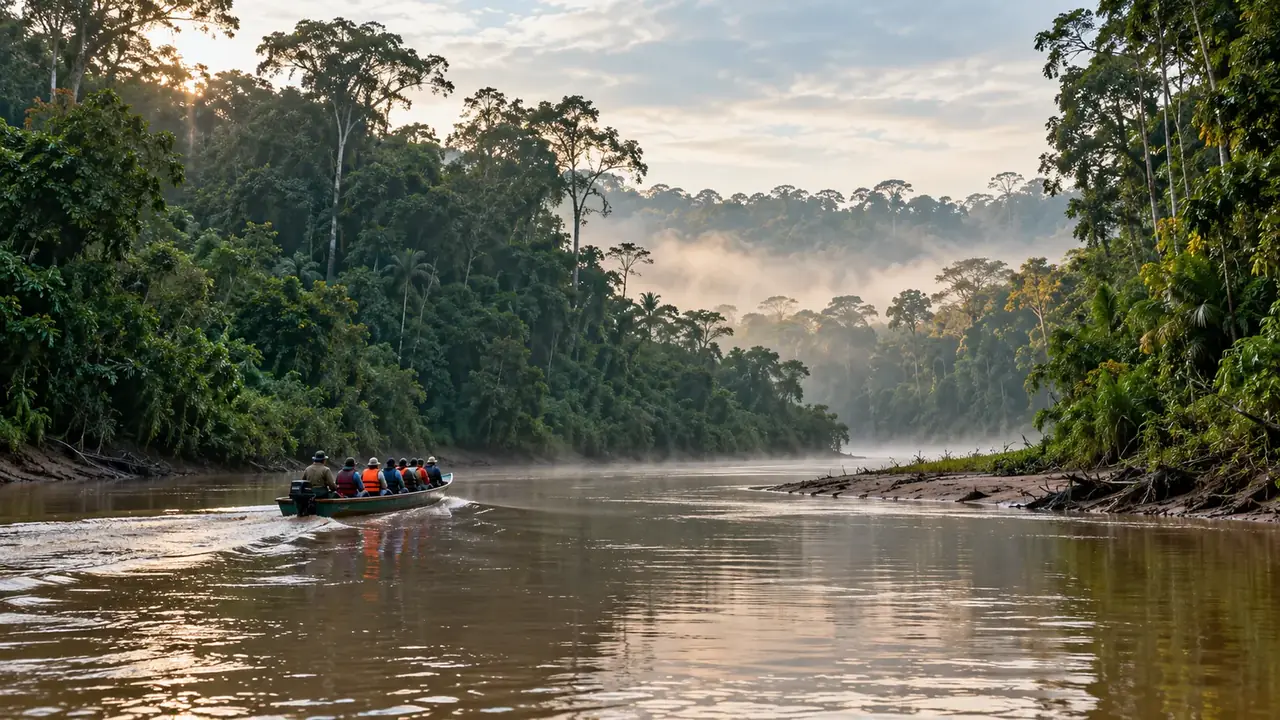
| The river | The Madre de Dios and the Tambopata, transport routes and environments in their own right | Riverbank birds, capybaras, sometimes caimans |
A good stay combines several of these environments. Be wary of programmes that promise everything in two days.
Puerto Maldonado
Puerto Maldonado, at an altitude of about 180 metres, was founded in 1902 at the confluence of the Tambopata and the Madre de Dios. The name of the rubber baron Carlos Fitzcarrald remains attached to the region, which he had linked to the Ucayali basin via the isthmus that bears his name; his death, in July 1897, in the wreck of the steamer Adolfito, is told in differing ways, and the accounts studied by the historian Lorena Córdoba place it in the Ucayali–Urubamba system, not at the confluence of Puerto Maldonado. Today it is a town of timber, Brazil nuts, boatbuilding, ecotourism and gold panning. You get there by plane from Lima or Cusco, or by the Interoceanic Highway, which links the Pacific coast with Brazil.
The town itself has little to visit: it is the embarkation point. The town and the lodge are two different things: compare the transfer times, the location and the activities that are really possible. Ask for the latest pick-up time at the airport on the first day, and the departure time from the lodge on the last, so as not to miss the plane.
The context. Illegal gold mining, which employs tens of thousands of people in the region, destroys rivers and forests. The FDFA reports a very tense situation in the south of the province of Tambopata, linked to illegal mining, and recommends travelling with guides who know the region well. The tourist lodges are in other sectors, but find out about the recent situation before you leave.
Tambopata and Lake Sandoval
The Tambopata National Reserve protects a vast area of forests, lakes and rivers, with about 600 species of birds and 169 of mammals according to SERNANP. A lodge that bears the name “Tambopata” is not necessarily in the reserve: ask which sector it is in, and whether entry to the reserve is included.
| Sector | Access from Puerto Maldonado | What people come for | Recommended nights |
|---|---|---|---|
| Lake Sandoval | 30 minutes by boat, then 3 km on foot | The most visited lake, with otters, caimans and an observation tower; possible as a day outing | Three, in a lodge on the lower Tambopata or the Madre de Dios |
| Middle Tambopata | About 3 hours by boat | More isolated lakes (Cocococha, Sachavacayoc, Condenado), less visited forest | Four |
| Upper Tambopata | About 5 hr 30 min by boat | The great macaw collpas, Chuncho and Colorado | Five |
The entry fee and opening hours: S/ 30 for one day, S/ 60 for two to three days, S/ 150 for four to thirty days (general rate); every day from 5:00 to 19:00; Lake Sandoval 30 minutes by boat then 3 km on foot; middle Tambopata (Cocococha, Sachavacayoc and Condenado lakes) about 3 hours by boat; upper Tambopata (Chuncho and Colorado clay licks) about 5 hr 30 min by boat.
Lake Sandoval, about 16 km from the town, is one of the largest oxbow lakes in south-eastern Peru, covering some 125 hectares. You get there on foot through the forest, then travel by boat or canoe; the giant otters and black caimans are its stars. The paiche, a large Amazonian fish that lives there today, escaped from a nearby fish farm during a flood in 1979. It is a good outing for a first stay; it can be very busy in the high season.
Choose an operator that respects the wildlife and refuses forced contact. A responsible programme explains that the animals are free; be wary of promises of interaction or a list of guaranteed species.
Manu
Manu National Park, listed by UNESCO, covers 1.7 million hectares, from the Andean grasslands above Cusco down to the lowland forests: it is this gradient that makes it one of the richest parks in the world, with more than 1,000 bird species. It is not a quick equivalent of Sandoval.
Very different zones. The park is divided into zones: most of it, reserved for protection and research, is home to intact forests and Indigenous peoples, some of whom live in voluntary isolation; tourism takes place in the zones set aside for it, with an authorised operator. Peoples in isolation are never an attraction: do not look for them, and do not pay to “see” them.
The journey. Andean sector via Paucartambo to Acjanaco (143 km, about 4 hours from Cusco); río Manu sector: Cusco–Atalaya in about 8 hours by road, then about 7 hours by boat to Limonal (a six-day visit is advised); an authorised operator is compulsory. In practice, you go down by vehicle from Cusco through the cloud forest, where you see the cock-of-the-rock, then continue by boat. It is a week-long expedition, with several nights in lodges or camps, a lot of travelling, and a diversity of landscapes that no other stay offers. Ask for the exact itinerary, the road and boat times, where you will spend the nights and the zone visited.
Three, four or five nights, including transfers
| Three nights | Four nights | Five nights | |
|---|---|---|---|
| Sector | Lower Tambopata or Madre de Dios | Middle Tambopata | Upper Tambopata |
| Outward transfer | Flight, then 30 minutes to 1 hour by boat | Flight, then about 3 hours by boat | Flight, then about 5 hr 30 min by boat |
| Full days | Two | Two to three | Three |
| Highlights | Lake Sandoval, a night outing, dry-land forest | Isolated lakes, a small collpa | The great macaw collpas, very well-preserved forest |
| Who it suits | A first stay, families | Wildlife watchers | Bird enthusiasts |
Activities, comfort, guide: what to ask
- The outings: how many per day, at what time (dawn and night are the best times), on foot or by boat, with how many travellers per guide.
- The guide: do they speak your language, are they trained in wildlife, how many travellers do they accompany?
- Comfort: a room open to the forest or closed, a mosquito net, hot water, electricity (possible hours), meals.
- The limits: the forest is dense, the animals discreet; you hear much more than you see. A good guide says so.
Choosing an authorised operator
SERNANP requires Tambopata, like Manu, to be visited with an authorised operator. Before booking, check:
- that the operator is among those authorised by SERNANP for the sector advertised;
- that the price specifies what is included: flights or not, transfers, reserve entry, meals, outings, guide;
- the cancellation conditions in case of a cancelled flight or an impassable river;
- the evacuation plan in case of a medical emergency, far from any hospital.
According to the CDC, yellow fever vaccination is recommended for Madre de Dios, and malaria is present east of the Andes below 2,500 metres: see a travel medicine centre. See Health.
Frequently asked questions
Tambopata or Manu?
Tambopata for a stay of three to five nights, reached by plane to Puerto Maldonado and then by boat. Manu for a week-long expedition, by road from Cusco through the cloud forest, then long hours by boat: a greater diversity of environments, much more travelling.
Will you see macaws at a collpa?
Often, but not always: whether they are there depends on the time (early in the morning), the season and the weather. The great collpas of the upper Tambopata require a long journey and a night nearby.
Is Lake Sandoval accessible to everyone?
You get there by 30 minutes by boat then 3 km on foot, partly on a boardwalk according to SERNANP, before getting into a boat on the lake. Ask the operator what is suitable for reduced mobility, for the whole chain of travel.
Sources and dates
8 sources
Prices, opening hours and rules change: every piece of information cited links to its source, with the date it was consulted.
Figures and rules cited
- S/ 30 for one day, S/ 60 for two to three days, S/ 150 for four to thirty days (general rate); every day from 5:00 to 19:00; Lake Sandoval 30 minutes by boat then 3 km on foot; middle Tambopata (Cocococha, Sachavacayoc and Condenado lakes) about 3 hours by boat; upper Tambopata (Chuncho and Colorado clay licks) about 5 hr 30 min by boat: Tambopata National Reserve: entry, opening hours, sectors and access (Tambopata National Reserve, Madre de Dios) . Visits only with an authorised operator. Peruvian adults: S/ 15 for one day.
Site management: SERNANP, Reserva Nacional Tambopata (new tab) · consulted on 2 October 2026 - Andean sector via Paucartambo to Acjanaco (143 km, about 4 hours from Cusco); río Manu sector: Cusco–Atalaya in about 8 hours by road, then about 7 hours by boat to Limonal (a six-day visit is advised); an authorised operator is compulsory: Manu National Park: sectors, access and rules (Manu National Park, Cusco and Madre de Dios) . Entry from S/ 30 (one day) to S/ 150 (four to thirty days); free on 24 June, 17 October and the last Sunday of the month. More than 1,000 bird species and 1.7 million hectares.
Site management: SERNANP, Parque Nacional del Manu (new tab) · consulted on 2 October 2026
Sources consulted
- Lorena Córdoba, “La tragedia del Adolfito, o de cómo un naufragio cambió la historia amazónica”, in La velocidad en los mundos lentos, Edizioni Ca’ Foscari, 2025 (pp. 15–30) (new tab) (consulted on 5 October 2026)
- SERNANP, Reserva Nacional Tambopata (prices, sectors, access) (new tab) (consulted on 2 October 2026)
- SERNANP, Parque Nacional del Manu (sectors, access, rules) (new tab) (consulted on 2 October 2026)
- Wikipedia (English), Puerto Maldonado, Lake Sandoval, Manu National Park, Clay lick (new tab) (consulted on 2 October 2026)
- CDC Yellow Book, Peru (yellow fever, malaria) (new tab) (consulted on 2 October 2026)
- FDFA, Conseils pour les voyages – Pérou (travel advice, in French: Madre de Dios) (new tab) (consulted on 1 October 2026)
- PROMPERÚ, Madre de Dios (new tab) (consulted on 25 September 2026)
- PROMPERÚ, Manu National Park (new tab) (consulted on 25 September 2026)
How we choose and date our information: our method. Has something changed? Let us know.