
In short
Ask before photographing a person, and accept a refusal. For a community visit, ask who organises it, who receives the money and who decides on the programme. Do not feed or touch any wild animal, and do not pay for a photo with a sloth or a monkey. Do not buy feathers, skins or antique objects. On a trek, ask how the porters are equipped, insured and loaded: the law limits their load to 20 kg.
Taking photos: three situations
The rule fits in one sentence, which the FDFA also points out: you ask before photographing a person, and a refusal is respected without insisting. It plays out differently depending on the place.
| Situation | What helps | What gets in the way |
|---|---|---|
| At the market | Buy something first, exchange a few words, then ask “¿Puedo tomar una foto?”; photograph the stalls rather than the faces | Aiming a telephoto lens at every stallholder, blocking a narrow passage, photographing someone who is eating or counting their money |
| In a workshop | Ask the craftsperson what they are willing to show; some stages or some patterns are their know-how | Filming the whole technique to post it online; assuming that a purchase gives you the right to film everything |
| In someone’s home | Ask the family what can be photographed, and post nothing in which children can be recognised without their agreement | Photographing the inside of the house, the kitchen or the bedrooms as if they were scenery |
Posed photos. In Cusco, people in costume, often with a llama or a lamb, offer to pose for a small sum. This is work, not a spontaneous scene: agree on the amount beforehand, and pay what was agreed.
During a festival. A religious or community celebration exists first and foremost for those who take part in it. Do not block a passage or a procession to take a shot again, do not use a flash in a church, and ask before photographing a person close up. Being with a guide does not amount to general permission to film. See festivals and calendar.
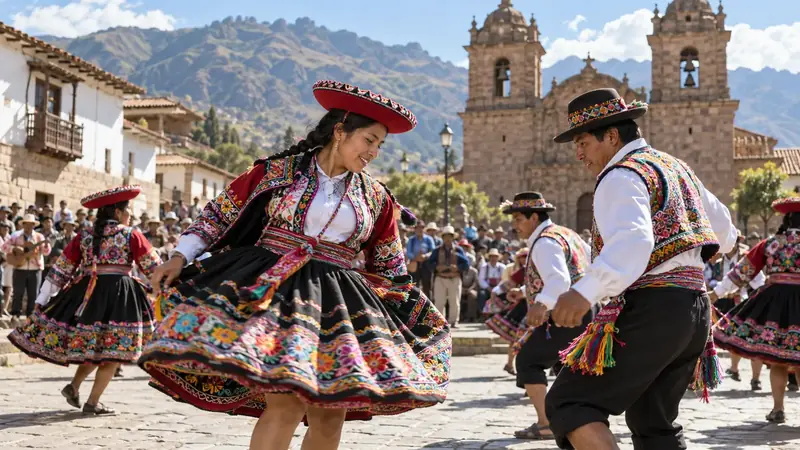
Community visits: who organises, who receives the money?
A “homestay” visit may be organised by the community itself, by an agency that pays a family, or by an intermediary who keeps most of the money. All three exist; the difference cannot be seen in a brochure. Before booking, ask:
- Who organises the visit, and how long has it existed?
- Who receives the money, and what share goes to the family or the community?
- Who decides on the programme: does the community choose what it shows, the times, the number of visitors?
- What can be photographed, and what is expected of you (a shared meal, taking part in a task, a gift).
Two examples on Lake Titicaca. UNESCO inscribed the textile art of Taquile on the list of intangible cultural heritage in 2008; it notes that the island’s economy relies on textiles and tourism, and that demand has changed the materials and methods. The residents built a model of tourism controlled by the community (accommodation, meals, guides), after losing control of the day trips organised from the mainland. On Amantaní, there are no hotels: families host travellers for the night, generally through guides and agencies. It is customary to bring staple products (rice, oil, fruit) or school supplies rather than sweets.
An example in the Amazon. The Shipibo-Konibo, 34,152 people according to the 2017 census, live mainly along the Ucayali, and also in Lima, in the Cantagallo neighbourhood. Their geometric patterns, the kené, drawn by women, have been recognised as cultural heritage of the Nation since 2008. A piece bought from the person who embroidered or painted it does not tell the same story as a printed copy.
Peoples in isolation. Some Amazonian peoples, such as the Mashco-Piro near Manu National Park, avoid all contact. The Peruvian state prohibits approaching them, notably because an illness that is minor for a visitor can be fatal to them. No serious excursion offers to “meet” them; if anyone suggests it to you, refuse.
Wildlife: watching, without feeding or touching
| Place | The rule |
|---|---|
| Ballestas Islands (Paracas) | They are seen from the boat, without landing, with an operator authorised by SERNANP |
| Palomino Islands (Callao) | An outing with an authorised operator, entry fee of S/ 11 on top of the boat; SERNANP requires boats to stay 30 metres from the edge of the islands and limits watching to 20 minutes |
| El Ñuro pier (north coast) | Green turtles come close to the fishing boats: you do not touch them and do not feed them, even if others do |
| Humpback whales (Máncora, Los Órganos) | A good operator keeps its distance and cuts the engine near the animals; no sighting is guaranteed |
| The Amazon (Iquitos, Puerto Maldonado) | A sloth, a monkey or a parrot offered for a photo has been captured: do not pay, walk away |
SERFOR, Peru’s wildlife authority, points out that contact with a wild animal outside its habitat causes severe stress, injuries, sometimes death, and transmits diseases in both directions. A place that offers you the chance to hold the animals in your arms is not a sanctuary.
To report an animal that is captured, sold or put on display: the Alerta SERFOR platform (appweb.serfor.gob.pe/alertaserfor) or WhatsApp on 947 588 269.
Crafts: the material, the origin, the maker
Three questions are enough in front of an object: what is it made of, where does it come from, who made it? A seller who knows the answers generally sells pieces they know.
- Vicuña. This wild animal of the high plateaus almost disappeared in the 1960s. All of Peru’s populations are now listed in Appendix II of CITES; the wool comes from the chaccus, community round-ups in which the vicuñas are sheared and then released. A vicuña scarf is very expensive: a low price signals a different fibre. For Switzerland, the FSVO exempts only a short list of protected souvenirs from a permit, and vicuña is not on it: find out before you buy.
- Alpaca and llama are domestic animals; their wool is sold freely. Before buying, see alpaca or not: the composition before the price. Ask for the exact composition: an “alpaca” label can mean a blend with other fibres.
- Chulucanas ceramics, near Piura, have been protected by a designation of origin since 2006, the third in Peru: black tones obtained by smoking, negative decoration, shaping with a paddle. Most of the workshops are in La Encantada.
- Taquile textiles: on the island, the men knit the hats (chullos), and the women weave the wide belts (chumpis) whose patterns follow the farming calendar.
What not to buy. Feathers, skins, teeth, claws and shells of wild animals: SERFOR seizes them as trafficked goods, and the Criminal Code punishes this trafficking with three to five years in prison. Antique objects (ceramics, textiles, pieces “found in a field”): Law 28296 prohibits taking any item of cultural heritage out of the country, and their permanent export is prohibited without exception. A copy sold as such is not a problem; an “authentic piece” offered to a traveller always is.
Water, waste, fragility: what changes by region
| Region | What is fragile | What you can do |
|---|---|---|
| Desert coast (Lima, Ica, Nazca) | Water: the coast is a desert. In Huacachina, the lagoon fed by the water table has fallen with agricultural pumping; it has been topped up by pumping since 2015 | Short showers, towels and sheets reused at the hotel |
| High Andes (Cusco, Huaraz, Puno) | The glaciers are retreating: Pastoruri has lost 22% of its surface area in 30 to 35 years; high-altitude wetlands are quickly trampled | Stay on the paths, do not cut across the bends, carry all your waste out of a trek |
| The Amazon (Tambopata, Iquitos) | Waste ends up in the rivers; batteries and plastics cannot be processed locally | Take batteries and packaging back to a big city, or to Europe for batteries |
| Sites and protected areas | Worn paths, waste, graffiti | Law 30884 prohibits plastic bags, straws and polystyrene trays in protected natural areas, World Heritage sites, museums and on beaches along the coast and in the Amazon |
The CDC recommends that travellers avoid tap water: a filter bottle saves you buying several bottles a day. See health.
Porters and guides: the quality of a trek starts there
On the Inca Trail and the big treks, porters carry the tents, the kitchen and the food. Since 2022, Law 31614 has set their conditions: up to 20 kg for a man and 15 kg for a woman, under the supervision of the labour inspectorate. It prohibits employing porters under 18 and makes the employer responsible for food, clothing, protective equipment, shelter for sleeping and insurance.
On the Inca Trail, the number of places also includes the teams: about 500 people, including porters, cooks and guides, of whom about 200 are hikers. That is about three team members for every two hikers.
Before booking, ask the agency:
- how many porters accompany the group, and how much the bag you give them weighs;
- where the porters sleep and eat, and with what equipment;
- whether they are employed and insured, as the law requires;
- how the tip is shared out, if you leave one.
An offer that is clearly cheaper than the others often saves on these points. See Machu Picchu and Huaraz.
Resources rather than slogans
“Responsible tourism” means nothing as long as you do not know who does what. A few sources for checking:
- SERNANP publishes, for each protected area, the visiting rules and the authorised operators;
- the database of Indigenous peoples of the Ministry of Culture (BDPI) presents each people, their language and their territory;
- UNESCO’s intangible heritage list describes the inscribed know-how, such as Taquile textiles;
- Alerta SERFOR receives reports of animal trafficking;
- the FSVO indicates which souvenirs of animal or plant origin can enter Switzerland.
The pages meeting people and markets describe possible visits and workshops.
Frequently asked questions
Do you have to pay to photograph someone?
Not as a general rule: you ask, and a refusal is respected. In Cusco, people in costume, sometimes with a llama or a lamb, pose for photos for a small sum: it is their work, so agree on the amount before taking the photo.
Can you take a vicuña wool garment back to Switzerland?
The vicuña is protected by CITES. The wool sold comes from shearing live animals, which are then released. The FSVO exempts only a short list of souvenirs from a permit, and vicuña is not on it: ask for proof of origin and check with the FSVO before an expensive purchase.
How much should you give the porters on a trek?
The tip is at your discretion. Preferably give it to each porter, or check with the guide how it will be shared out. The most important part is decided beforehand: choosing an agency that respects the maximum load, the equipment and the insurance the law requires.
Sources and dates
9 sources
Prices, opening hours and rules change: every piece of information cited links to its source, with the date it was consulted.
Figures and rules cited
- S/ 11: Entry fee for the reserve (Cavinzas islands and Palomino islets), on top of the boat (Palomino islets, off Callao) (General rate, adult) . Visits from 7:00 to 14:30 with an operator authorised by SERNANP; life jacket compulsory; minimum distance of 30 m from the edge of the islands; observation limited to 20 minutes.
Site management: SERNANP, Reserva Nacional SIIPG, islas Cavinzas e islotes Palomino (new tab) · consulted on 2 October 2026 - the Alerta SERFOR platform (appweb.serfor.gob.pe/alertaserfor) or WhatsApp on 947 588 269: Reporting a wild animal that is captured, sold or put on show (Peru) . The Criminal Code provides for 3 to 5 years in prison for wildlife trafficking, according to the same article.
Press or reseller: Infobae, SERFOR warning about wildlife during carnivals (8 February 2026) (new tab) , published on 8 February 2026 · consulted on 2 October 2026 - up to 20 kg for a man and 15 kg for a woman, under the supervision of the labour inspectorate: Maximum load for a porter on a tourist expedition in Peru (Peru (Inca Trail, treks, expeditions)) . Law 31614 repeals law 27607. It forbids employing porters under 18 and makes the employer responsible for meals, clothing, protective equipment, gear for sleeping under shelter, accident insurance and life insurance, with five days of rest before another trip.
Official source: Congress of Peru, law 31614, new law on porters (consolidated text) (new tab) , published on 11 November 2022 · consulted on 2 October 2026 - about 500 people, including porters, cooks and guides, of whom about 200 are hikers: Number of people allowed on the classic Inca Trail each day (Machu Picchu Inca trail network) . Figure given by the agencies; it may change from one year to the next.
Old source: Wikipedia (English), Inca Trail to Machu Picchu (Permits section) (new tab) · consulted on 2 October 2026
Sources consulted
- FDFA, Conseils pour les voyages – Pérou, particularités culturelles (travel advice, in French: cultural particularities; valid on 2 October 2026) (new tab) (consulted on 2 October 2026)
- UNESCO, Taquile and its textile art (intangible cultural heritage, inscribed in 2008) (new tab) (consulted on 2 October 2026)
- Ministry of Culture, database of Indigenous peoples (BDPI): Shipibo-Konibo (new tab) (consulted on 2 October 2026)
- SERNANP, SIIPG National Reserve, Cavinzas Islands and Palomino Islets (observation rules) (new tab) (consulted on 2 October 2026)
- Congress of Peru, Law 31614 on porter workers (2022) (new tab) (consulted on 2 October 2026)
- El Peruano, Law 30884 on single-use plastic (19 December 2018) (new tab) (consulted on 2 October 2026)
- Law 28296, general law on the Nation’s cultural heritage (articles 33 and 34), copy published by SENACE (new tab) (consulted on 2 October 2026)
- FSVO, souvenirs and CITES (what can enter Switzerland without a permit; page in French) (new tab) (consulted on 2 October 2026)
- Wikipedia, Taquile, Amantaní, Vicuña, Chulucanas ceramics (Spanish), Huacachina, Pastoruri Glacier, Mashco-Piro (new tab) (consulted on 2 October 2026)
How we choose and date our information: our method. Has something changed? Let us know.