
In short
Start with a museum (the Museo Larco in Lima gives the overview), then choose a region: the north coast for the Moche, Lambayeque and Chimú; Lima and its surroundings for Caral, the Lima culture and Pachacámac; the Andes for Chavín, the Chachapoyas and the Incas. The cultures do not follow one another in single file: Nasca, Lima and Moche were contemporaries. On site, distinguish what is proven from what is interpreted, and from what belongs to legend.
A timeline, with its overlaps
The dates are approximate and vary according to the authors; they serve to place the cultures in relation to one another.
| Culture | Period | Region | What you see of it | Where to see it |
|---|---|---|---|---|
| Caral-Supe | Around 3000 to 1800 BC | North-central coast, Supe valley | Platform pyramids, sunken circular plazas | Caral, World Heritage in 2009 |
| Chavín | Around 1200 to 250 BC | Andes, Áncash | Temple with underground galleries, the Lanzón monolith, tenon heads | Chavín de Huántar and its national museum (1985) |
| Paracas | Around 800 to 100 BC | South coast, Ica | Large embroidered funerary textiles | Lima museums and the Ica regional museum |
| Nasca | Around 100 BC to 800 AD | South coast | Geoglyphs, polychrome pottery | Nazca and Palpa Lines (1994) |
| Lima | Around 100 to 650 | Central coast, Rímac and Lurín valleys | Pyramids of small adobe bricks | Huaca Pucllana, site and museum |
| Moche | Around 100 to 800 | North coast | Adobe huacas with painted reliefs, portrait pottery, royal tombs | Huacas del Sol y de la Luna, El Brujo and the Cao museum, Huaca Rajada and Tumbas Reales |
| Wari | Around 500 to 1000 | South-central Andes, from Ayacucho | Administrative centres, textiles, influence on Pachacámac | Few sites on the usual itineraries; Museo Larco collections |
| Lambayeque (Sicán) | Around 750 to 1375 | North coast | Adobe pyramids of Túcume, metalwork | Sicán, Túcume, Brüning |
| Chimú | Around 900 to 1470 | North coast, capital Chan Chan | Adobe city with walls carved with friezes | Chan Chan (1986, in danger) |
| Chachapoyas | Kuélap built mainly between 900 and 1100; Inca conquest in the 15th century | Cloud forests of Amazonas | Walled fortress, sarcophagi, mausoleums | Kuélap, Karajía, Revash, Leymebamba |
| Ichma | Around 1100 to 1470 | Lurín and Rímac valleys | Pyramids with ramps | Pachacámac, site and museum |
| Inca | 15th century to 1532 | From the Andes to the coast, from Ecuador to Chile | Fitted stone, terraces, roads, water management | Cusco and Machu Picchu (1983), Qhapaq Ñan (2014), Tipón |
Three overlaps change the reading: the Nasca, Lima and Moche lived in the same centuries, each in its own region; the Lambayeque and the Chimú shared the north coast for five centuries; and Pachacámac was a sanctuary under the Lima, the Wari, the Ichma and then the Incas. The Incas, for their part, ruled most of the country for only about a century.
Eight techniques to recognise
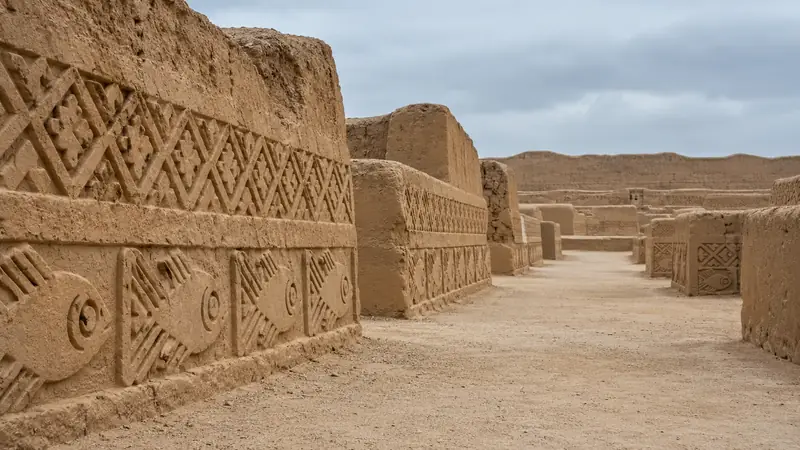
- Adobe, a brick of raw earth dried in the sun, the main building material on the coast. The Moche painted reliefs on it; the Chimú carved the walls of Chan Chan with friezes of fish and birds. Because it melts in the rain, Chan Chan has been on the List of World Heritage in Danger since 1986.
- The “librero” technique at Huaca Pucllana: small bricks set upright, side by side, like books on a shelf, in trapezoidal panels.
- Inca fitted stone. It is famous, but rare: most Inca buildings are in fieldstone bound with mortar or in adobe. Blocks cut and fitted without mortar, in regular courses or in polygons, were reserved for temples and palaces.
- The stone platforms of Caral, built about four thousand years before the Incas.
- Terraces (andenes), which make it possible to farm the slopes and hold back water and soil: Pisac, Moray, Machu Picchu.
- Water management: at Tipón, terraces irrigated by a network of canals and fountains fed by a spring.
- The geoglyphs of Nazca and Palpa: figures and lines traced by removing the reddish stones from the surface of the desert, which uncovers lighter ground.
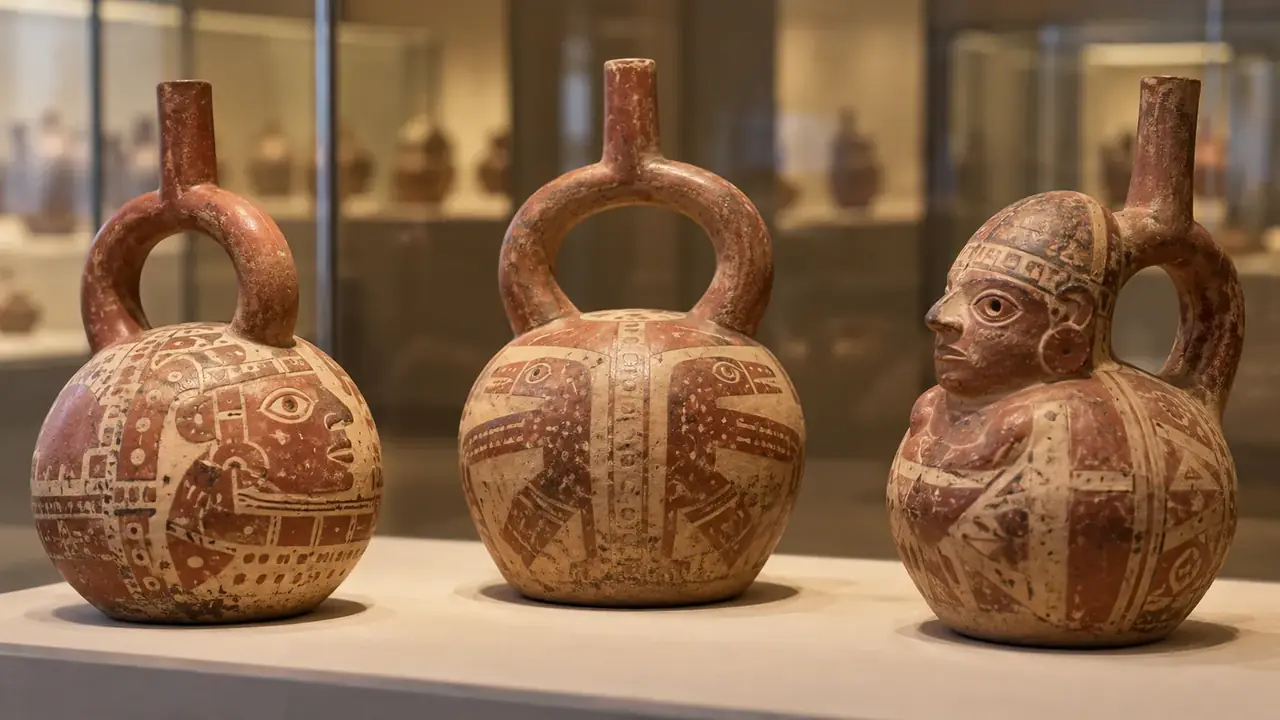
- Metalwork and pottery: the gold of the tombs of Sipán and Sicán, Moche portrait vessels, Nasca polychrome pottery, to be seen in museums.
Evidence, interpretations, legends
| What you hear | What is established | What is interpreted | What belongs to legend or error |
|---|---|---|---|
| “The Nazca Lines are a calendar” | Figures and lines traced by the Nasca, achievable with simple means | An astronomical calendar (Maria Reiche), ritual paths, a link with water: no explanation is unanimously accepted | Erich von Däniken’s “ancient astronauts”, refuted |
| “The Señora de Cao was a queen” | A tattooed woman, buried with weapons and ornaments | A high-ranking priestess or a Moche ruler | |
| “Machu Picchu, the lost city” | Occupied from around 1420 to 1530 according to Yale’s dating (2021) | A royal estate of the Inca Pachacútec, according to the chronicles | “Lost”: farmers were living and farming on the site when Bingham arrived in 1911 |
| “Caral, the oldest city in the Americas” | Monumental buildings from around 3000 BC, carbon-14 dated | The oldest known civilisation on the continent, depending on the definition of “city” or “civilisation” used | |
| “Moray, the Incas’ agricultural laboratory” | Circular terraces, with a temperature difference between the top and the bottom | A place for crop trials: a hypothesis with no text to confirm it |
A good guide makes these distinctions unprompted; ask them “how do we know?”.
Three themed routes
Lima, five thousand years in three days. The Museo Larco for the overview; Huaca Pucllana for the Lima culture; Pachacámac, a sanctuary spanning four periods; and, for a long day, Caral. See Lima in one, three or five days.
The north coast: Moche, Lambayeque and Chimú. Trujillo for the Huacas del Sol y de la Luna, Chan Chan and El Brujo; Chiclayo for Sipán, Sicán and Túcume. Each site has its museum: visit them together. See northern Peru, culture and beaches.
The Andes, from Chavín to the Incas. Chavín de Huántar from Huaraz, then Cusco, Tipón, Pisac, Ollantaytambo and Machu Picchu; as an extension, the Chachapoyas and Kuélap. See Cusco and the Sacred Valley.
Human remains, conservation: visiting with respect
- Human remains. The Leymebamba mummies (219 in the museum, most of them from the Laguna de los Cóndores), the Señora de Cao, the royal tombs of Sipán: these are the dead, to be looked at as such. Follow each room’s rule on photos, without flash, and speak quietly.
- Earthen walls cannot bear being leant on or climbed: stay on the walkways and paths.
- The geoglyphs are viewed from the viewing towers or from a plane, never by walking on the pampa.
- Nothing is taken away, neither potsherd nor stone: the law forbids taking any item of cultural heritage out of the country. See travelling respectfully.
Choosing a guide
A guide brings to life sites that mostly show earth and stones. Ask them how much time is planned at each place, whether they also present the museum, and how they deal with what is still debated. A well-understood visit is worth more than a series of photo stops.
Frequently asked questions
Did the Incas build Chan Chan or the Nazca Lines?
No. Chan Chan is the capital of the Chimú kingdom, conquered by the Incas around 1470. The Nazca Lines are the work of the Nasca culture, more than a thousand years before the Incas.
Do you need a guide at the sites?
It is strongly advised: many sites mostly show earth and walls, which only an explanation brings to life. Ask for a guide who can distinguish the periods and say what is still debated.
Can you photograph the mummies in museums?
Follow the rule displayed in each room, without flash; it may forbid photos. These are the dead, to be looked at as such.
Sources and dates
5 sources
Prices, opening hours and rules change: every piece of information cited links to its source, with the date it was consulted.
Sources consulted
- Wikipedia (English), Norte Chico civilization, Chavín culture, Paracas culture, Nazca culture, Lima culture, Moche culture, Wari culture, Sican culture, Chimú culture, Chachapoya culture, Ichma, Inca architecture (new tab) (consulted on 2 October 2026)
- Wikipedia (English), List of World Heritage Sites in Peru (years of inscription) (new tab) (consulted on 2 October 2026)
- Wikipedia, Chan Chan (in danger since 1986), Nazca Lines, Lady of Cao, Tipón, Kuélap; Huaca Pucllana, Señor de Sipán, Museo de Leymebamba (Spanish) (new tab) (consulted on 2 October 2026)
- Complejo Arqueológico El Brujo, route through the seven rooms of the site museum (new tab) (consulted on 2 October 2026)
- Museo Larco, online catalogue of the collections (new tab) (consulted on 2 October 2026)
How we choose and date our information: our method. Has something changed? Let us know.