
In short
Make an appointment at a travel medicine centre several weeks before departure, with your day-by-day itinerary. The essentials: routine vaccines up to date and hepatitis A for everyone; yellow fever only if you go below 2,500 metres in the Amazon or certain valleys, not for Lima, Cusco or Machu Picchu. No certificate is required on entry. Malaria is present below 2,500 metres east of the Andes, not in Lima, Cusco or Machu Picchu. In a life-threatening emergency, call the emergency services (SAMU 106): treatment must not depend on prior payment.
The consultation: what to bring
Make an appointment at a travel medicine centre or with your doctor, early enough to have boosters and multi-dose vaccines: several weeks before departure. Bring:
- Your day-by-day itinerary, with the regions and the nights: the difference between a night in Iquitos and a day at Machu Picchu changes everything.
- The altitudes where you will sleep, and the outings planned above 4,000 metres.
- Your activities: trekking, rafting, a stay in a lodge, contact with animals, long bus journeys.
- Your vaccination record and your medical history (illnesses, allergies, pregnancy, current treatment).
- The length of your stay and the type of accommodation (an air-conditioned hotel or a lodge open to the forest).
Vaccines: the essentials
No vaccine is required to enter Peru. For a tourist trip, the Swiss Expert Committee for Travel Medicine (CEMV) and the CDC agree on the essentials:
| Vaccine | For whom |
|---|---|
| Routine vaccines up to date | All travellers, following your country’s vaccination schedule |
| Hepatitis A | All travellers who are not protected |
| Yellow fever | Only if you go below 2,500 metres in the Amazon or certain valleys (see below) |
Yellow fever, case by case. The CEMV recommends it for any trip below 2,500 metres in the regions of Amazonas, Cusco, Huánuco, Junín, Loreto, Madre de Dios, Pasco, Puno, San Martín and Ucayali, and in certain areas of other regions, including the “jungle” treks to Machu Picchu. It does not recommend it for the cities of Lima, Cusco and Puno, for Machu Picchu and Aguas Calientes, or for the classic Inca Trail (CEMV). The CDC sets the limit at 2,300 metres. No certificate is required to enter Peru; a country you visit next may, however, require one: check if you are continuing to Brazil, Bolivia or elsewhere.
Other vaccines only concern certain trips, for example a long stay or work in contact with animals: your doctor will tell you whether they apply to you.
The risk map
| Risk | Where | Where it is not |
|---|---|---|
| Yellow fever | Low-lying areas of the Amazon and certain valleys: see vaccines | Lima, the coast, high-altitude towns and sites, including Cusco and Machu Picchu |
| Malaria | East of the Andes below 2,500 metres, particularly around Iquitos and Puerto Maldonado; rare cases in Tumbes and Piura | Lima, Arequipa, Cusco, Machu Picchu, Lake Titicaca, the south coast |
| Dengue | The coast, including Lima, and tropical areas | High altitude |
| Chikungunya, Zika | The country’s low-lying areas | High altitude |
| Leishmaniasis | Inter-Andean valleys and the Amazon rainforest, including Manu | Cities and the coast |
Source: CDC traveller page for Peru, updated on 1 October 2026 and consulted on 7 October 2026 (vaccines, yellow fever, malaria); Peru chapter of the Yellow Book, consulted on 2 October 2026 (dengue, chikungunya, Zika, leishmaniasis). A region that is mentioned is not exposed everywhere: the CDC page talks of areas and altitudes, which the doctor matches with your stops.
Malaria, area by area
The CEMV classifies Peru’s regions into four levels, with what to do for each:
| Level | Where | Prevention |
|---|---|---|
| High | Loreto department and the north of Amazonas department | Protection against mosquitoes and preventive medication, to discuss with a travel medicine doctor |
| Moderate | Certain areas below 2,500 m east of the Andes; Iquitos city centre; river cruises with nights on board in high-risk areas | Protection against mosquitoes; ask whether to carry emergency treatment |
| Low | The rest of the area east of the Andes and the inter-Andean valleys below 2,500 m; the town of Puerto Maldonado | Protection against mosquitoes |
| None | Above 2,500 m (Cusco, Machu Picchu, Lake Titicaca); west of the Andes; the cities of Arequipa, Ica, Lima, Nazca, Puno and Tacna | No particular measures |
Around Iquitos, the risk is high in the neighbouring villages and along the tributaries of the Amazon, more than in the city: a stay in a lodge on a tributary should be prepared like a stay in a high-risk area. See Northern Amazon.
Mosquitoes: protecting yourself according to the place and the accommodation
The malaria mosquito bites mainly at night; the dengue mosquito, during the day, including in towns. Protection combines several measures:
- A repellent suitable for tropical areas, recommended by your pharmacist or your doctor, applied to exposed skin, after sun cream.
- Long, light-coloured clothing in the evening and in the forest, possibly impregnated.
- Protected sleeping: in a lodge open to the forest, a mosquito net in good condition, tucked under the mattress; in a city hotel, screens on the windows or air conditioning.
Ask the lodge how the rooms are protected, and how it deals with someone who falls ill: the time needed to reach a town, means of communication, transport.
Eating out
Water. The CDC recommends avoiding tap water and ice, and drinking sealed bottled water or treated water. For juices and ice at restaurants, ask which water is used. A filter bottle cuts down on plastic bottles.
Meals. Favour food that is well cooked and served hot, and fruit you can peel. A raw dish is never risk-free: the lime in ceviche changes the texture of the fish but does not make it safe, and neither the advertised freshness, nor the time of the meal, nor a full dining room guarantee the absence of parasites or bacteria. The FDA advises pregnant women, young children, older people and people with weakened immune systems to avoid raw seafood: Peruvian seafood cooking also offers cooked dishes (sudado, jalea, arroz con mariscos). For other travellers, it is a choice to make with full knowledge of the facts; the ceviche recipe explains what the lime does and does not do. You can discover the local cuisine without turning every meal into a worry.
Allergies and diets. A dish without pieces of meat may contain an animal stock; a sauce may include milk, egg, peanuts or tree nuts. With a severe allergy, a card written in Spanish and a clear exchange with the establishment are more useful than a translation of the name of the dish; take your emergency treatment with you. See reading the menu.
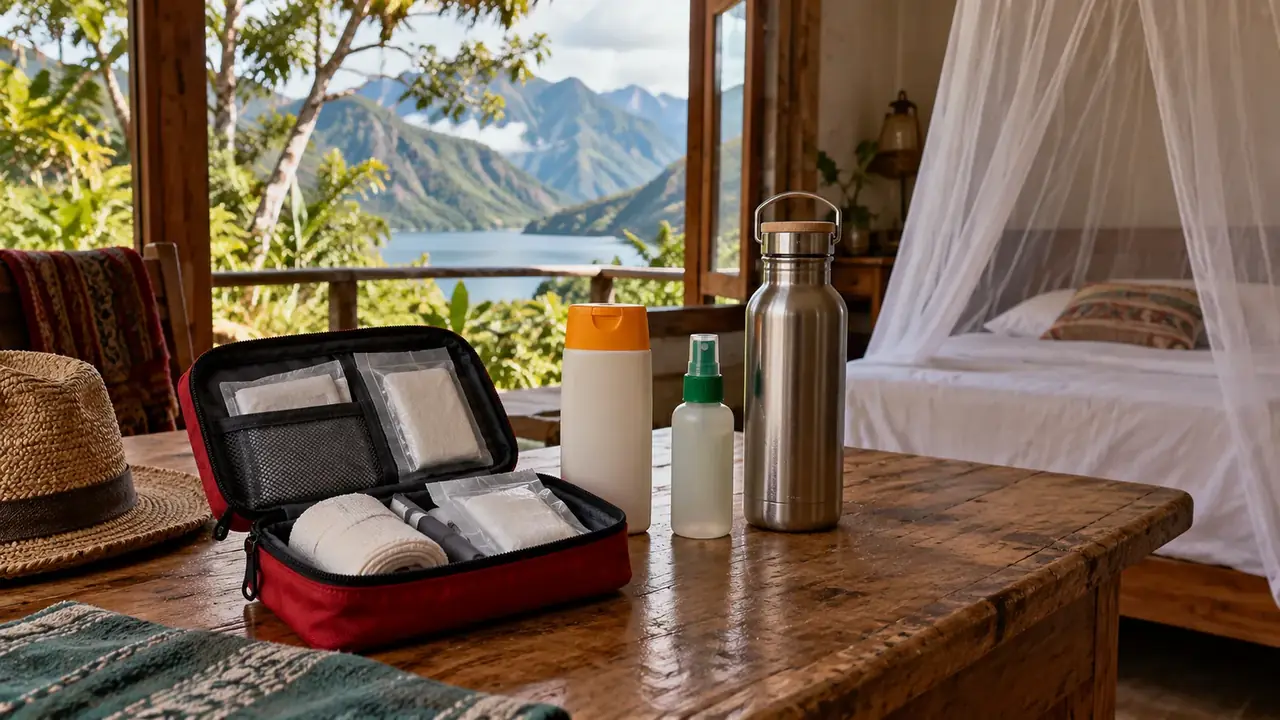
Your personal first-aid kit
Put it together with your doctor or your pharmacist, according to your itinerary and your health, rather than from a generic list. France Diplomatie points out three rules:
- take only the medicines you need, in their original packaging, with a prescription giving the name of the active substance (international non-proprietary name);
- check that your medicines are authorised in Peru;
- never buy medicines in the street: the risk of counterfeits is real.
For travellers’ diarrhoea, three things take up little space: oral rehydration sachets, a probiotic and a charcoal-based product. See minor travel ailments, further down.
Minor travel ailments
Travellers’ diarrhoea. It is the most common complaint. According to the CDC, untreated bacterial diarrhoea usually lasts 3 to 7 days, viral diarrhoea 2 to 3 days (CDC).
- Before you leave, probiotics. This is advice from experience on the ground: start a probiotic from the pharmacy (Saccharomyces boulardii or a lactobacillus, for example) a few days before departure, and keep taking it during the trip. The CDC considers the studies still insufficient to recommend it; ask your pharmacist for advice, especially if your immune system is weakened.
- Once there, drink first. The Swiss expert committee for travel medicine advises 2 to 3 litres a day of safe drinks: water, tea, broth, salty soup, but no fizzy drinks (CEMV). An oral rehydration solution from sachets is best, and the only one to give young children. Then go back to eating gradually, with rice, bananas or carrots, and for the first few days avoid fatty, sugary or spicy dishes and dairy products.
- Home-made rehydration solution, if you have no sachets: according to the International Red Cross, mix into one litre of safe water (bottled, or boiled then cooled) half a teaspoon of salt, that is 3.5 g, and eight teaspoons of sugar, that is 40 g, until dissolved (IFRC). Use level spoons: too much salt or sugar does more harm than good.
- Carbolevure or an equivalent. A medicine made of yeast and activated charcoal, such as the French Carbolevure, is used by adults alongside rehydration: 3 capsules a day, for 3 days at most, according to its product information (product information). Charcoal reduces the absorption of other medicines: take it more than 2 hours apart from any other treatment, for example malaria medication or the contraceptive pill.
- When to see a doctor. A medicine that slows the gut should not be taken on its own if there is fever or blood in the stools. See a doctor if the diarrhoea comes with fever or blood, if you cannot keep fluids down, if it stops you travelling, or if it lasts more than two weeks or persists after you get home. Your doctor can provide a standby treatment before you leave.
The sun. At altitude it burns quickly, even in cool weather: sun cream, a hat and sunglasses. See altitude.
An animal bite or scratch. Dog, cat, monkey or bat: wash the wound thoroughly with soap and water, then see a doctor the same day, without waiting until you get home.
Clinics and pharmacies
In Lima, France Diplomatie lists several private clinics that also offer general consultations, including the Anglo Americana clinic and the Ricardo Palma clinic (San Isidro), the Delgado clinic (Miraflores), the San Borja and Santa Isabel clinics (San Borja), the Tezza clinic and the Maison de Santé clinics (several sites); in Arequipa, the Arequipa clinic. The list, with addresses and telephone numbers, is published on France Diplomatie’s useful contacts page. Outside the big cities, healthcare is limited: your assistance service will direct you.
Pharmacies (boticas or farmacias) are plentiful in towns. Buy your medicines in an established pharmacy, never in the street, and keep the prescriptions for your usual treatment.
If you fall ill
- In a life-threatening emergency (loss of consciousness, difficulty breathing, severe chest pain, serious accident), first call the emergency services or go to the nearest emergency department: SAMU, medical emergencies, on 106; the fire brigade on 116. According to SUSALUD, Peru’s health supervisory authority, a public or private establishment must treat an emergency with no prior condition of payment, financial guarantee, signing an acknowledgement of debt or any formality, not even showing an identity document. This does not mean it is free: the costs remain payable afterwards. Inform your assistance provider as soon as possible, to organise what happens next and the payment of costs.
- For ordinary care (consultation, tests, planned hospital stay), call your travel assistance insurance first: it will direct you to a clinic and can guarantee payment. Outside emergencies, the FDFA and France Diplomatie point out that clinics and hospitals ask for a financial guarantee before treating you (insurance, bank card, advance payment). The private clinics in Lima are well equipped; outside the big cities, medical care is limited.
- Police: 105; the tourist police in Lima answer on +51 980 122 335 (mobile) and on +51 1 460 1060 (landline), numbers published by MINCETUR. See Everyday safety.
- In an isolated region (an Amazon lodge, a trek), evacuation goes through the provider: ask before you leave how they go about it and how long it takes.
- A fever after returning from the Amazon, even several weeks later, means seeing a doctor quickly and mentioning the trip: a reflex to keep in mind after being in a malaria area.
Insurance
Before you leave, check in writing that your insurance covers:
- medical and hospital costs abroad, without too low a ceiling;
- medical repatriation, including from an isolated area;
- the activities you have planned (high-altitude trekking, rafting);
- and note its assistance number, available 24 hours a day, on paper and in your phone.
Frequently asked questions
Is the yellow fever vaccine compulsory?
Not to enter Peru: according to the CDC, no certificate is required on entry. The vaccine is recommended from 9 months of age for areas below 2,300 metres in several regions (Amazonas, Cusco, Huánuco, Junín, Loreto, Madre de Dios, Pasco, Puno, San Martín, Ucayali, and parts of other regions), not for Lima or for the high-altitude tourist sites. A country you go to afterwards may require a certificate: check this if you are continuing your journey.
Which vaccines do you need for Peru?
For a tourist trip: routine vaccines up to date and hepatitis A; yellow fever only if you go below 2,500 metres in the Amazon or certain valleys. Other vaccines only concern particular cases, which your doctor assesses with your itinerary.
Do you need the yellow fever vaccine for Machu Picchu?
No: the Swiss expert committee for travel medicine does not recommend it for a visit to Cusco, Machu Picchu and Aguas Calientes, or for the classic Inca Trail. It does recommend it for the “jungle” treks to Machu Picchu, which pass through lower valleys.
Do you need malaria treatment?
Only for certain areas: according to the CDC, the risk exists east of the Andes below 2,500 metres, particularly around Iquitos and Puerto Maldonado, with rare cases in Tumbes and Piura. There is none in Lima, Arequipa, Cusco, Machu Picchu, Lake Titicaca or on the south coast. It is the doctor who decides on preventive treatment according to your stops.
Can you eat ceviche without any risk?
No, not without any risk: the fish is raw, and the lime changes its texture without making it safe. Neither freshness, nor the time of day, nor a full dining room guarantee it. The FDA advises pregnant women, young children, older people and people with weakened immune systems to avoid raw seafood and to choose cooked dishes.
Is tap water safe to drink?
Better not to drink it: the CDC recommends avoiding tap water and ice, and drinking sealed bottled water or treated water. A filter bottle saves buying plastic bottles.
What should you do if you get diarrhoea?
Drink first: 2 to 3 litres a day, preferably an oral rehydration solution, from sachets or home-made (a litre of safe water, half a teaspoon of salt, eight teaspoons of sugar). According to the CDC, untreated bacterial diarrhoea usually lasts 3 to 7 days, viral diarrhoea 2 to 3 days. See a doctor if there is fever or blood in the stools, if you cannot keep fluids down, or if it lasts more than two weeks.
Sources and dates
13 sources
Prices, opening hours and rules change: every piece of information cited links to its source, with the date it was consulted.
Figures and rules cited
- 106: SAMU, medical emergencies and ambulances of the Ministry of Health (Peru (bases in Lima, Callao and most regions)) . Free service according to the ministry quoted by Andina; coverage varies outside the cities. Fire brigade: 116. A single 911 number is being trialled in Lima and Callao (Infobae, June 2026).
Press or reseller: Andina, how SAMU works, a free service (10 August 2025) (new tab) , published on 10 August 2025 · consulted on 7 October 2026 - 116: Fire brigade (Cuerpo General de Bomberos Voluntarios del Perú) (Peru) . Fires, road accidents with injuries, rescues.
Press or reseller: Infobae, emergency numbers in Peru: police, fire brigade, SAMU (26 June 2026) (new tab) , published on 26 June 2026 · consulted on 7 October 2026 - with no prior condition of payment, financial guarantee, signing an acknowledgement of debt or any formality, not even showing an identity document: Treatment of a medical emergency in a public or private facility (Peru) (Anyone in an emergency (life in danger, childbirth)) . The rule covers emergencies, not ordinary care; it does not make care free: the costs remain payable after treatment.
Official source: SUSALUD, “SUSALUD garantiza atención por emergencia” (19 June 2025) (new tab) , published on 19 June 2025 · consulted on 7 October 2026 - 105: Emergency number (police) given by the FDFA (Peru)
Official source: FDFA, Conseils pour les voyages – Pérou, useful addresses (in French) (new tab) , published on 2 March 2026 · consulted on 1 October 2026 - +51 980 122 335: Tourist Police (Policía de Turismo, Lima), mobile phone (Peru (Lima headquarters)) . Peruvian mobile number: no Lima “1” area code in international format. Checked against the publications, not by calling; to be rechecked before each publication.
Official source: MINCETUR, prevention protocol and tourist contacts (30 July 2025) (new tab) , published on 30 July 2025 · consulted on 7 October 2026 - +51 1 460 1060: Tourist Police (Policía de Turismo, Lima), landline (Peru (Lima headquarters)) . Lima landline (area code 1). Checked against the publications, not by calling.
Official source: MINCETUR, prevention protocol and tourist contacts (30 July 2025) (new tab) , published on 30 July 2025 · consulted on 7 October 2026
Sources consulted
- CDC, Peru traveller page (update of 1 October 2026: vaccines, yellow fever, malaria) (new tab) (consulted on 7 October 2026)
- Expert Committee for Travel Medicine (CEMV, Switzerland), healthytravel.ch, Peru: vaccinations and malaria (in French) (new tab) (consulted on 13 October 2026)
- CDC Yellow Book 2026, Travelers’ Diarrhea (24 March 2026) (new tab) (consulted on 13 October 2026)
- Expert Committee for Travel Medicine (CEMV, Switzerland), healthytravel.ch, diarrhoea factsheet (drinks, diet; in French and English) (new tab) (consulted on 13 October 2026)
- International Federation of Red Cross and Red Crescent Societies (IFRC), preparing oral rehydration solution (31 March 2023) (new tab) (consulted on 13 October 2026)
- French public medicines database, Carbolevure adultes, capsule (update of 29 September 2026, in French) (new tab) (consulted on 13 October 2026)
- CDC Yellow Book, Peru (general chapter: vaccines, malaria, dengue, water) (new tab) (consulted on 2 October 2026)
- SUSALUD, emergency treatment without any payment condition (19 June 2025) (new tab) (consulted on 7 October 2026)
- MINCETUR, tourist police contact details (30 July 2025) (new tab) (consulted on 7 October 2026)
- France Diplomatie, Pérou, santé (health, in French; updated on 21 September 2026) (new tab) (consulted on 2 October 2026)
- France Diplomatie, Pérou, contacts utiles (useful contacts, in French: clinics; updated on 21 September 2026) (new tab) (consulted on 13 October 2026)
- FDFA, Conseils pour les voyages – Pérou (travel advice, in French: medical care, financial guarantee) (new tab) (consulted on 1 October 2026)
- FDA: selecting and serving seafood safely (people at risk, raw fish) (new tab) (consulted on 7 October 2026)
How we choose and date our information: our method. Has something changed? Let us know.