
Northern Amazon
Tarapoto and San Martín: a week of discovery
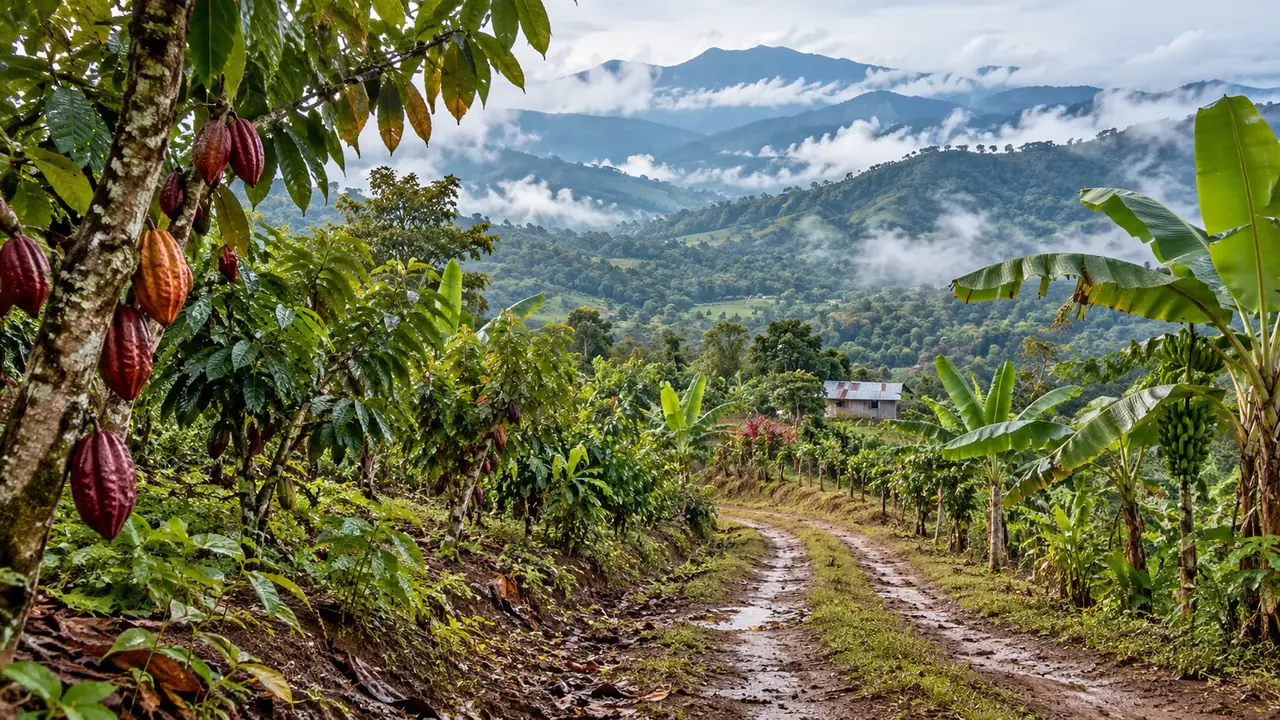
Tarapoto is a gentle gateway to the rainforest: a foothill town, linked by road, from which you head out to waterfalls, a Quechua village, cacao farms and a large lagoon. The main programme keeps a single base; the variants say what you gain and what you lose by moving.
- Length
- 7 days, 6 nights
- In the country
- 7 days, 6 nights
- Pace
- Moderate: a single base, one outing a day, two free days
- Regions
- Northern Amazon
Who is it for? Those who want to alternate town, food and nature for a first taste of the rainforest, as a family or as a couple.
A route to adapt to your dates, excluding international flights. Keep a day in hand before your flight home.
Day by day
ArrivalSightseeingFree dayBuffer
-
Day 1
Tarapoto Arrival
Flight from Lima, settling in, a first meal: juane or tacacho con cecina
Night: Tarapoto
-
Day 2
Ahuashiyacu waterfall Sightseeing
The waterfall 14 km away, early in the morning, a swim in the pool; lunch in town, a free afternoon
Night: Tarapoto
-
Day 3
Lamas and the Wayku Sightseeing
Lamas, 39 km away, and a visit to the Quechua quarter of the Wayku arranged in advance: a pottery or weaving workshop, paid to the person who runs it
Night: Tarapoto
-
Day 4
Tarapoto Free day
A free day; if one is arranged, a cacao or coffee farm, from the pod to the cup
Night: Tarapoto
-
Day 5
Sauce and the Laguna Azul Sightseeing
An early departure for Sauce, 57 km away: a boat, a swim, fish at midday, back in the late afternoon
Night: Tarapoto
-
Day 6
Tarapoto Free day
A spare day: an outing postponed because of rain, the market, or nothing at all
Night: Tarapoto
-
Day 7
Departure Buffer
Return flight to Lima
One base, one outing a day
The programme keeps Tarapoto as its only base, for six nights: you head out to one outing each day, and come back in the evening to the town’s restaurants and services. The distances are short (14 km to Ahuashiyacu, 39 km to Lamas, 57 km to Sauce, according to the OpenStreetMap calculation), but it is hot and humid, and the roads are tiring: two days are left free.
Tarapoto is in the “selva alta”, the forest of the first foothills: cooler and more accessible than the plain around Iquitos. The CDC nevertheless recommends the yellow fever vaccine for most of San Martín, and malaria is present below 2,500 metres east of the Andes. See health.
Day by day
Day 2, the laughing water. The Ahuashiyacu waterfall, “the water that laughs” in Quechua, falls in two drops; the second ends in a pool where you can swim. Come early or on a weekday: the site is very busy at weekends.
Day 3, Lamas. The “three-storey town” is spread over a hill on several levels; according to tradition, part of its population is descended from Andean peoples who took refuge in the forest in the 15th century. The Wayku, a nearby quarter, is the main centre of the Lamista Quechua-speaking community: it is a place where people live, not a museum. The visit is arranged in advance, around a pottery or weaving workshop, paid to the person who runs it; ask before taking photos. See meeting people.
Day 4, cacao. If a visit is arranged, a farm or a cooperative shows the whole chain: the pod picked by hand, the fermentation of the beans, drying in the sun, roasting, then chocolate or coffee. Otherwise, a free day in town, and a lunch of Amazonian cooking.
Day 5, the Laguna Azul. Sauce lies on a large lagoon surrounded by hills: a boat, a swim, fish at midday. About an hour’s drive each way according to the road calculation, often more.
Day 6, the spare day. If rain caused an outing to be cancelled, it can be made up here; after heavy rain, ask whether access to the waterfall is open. Otherwise, the market, food, rest.
When it rains
It rains all year round, more from October to April. On days of heavy rain, keep to the outings that do not depend on a trail: Lamas, a cacao farm, the town. The waterfalls and the tracks can be postponed.
Budget: the items to add up
| Item | Basis of calculation | Known amount |
|---|---|---|
| Lima–Tarapoto flights | Outward and return, per person | Your quote |
| Accommodation | 6 nights, per room | Your quote |
| Taxis and drivers by the day | Per vehicle, for Ahuashiyacu, Lamas, Sauce | Your quote |
| Workshop in the Wayku, cacao farm | Per person | On site or your quote |
| Entry to natural sites | Per person | On site |
Variant: two nights by the Laguna Azul
| Day | Programme | Night |
|---|---|---|
| 1 | Flight to Tarapoto | Tarapoto |
| 2 | Ahuashiyacu | Tarapoto |
| 3 | Lamas and the Wayku | Tarapoto |
| 4 | Road to Sauce, an afternoon on the water | Sauce |
| 5 | A day at the lake: dawn on the water, swimming, reading | Sauce |
| 6 | Back to Tarapoto, cacao if arranged | Tarapoto |
| 7 | Return flight |
A day or two nights? In a day, you see the lagoon between two journeys; with two nights, what you buy above all is time. Before booking, ask what is accessible without another transfer: the shore, swimming, the boat, the meals.
Variant: the Alto Mayo, three nights in Moyobamba
| Day | Programme | Night |
|---|---|---|
| 1 | Flight to Tarapoto | Tarapoto |
| 2 | Lamas and the Wayku | Tarapoto |
| 3 | Road to Moyobamba (114 km), the port of Tahuishco on the Mayo | Moyobamba |
| 4 | Tingana: from Moyobamba, about 45 minutes by road to Puerto Boca de Huascayacu, then 20 minutes by boat; a day visit; best period from May to November | Moyobamba |
| 5 | The orchids and the San Mateo hot springs | Moyobamba |
| 6 | Road to Tarapoto | Tarapoto |
| 7 | Return flight |
Moyobamba, the regional capital, founded in 1540, is nicknamed the “city of orchids”. Tingana is a swamp forest of aguaje palms, managed by a community association, which you explore by canoe, in silence. This variant sacrifices Ahuashiyacu and Sauce: you exchange two day trips for a whole region. Choose a theme (orchids, birds, flooded forest) and the contact person who goes with it.
What to arrange in advance
- The flights Lima–Tarapoto and back. To continue to Iquitos, Star Perú publishes a Tarapoto–Iquitos connection without going through Lima: check whether it flies on your date.
- The visit to the Wayku, arranged in advance, with someone to welcome you.
- A cacao or coffee farm, if you want a visit: who welcomes you, what you will taste, and whether what you buy goes to the producer.
- Accommodation in town, on the courtyard side rather than the street side: the mototaxis are noisy.
What this route leaves out
- Chachapoyas and Kuélap, several hours’ drive towards the Andes: a longer trip, with a transfer built in as a stage.
- Iquitos, with no road from Tarapoto: another trip, by plane (Tarapoto–Iquitos flight or a connection via Lima) or by the long river route from Yurimaguas.
Variations
-
Two nights by the Laguna Azul
Less road, more time on the water; you lose the free day. Schedule below.
-
The Alto Mayo, three nights in Moyobamba
Tingana, the orchids, the hot springs; you lose Sauce and Ahuashiyacu. Schedule below.
Sources and dates
6 sources
Prices, opening hours and rules change: every piece of information cited links to its source, with the date it was consulted.
Figures and rules cited
- from Moyobamba, about 45 minutes by road to Puerto Boca de Huascayacu, then 20 minutes by boat; a day visit; best period from May to November: Tingana (Alto Mayo): access and season (Tingana, Alto Mayo, Moyobamba) . Site run by the community association ADECARAM (aguaje palm swamps and renaco swamps of the Alto Mayo).
Official source: PROMPERÚ, the Tingana experience (new tab) · consulted on 2 October 2026
Sources consulted
- Star Perú, intermediate routes (Tarapoto–Iquitos without a stop in Lima) (new tab) (consulted on 7 October 2026)
- PROMPERÚ, five places around Tarapoto (new tab) (consulted on 2 October 2026)
- PROMPERÚ, the Tingana experience (access, community management, season) (new tab) (consulted on 2 October 2026)
- Wikipedia (Spanish), Catarata de Ahuashiyacu, Lamas; (English) Moyobamba (new tab) (consulted on 2 October 2026)
- Road routes calculated on OpenStreetMap (FOSSGIS routing server) (new tab) (consulted on 2 October 2026)
- CDC Yellow Book, Peru (yellow fever, malaria) (new tab) (consulted on 2 October 2026)
How we choose and date our information: our method. Has something changed? Let us know.