
In short
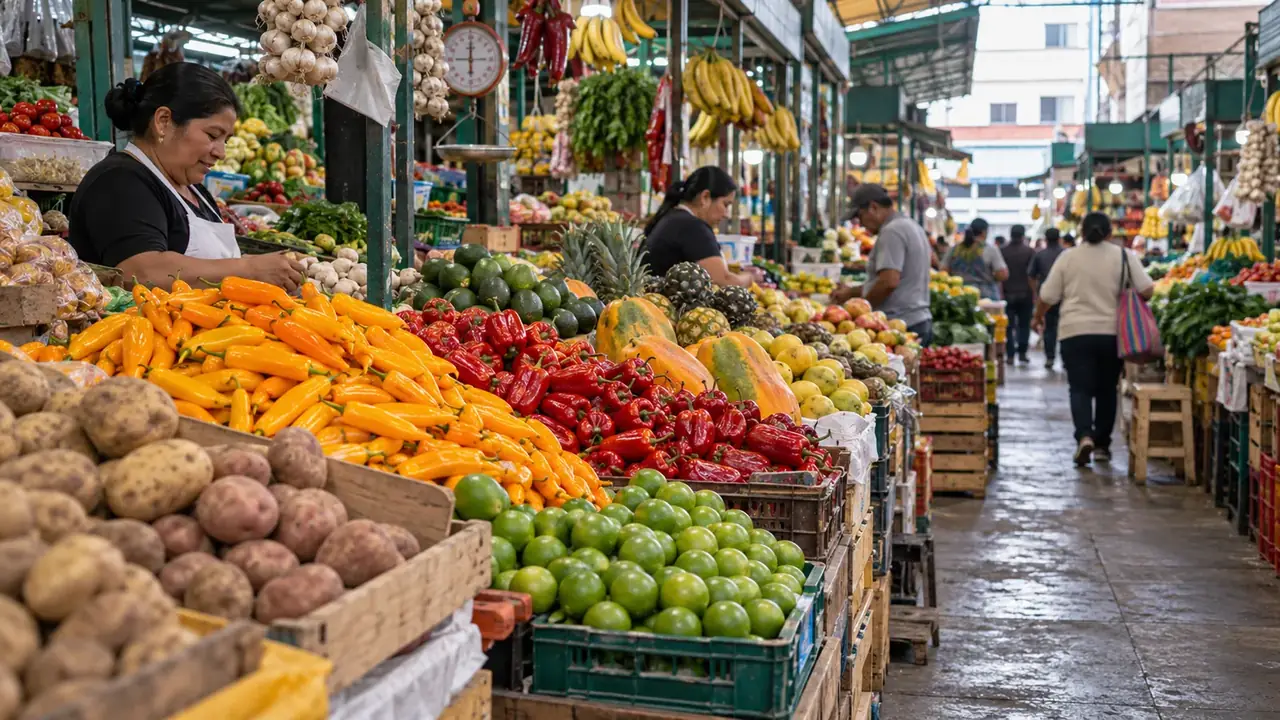
Go to the market in the morning, with a specific question: tasting unfamiliar fruit, putting together a breakfast, recognising potatoes. The markets in the guide: in Lima the Mercado Central, Magdalena and Surquillo; in Cusco San Pedro; in the Sacred Valley Pisac; in Arequipa San Camilo; in Huancayo the Sunday fair; in Iquitos Belén. Always ask the price and the unit, where an object comes from, and for consent before a photo.
Three kinds of market
| Market | What you find there | When to go | What it asks of you |
|---|---|---|---|
| The neighbourhood market (mercado municipal) | Fruit, vegetables, meat, fish, bread, cheese; juice and dish-of-the-day counters | In the morning, every day or nearly | Not getting in the way of local shoppers; asking the price and the unit |
| The craft market | Textiles, ceramics, jewellery, souvenirs | During the day, often every day | Telling a handmade piece from a factory product |
| The periodic fair (feria) | Produce from the surrounding communities, livestock, tools, crafts | One or more fixed days a week | Checking the day on site; arriving early |
Six cities, named markets
| City | Market | What you find there | Good to know |
|---|---|---|---|
| Lima | Mercado Central, Magdalena, Surquillo (markets no. 1 and no. 2), bioferia | Everything; the Central near the Barrio Chino, Surquillo near Miraflores | In Surquillo, market no. 1 has partly reopened after two years of closure; market no. 2, covered, reopened in 2024. See five markets compared |
| Cusco | San Pedro, south-west of the Plaza de Armas | Fruit juices, soups, Andean breads and cheeses from early morning | Keep an eye on your belongings. See Cusco |
| Pisac | The village market | Crafts every day; produce from the communities on certain days | Bigger on Sunday. See Pisac |
| Arequipa | San Camilo, south-east of the square | Fruit, cheeses, bread, freshly squeezed juices | See Arequipa |
| Huancayo | The Sunday fair (feria dominical) | Crafts from the Mantaro valley: mates burilados, silver filigree, weavings | See the central and northern Andes |
| Iquitos | Belén | River fish, forest fruit such as aguaje, medicinal plants | In the morning; the lower part of the neighbourhood, on stilts, with a local guide. See Belén |
What you only find in certain regions
- In the Andes: potatoes of every shape and colour, chuño, potato dried by frost and sun that keeps for years, fresh cheeses, corn in all its forms.
- On the coast: fruit from the irrigated valleys, including lúcuma, with orange, floury flesh, which flavours desserts and ice cream; the fish of the day.
- In the Amazon: aguaje, the fruit of a palm with brown scales; camu camu, a small, sour berry from the flooded riverbanks; paiche, one of the largest freshwater fish in the world.
See ingredients and fruit and reading the menu.
Reading a price and an origin
- The unit. By the kilo, by the piece, by the dozen, by the pile: ask “¿Se vende por kilo o por unidad?” before comparing. See understanding the units.
- The price before cutting. Have the price stated before having something weighed, cut or prepared.
- Where an object comes from. Ask about the material (alpaca, sheep’s wool, cotton, synthetic), who made it and where. A seller who answers precisely generally sells pieces they know. See crafts: the material, the origin, the maker.
Alpaca or not: the composition before the price
In the craft markets of Cusco, Pisac, Chinchero or Lima, jumpers, scarves, ponchos and blankets are often presented as “alpaca”. Some are, others are blends, sheep’s wool or synthetic fibres. Nobody has measured the share of wrongly described items, but the rule of caution is simple.
Four aims for a visit, one hour each
- Taste five unfamiliar fruits. Buy one of each, ask how it is eaten, note its name.
- Put together a market breakfast. A freshly squeezed juice, some bread, a piece of cheese, a soup if the counter serves one.
- Recognise the potatoes and the corn. Ask a seller for three varieties and what each one is used for: purée, soup, frying.
- Buy an object knowing who made it. Choose a piece, ask who made it and how long it took, and pay the price asked or discuss it courteously.
Good habits, everywhere
- Go in the morning: the produce is fresh and the counters are serving.
- Buy small quantities to taste; tasting is not necessarily free.
- Choose preparations cooked in front of you, fruit you can peel, and ask what water is used for juices and ice. See eating out.
- Keep your bag in front of you and your phone put away in the aisles.
- Ask for consent before photographing a person; photograph the stalls rather than faces.
- Discussing the price has its place for crafts, rarely for food. See local customs.
With or without a guide?
On your own, a market is easy to visit with these pointers and a few words of Spanish. A guide helps above all to name the produce, to start conversations, and, in Belén, to visit the lower part of the neighbourhood. Keep the group small: a visit with ten people in a narrow aisle is pleasant for nobody.
Frequently asked questions
Which day should you go to the Pisac market?
The craft stalls fill the square every day. The produce market is described as bigger on Tuesday, Thursday and above all Sunday, when the surrounding communities come down; ask for the days to be confirmed on site, as they are not published by any official source we consulted.
Can you eat at the market?
Yes: freshly squeezed juices, morning soups, dishes of the day at the counters. Choose preparations cooked in front of you, fruit you can peel, and ask what water is used for juices and ice.
Sources and dates
6 sources
Prices, opening hours and rules change: every piece of information cited links to its source, with the date it was consulted.
Sources consulted
- Inacal, checking labels and origin for a safe purchase (16 June 2026) (new tab) (consulted on 7 October 2026)
- Inacal, technical standards for artisan weaving and embroidery, labelling (1 March 2022) (new tab) (consulted on 7 October 2026)
- alpaca.ch (Swiss seller of alpaca clothing), fibre categories (“baby alpaca”) (new tab) (consulted on 7 October 2026)
- Wikipedia (English), Pisac (market days) (new tab) (consulted on 2 October 2026)
- Wikipedia (Spanish), Chuño, Mauritia flexuosa (aguaje), Myrciaria dubia (camu camu), Arapaima gigas (paiche), Pouteria lucuma, Mate burilado (new tab) (consulted on 2 October 2026)
- PROMPERÚ, Lima’s gastronomy (new tab) (consulted on 2 October 2026)
How we choose and date our information: our method. Has something changed? Let us know.