In short
Allow a day in the city and at least three nights in the forest, five if you are aiming for Pacaya Samiria. Choose the sector first: a lodge near Iquitos, on the Amazon or a tributary, for a first contact; Pacaya Samiria, via Nauta, for a better-preserved flooded forest, with an authorised operator. Have the whole chain described: plane, road, pier, boat, outing times. A travel medicine consultation is essential (yellow fever, malaria).
The rubber city, without embellishing it
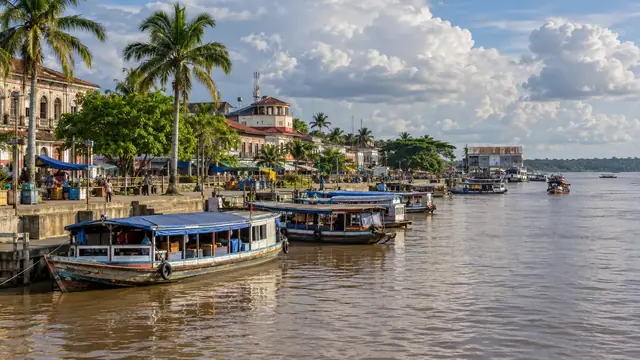
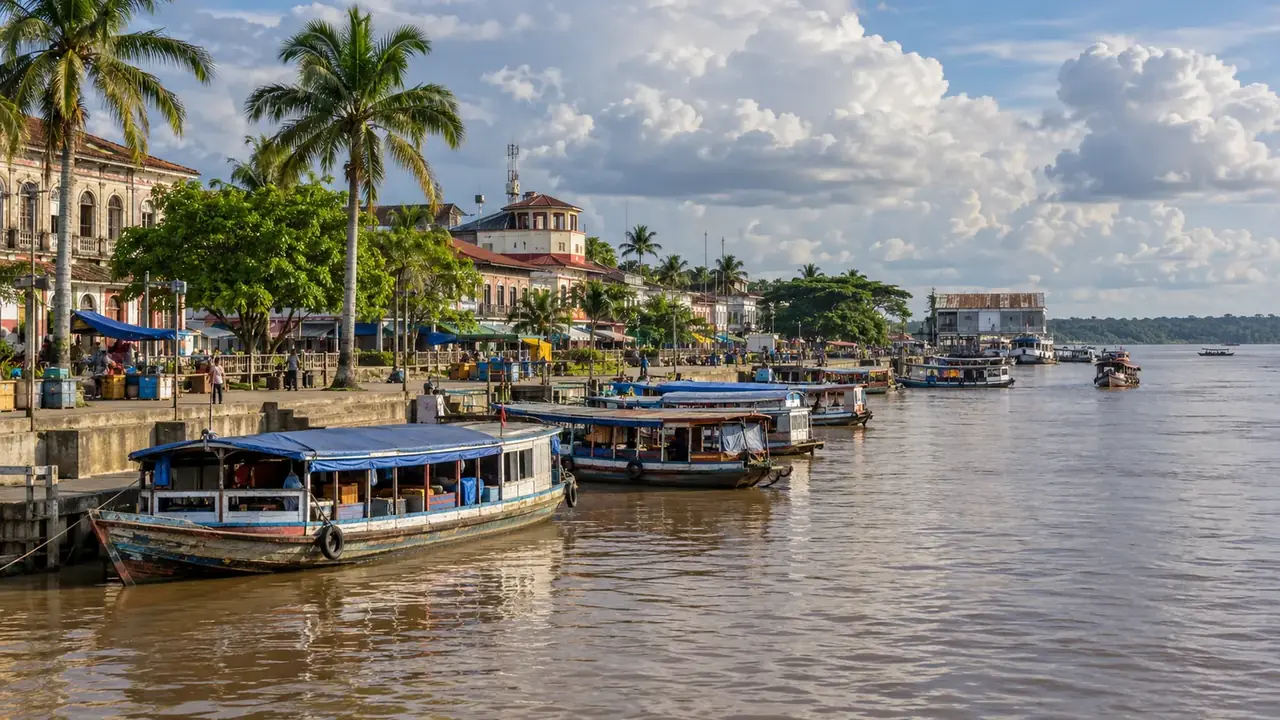
At the end of the 19th century, the car industry sent world demand for rubber soaring. Iquitos became, along with Manaus in Brazil, one of the capitals of the rubber boom (1880–1914): trading houses, European immigrants, palaces covered in imported azulejo tiles. This wealth had a dark side that the city long kept quiet. The rubber “barons” organised raids against the Indigenous populations to force them to collect latex; children and young women were sold in Iquitos. In the Putumayo basin, Julio César Arana’s Peruvian Amazon Company, based in Iquitos, was accused in 1913 by the British consul Roger Casement of mass crimes against the Indigenous people: today, people speak of the Putumayo genocide. The boom collapsed when rubber tree seeds, smuggled out of the Amazon basin, made plantations in Asia possible.
So look at the façades of the malecón with this double view: they speak of the prosperity of a few and of the violence done to many others.
Half a day in the city
- The Plaza de Armas, the starting point of the walk, with the Iglesia Matriz and the Casa de Fierro, a house with a metal structure that legend attributes to Gustave Eiffel, with no solid proof.
- The Malecón Tarapacá, a promenade above the river, lined with houses from the rubber era, including the former Palace Hotel, and the Amazonian Library.
- The port of Bellavista-Nanay, to the north, in the district of Punchana, with its market and its boat departures.
- Around the city: the Allpahuayo-Mishana National Reserve, on the road to Nauta, for a first taste of the forest; Lake Quistococha and its park; the Pilpintuwasi butterfly farm, at Padre Cocha.
Belén, the neighbourhood on the water
Belén, south of the centre, is a very dense working-class district, nicknamed the “Venice” of Iquitos: its lower part is made up of houses on stilts and floating houses, which follow the rise and fall of the river. Its market, one of the liveliest in the Amazon, shows the produce of the forest: river fish, fruit such as aguaje, medicinal plants.
The market is visited in the morning. For the lower part, by boat during high water, go through a local guide who knows the residents: it is not a stage set, and the poverty there is real. Leave valuables at the hotel. If you cannot find a trustworthy guide, the port of Bellavista-Nanay gives a quieter glimpse of life on the river, and the San Juan craft market a view of the region’s crafts.
The city, a nearby lodge, Nauta or Pacaya Samiria?
| Excursions from the city | A nearby lodge | Nauta and the mouth of the Ucayali | Pacaya Samiria | |
|---|---|---|---|---|
| Where | Allpahuayo-Mishana, Quistococha, nearby riverbanks | On the Amazon or a tributary, one to a few hours by boat from Iquitos | Nauta, on the Marañón, 103 km along the only road out of Iquitos | A national reserve of more than two million hectares, south-west of Nauta |
| Forest | Secondary forest and peri-urban reserves | Forest more or less preserved depending on the distance | A starting point, not a destination in itself | Preserved flooded forest, many lakes (cochas) |
| Recommended nights | None | Three to four | One, in transit | Four to six |
| Who it suits | A first glimpse | A first stay in the forest, families | Those joining a boat or a lodge on the Ucayali | Those who want the great forest and accept the journey |
Nauta
Nauta, an access town on the Marañón, a few kilometres from its confluence with the Ucayali (where the Amazon is often said to begin), is above all an embarkation point: an outing from Nauta is not necessarily an entry into Pacaya Samiria. Ask precisely where you will sleep and which sector you will visit.
Pacaya Samiria
With 2,080,000 hectares, it is the largest reserve in Peru: a plain of flooded forests between the Marañón and Ucayali rivers, where water dictates the landscape. You come across pink and grey river dolphins, monkeys, giant otters, giant fish such as the paiche, hundreds of bird species; Kukama communities live in and around the reserve.
| Practical details | Detail |
|---|---|
| Entry and rules | S/ 30 a day for a foreign visitor (S/ 15 for a Peruvian adult); every day from 6:00 to 17:00; visits only with an authorised operator |
| Sectors | Yanayacu-Pucate, the most accessible, with around twenty lakes; Pacaya; Samiria; Tibilo, more isolated, from Lagunas |
| Access | Plane to Iquitos, road to Nauta, then from three hours to two days by boat depending on the sector |
| Season | SERNANP advises May to September |
Ask which sightings are possible, without demanding a list of guaranteed animals: the time spent watching and listening is part of the trip.
Reading the flooded forest
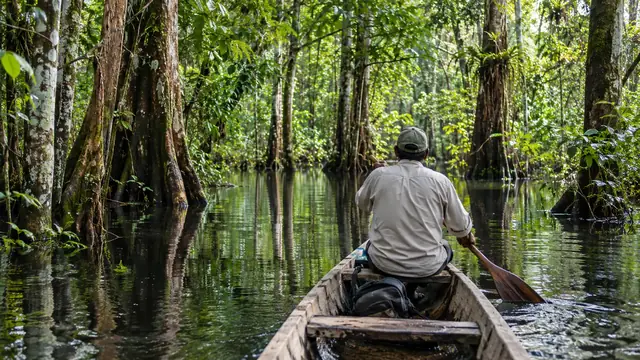
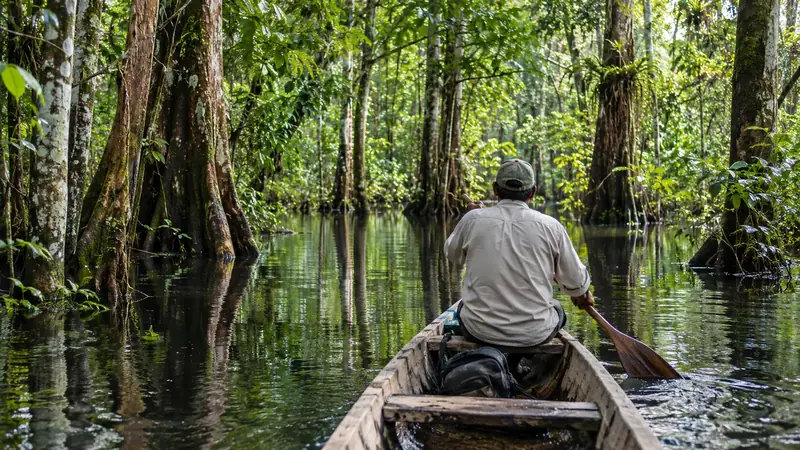
- The river rises and falls by several metres over the year. At high water, the forest is flooded: you travel by canoe between the trunks, getting close to the treetops. At low water, the trails reappear and the sandy beaches are uncovered.
- A cocha is an old meander of the river that has become a lake, calm and full of life: that is where you watch the birds, the otters, sometimes the caimans.
- The dry-land forest, never flooded, is explored on foot; it is the forest of the big trees.
- The night outings, on foot or by boat, show another world: frogs, insects, caimans whose eyes you pick out with a torch.
Three or five nights: the time actually spent in the forest
| Three nights | Five nights | |
|---|---|---|
| Arrival day | Flight, transfer, arrival in the afternoon: one outing | The same |
| Full days | Two | Four |
| Possible outings | One dawn, one night, one cocha, one walk | Several dawns and nights, a day in a more remote sector |
| Departure day | An outing at dawn then the return | The same |
| Margin for rain | None | One day |
Before booking, have the whole chain put in writing: the flight’s arrival time, the vehicle to the pier, the length of the boat trip, the time of arrival at the lodge, and the latest departure time on the last day so as not to miss the plane. Our lodge comparison tool helps you note the answers.
A lodge is not chosen from a photo of a cabin
Start with the real location: how long from the airport, which parts by car and by boat, is the accommodation in a protected area, near one or further away? The comfort should be described concretely: bedding, bathroom, mosquito net, ventilation, electricity, meals, connectivity. And the guide: do they speak your language, do they know the forest, how many travellers per outing?
With guides who know the region
In the Amazon region, the FDFA recommends being accompanied by guides who know the region well, and travelling on the Amazon only with a tour operator or trustworthy guides. It advises against the border region with Colombia, downstream from Iquitos: our briefing on the tri-border area explains why.
Preparing your health
According to the CDC, yellow fever vaccination is recommended for Loreto and the other Amazonian regions, and malaria is transmitted east of the Andes below 2,500 metres; dengue circulates in the low-lying areas. A travel medicine consultation lets you adapt vaccines, preventive malaria treatment and protection against bites to your stay. See Health.
Frequently asked questions
Three or five nights in the forest?
Three nights give you, in practice, two full days of outings, because arrival and departure each take up half a day. Five nights let you go further (Pacaya Samiria), do more outings at dawn and at night, and absorb a day of rain.
Do you need to be vaccinated against yellow fever?
According to the CDC, vaccination is recommended for Loreto and the other Amazonian regions, and there is a risk of malaria east of the Andes below 2,500 metres. See a travel medicine centre several weeks before departure.
Can you visit Belén on your own?
The market can be visited in the morning, with a minimum of precautions. For the lower part of the neighbourhood, on stilts and with floating houses, go with a local guide who knows the residents, and without valuables.
Sources and dates
5 sources
Prices, opening hours and rules change: every piece of information cited links to its source, with the date it was consulted.
Figures and rules cited
- S/ 30 a day for a foreign visitor (S/ 15 for a Peruvian adult); every day from 6:00 to 17:00; visits only with an authorised operator: Pacaya Samiria National Reserve: entry, opening hours and the rule on operators (Pacaya Samiria National Reserve, Loreto) . Sectors: Yanayacu-Pucate (one to three days, the most accessible, some twenty cochas), Pacaya, Samiria (Kukama communities), Tibilo (two to three days, from Lagunas). Access from Nauta, then 3 to 48 hours by boat depending on the sector. Do not disturb nesting turtles (July to September).
Site management: SERNANP, Reserva Nacional Pacaya Samiria (new tab) · consulted on 2 October 2026
Sources consulted
- SERNANP, Reserva Nacional Pacaya Samiria (sectors, prices, rules) (new tab) (consulted on 2 October 2026)
- CDC Yellow Book, Peru (yellow fever, malaria) (new tab) (consulted on 2 October 2026)
- Wikipedia (English), Iquitos, Amazon rubber cycle, Putumayo genocide, Nauta, Pacaya-Samiria (new tab) (consulted on 2 October 2026)
- FDFA, Conseils pour les voyages – Pérou (travel advice, in French: Amazon region, Colombian border) (new tab) (consulted on 1 October 2026)
- PROMPERÚ, Loreto (new tab) (consulted on 25 September 2026)
How we choose and date our information: our method. Has something changed? Let us know.