
Recipe · Main course · Lima and criolla cooking
Ají de gallina with chicken
Shredded poultry in a sauce of yellow chilli, soaked bread, milk, pecans and parmesan: the chicken recipe for four.
- Serves 4
- About 1 hr 15 min, 45 minutes with chicken that is already cooked (estimate)
- Intermediate
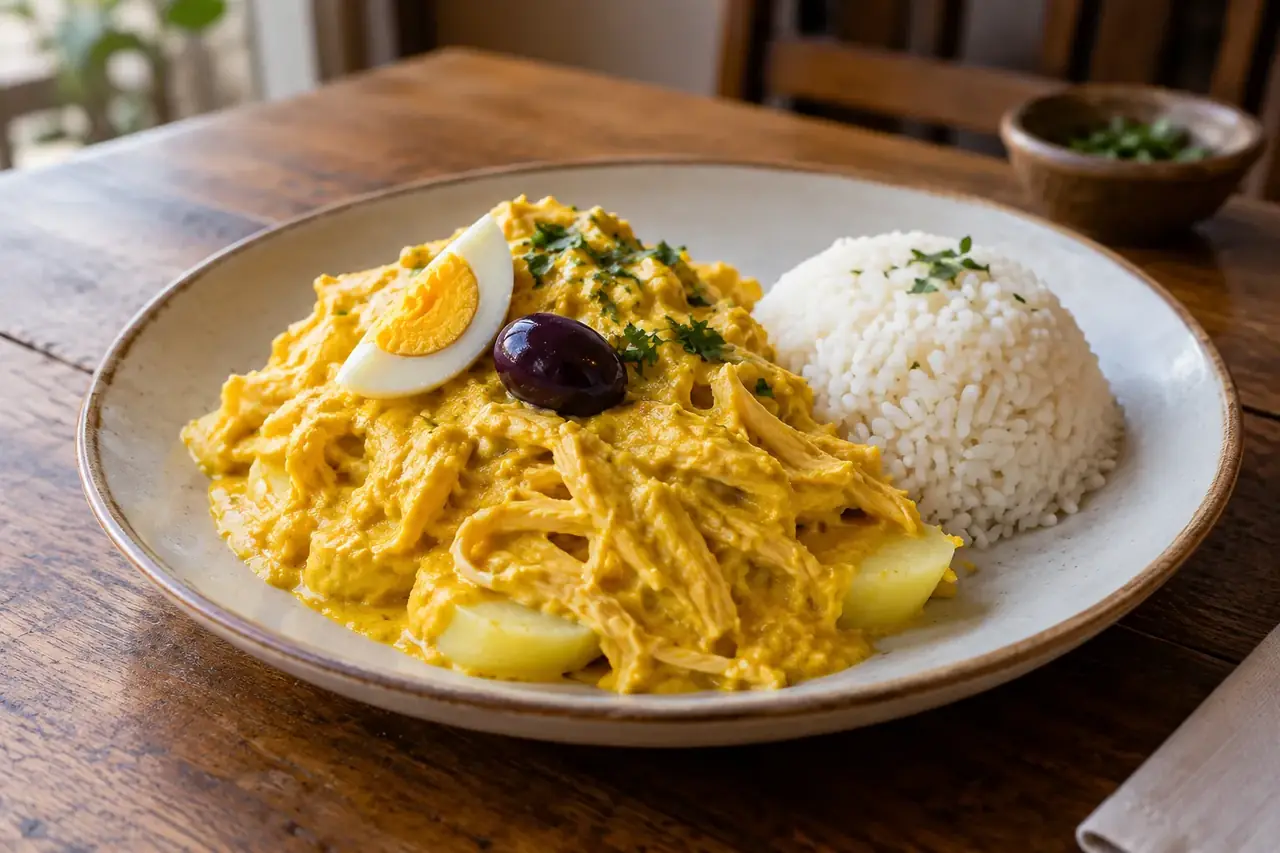
Ají de gallina is one of Lima’s best-known criollo dishes: shredded poultry in a thick yellow chilli sauce, bound with soaked bread and milk, served on potatoes. The yellow chilli is more fragrant than fiery here.
Where the dish comes from
Wikipedia places it in the cooking of the coast and reports the hypothesis of the researcher Gloria Hinostroza: a blend of Spanish migas, breadcrumbs, and the Andean uchu, a stew of meats with chilli. The recipe published by PROMPERÚ keeps these elements: a bird poached with bay and vegetables, whose stock is kept, bread soaked in milk, an aderezo of onion, garlic and ají amarillo cream, pecans and parmesan.
Hen or chicken
The name says “gallina”, the hen, but Wikipedia notes that it is often replaced by chicken. The hen, being older, has firmer flesh and gives a richer stock; chicken cooks more quickly and stays more tender. This version uses chicken thighs or breasts, poached: it is their stock that loosens the sauce.
Choosing the ingredients well
- Ají amarillo paste is sold in jars in Latin American grocery shops; its intensity varies from one brand to another: start with three spoonfuls, taste, add more.
- The bread: a day-old white bread with a dense crumb. Sweetened industrial sandwich bread changes the taste.
- The potatoes: yellow and waxy, cut into thick rounds.
Our version
We make it with chicken, easier to find than a boiling hen. The amount of stock depends on the bread and the ají paste: rely on the texture pointers rather than on a fixed volume. Parmesan replaces the local cheese of some versions, as in PROMPERÚ’s recipe.
Ingredients
Serves 4
Estimated preparation time
- Advance preparation
- 30 to 40 minutes to poach the chicken and make the stock (not needed with chicken that is already cooked)
- Active time
- 35 minutes
- Cooking
- 15 to 20 minutes of simmering the sauce
- Total
- About 1 hr 15 min, 45 minutes with chicken that is already cooked
Techniques: Boiling, Simmering, Blended sauce.
The chicken and its stock
The sauce
To serve
Tick off the ingredients as you go: the boxes are remembered on this device.
Useful equipment
- A large saucepan for poaching
- A blender
- A heavy-based saucepan
- A cooking thermometer
Method
- Put the chicken, carrot, leek and bay leaf in 1.2 litres of cold salted water. Bring to a simmer and poach for 25 to 30 minutes without boiling hard, until 74 °C (165 °F) at the thickest point.
- Take out the chicken, leave it to cool for 10 minutes, then shred it with a fork into fine strands. Strain the stock and keep about 500 ml of it warm.
- Crumble the bread into 200 ml of milk and leave it to soak for 10 minutes, then blend until you have a smooth paste, with no lumps.
- In the heavy-based saucepan, fry the onion in the oil over a medium heat for 8 to 10 minutes, without colouring, until it is translucent and soft. Add the garlic for one minute.
- Add the ají paste, cumin and turmeric. Stir for 3 to 4 minutes: the oil turns orange-yellow and the smell of raw chilli disappears. This is the aderezo, the base of the dish.
- Pour in the blended bread, then the stock a ladleful at a time, stirring. Simmer gently for 10 minutes, scraping the bottom so it does not stick.
- Add the rest of the milk, the shredded chicken, the pecans and the parmesan. Simmer for another 5 minutes. The sauce should coat the spoon: if it is too thick, add stock; too thin, cook it a little longer uncovered. Season with salt and pepper at the end, as the parmesan is already salty.
- Serve on the potato rounds, with the rice, the hard-boiled egg in quarters and the olives.
Signs of success
- The blended bread is perfectly smooth: a visible crumb of bread will make the sauce grainy.
- The aderezo is ready when the onion is soft and the ají paste has lost its raw smell.
- The sauce is orange-yellow, creamy, and coats the spoon without running like a soup.
- The chicken is in fine strands, coated in sauce, not in cubes.
Precautions
- Poultry: 74 °C (165 °F) at the thickest point, checked with a thermometer.
- Keep the board and knife used for the raw chicken separate from those for the vegetables and the bread.
Allergens identified
Present: gluten (bread), milk, tree nuts (pecans). Possible: egg (if served), celery (if used in the stock).
Always check the labels of the products you buy (sauces, stocks, chilli pastes).
Variations and tips
- With a boiling hen (gallina), as the name suggests: an older bird, with firmer flesh and a more flavoursome stock, which needs longer cooking.
- Some recipes replace part of the milk with evaporated milk, which is more concentrated.
Reasonable substitutions
- Pecans: ordinary walnuts give a more bitter taste; without nuts, leave them out and note that the sauce will be less rounded.
- Ají amarillo paste: a roasted yellow pepper and a little chilli give the colour, not the fruity aroma. It is then an adaptation.
Storage
- Leftovers: in the fridge within one to two hours of cooking, to be eaten within 48 hours or frozen. The sauce thickens when cold: loosen it with a little stock or milk when reheating to at least 70 °C.
- Rice served with the dish: cooled within an hour of cooking, kept in the fridge, eaten within 24 hours, reheated only once to 70 °C at the core for 2 minutes.
Going further
Sources and dates
2 sources
Prices, opening hours and rules change: every piece of information cited links to its source, with the date it was consulted.
Figures and rules cited
- 74 °C (165 °F) at the thickest point: Minimum core temperature for poultry (chicken, turkey, giblets, stuffing) (United States) . A US threshold, stricter than the FSVO’s general guideline of 70 °C; used for the poultry recipes.
Official source: FoodSafety.gov, safe minimum cooking temperatures (reviewed on 21 November 2024) (new tab) , published on 21 November 2024 · consulted on 3 October 2026 - in the fridge within one to two hours of cooking, to be eaten within 48 hours or frozen: Cooling and keeping cooked leftovers (United Kingdom) . The same source asks you to thaw food in the fridge and to eat thawed food within 24 hours.
Official source: GOV.UK (Food Standards Agency), cooling, freezing and defrosting food safely (18 December 2017) (new tab) , published on 18 December 2017 · consulted on 3 October 2026 - to at least 70 °C: Reheating a dish that is already cooked (Switzerland)
Official source: FSVO, Hygiène et aliments (food hygiene, in French) (new tab) · consulted on 3 October 2026 - cooled within an hour of cooking, kept in the fridge, eaten within 24 hours, reheated only once to 70 °C at the core for 2 minutes: Storing cooked rice (United Kingdom)
Official source: NHS, starchy foods and carbohydrates (reviewed on 15 March 2023) (new tab) , published on 15 March 2023 · consulted on 3 October 2026
Sources consulted
- PROMPERÚ, recipe for ají de gallina (new tab) (consulted on 3 October 2026)
- Wikipedia (Spanish), Ají de gallina (hen or chicken, hypotheses about its origin) (new tab) (consulted on 3 October 2026)
How we choose and date our information: our method. Has something changed? Let us know.