
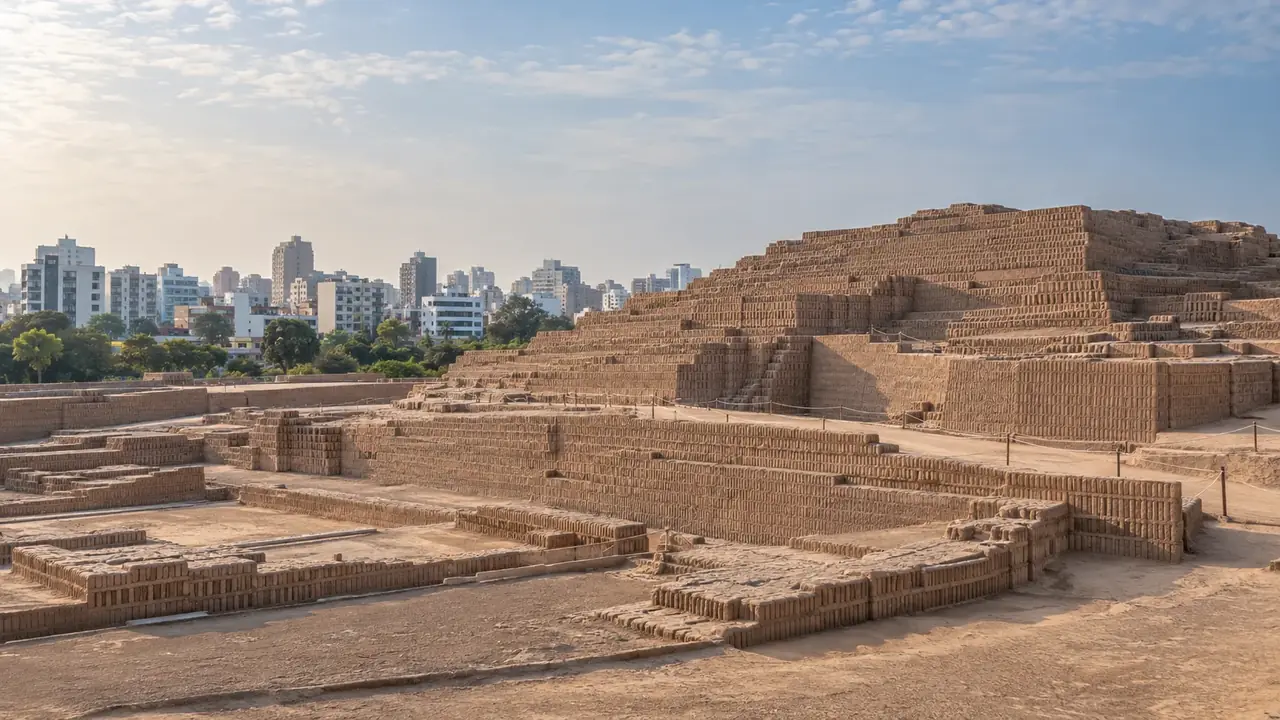
A pyramid among the apartment blocks
Among the residential blocks of Miraflores, a large stepped mound of earth covers several city blocks: the Huaca Pucllana. A huaca, in Quechua and in Peruvian usage, means a sacred place or object; the word is now used for the pre-Hispanic earthen monuments scattered across Lima. This one is among the best studied and the easiest to visit, a few streets from Kennedy Park.
It shows a reality that is often forgotten: Lima did not begin with the Spanish foundation of 1535. The Rímac valley had been inhabited and developed for centuries, and several cultures followed one another there.
Three successive occupations
| Period | Who | What they made of the place |
|---|---|---|
| Around 450-650 AD | Lima culture | Construction of the ceremonial centre: stacked platforms, plazas and patios, where ceremonies and banquets linked to the sea were held |
| Around 800 AD | Wari | The top of the pyramid becomes an elite cemetery |
| Around 1000 AD | Ychsma (Ichma) | The building is used as a repository for offerings |
The Lima culture developed on the central coast, in the Chillón, Rímac and Lurín valleys. The Wari, who came from the south-central Andes (Ayacucho region), extended their influence over a large part of Peruvian territory between the 7th and 10th centuries. The Ychsma dominated the Lima coast later, before the arrival of the Incas; their great sanctuary was Pachacámac.
Millions of earth bricks
The pyramid is built with millions of small adobes, bricks of raw earth moulded and dried in the sun. The guides point out how they are laid: set vertically, side by side, with spaces between them, like books on a shelf. This method is often called the “bookshelf technique”; archaeologists see it as a way of better withstanding earthquakes, an interpretation the guides present as such. Look at the walls closely: the rows of bricks are visible, as are the successive layers of construction.
What the visit shows
- The archaeological area, explored along marked paths, with views over the platforms and patios.
- An exhibition room with original objects found during the excavations: ceramics, textiles, offerings.
- A park of native flora and fauna, a reminder of what the valley’s inhabitants grew and raised.
- An interactive room, Pukllaywasi, devoted to the pre-Hispanic history of the site, useful with children.
Day and night visits do not offer the same experience: by day, you get a better sense of the overall shape and scale; at night, by booking, the illuminated pyramid is more spectacular but the details of the bricks are harder to make out.
Daytime, heat and mobility
The archaeological area has very little shade. In the southern summer (December to March), visit in the morning, with a hat and water. The paths include slopes and steps: if you have difficulty walking, ask at reception which part of the route suits you.
The restaurant and the huaca: two different things
A restaurant on the edge of the site offers a view of the pyramid. The meal does not include the archaeological visit, and the visit does not include access to the restaurant: if you want both, plan two separate bookings.
Practical information
- Opening hours: daytime visits from 9:00 to 17:00, closed on Tuesdays; night visits from Wednesday to Sunday from 18:30 to 21:00, by booking.
- Prices: S/ 15 by day, S/ 17 at night (prices published by the tourism website of the municipality of Miraflores).
- Getting there: Calle General Borgoño, cuadra 8, 1.8 km, about 25 minutes on foot from Kennedy Park.
Our suggestion
A morning visit, to open a day in Miraflores: the huaca first, while the sun is still low, then Kennedy Park and the seafront on foot.
What to ask before you go
- The time of the next tour and its language.
- Booking for a night visit, and the accessible route if you have difficulty walking.
Have the opening hours, a dish or a price changed? Let us know and we will correct this page.
Sources and dates
3 sources
Prices, opening hours and rules change: every piece of information cited links to its source, with the date it was consulted.
Figures and rules cited
- daytime visits from 9:00 to 17:00, closed on Tuesdays; night visits from Wednesday to Sunday from 18:30 to 21:00, by booking: Opening hours of the Huaca Pucllana (Huaca Pucllana, calle General Borgoño, block 8, Miraflores)
Official source: Visita Miraflores (municipality), Museo de sitio Pucllana (new tab) · consulted on 2 October 2026 - S/ 15 per admission: Huaca Pucllana: daytime visit (Museo de sitio Huaca Pucllana (Miraflores), Lima) (Published general rate)
Price recorded: Visita Miraflores (municipality), Museo de sitio Pucllana (new tab) · consulted on 2 October 2026 - S/ 17 per admission: Huaca Pucllana: night visit (Museo de sitio Huaca Pucllana (Miraflores), Lima) (Published general rate)
Price recorded: Visita Miraflores (municipality), Museo de sitio Pucllana (new tab) · consulted on 2 October 2026 - 1.8 km, about 25 minutes: Walking distance and time, Kennedy park–Huaca Pucllana (Miraflores)
Press or reseller: Walking route calculated on OpenStreetMap (FOSSGIS routing server, pedestrian profile) (new tab) · consulted on 2 October 2026
Sources consulted
- Visita Miraflores (municipality), Museo de sitio Pucllana (new tab) (consulted on 2 October 2026)
- Museo de sitio Pucllana, museum page (new tab) (consulted on 2 October 2026)
- Ministry of Culture, guide to the museums and museum institutions of Peru 2023 (new tab) : cited by the audit; document not reread in full (consulted on 1 October 2026)
How we choose and date our information: our method. Has something changed? Let us know.