
Recipe · Main course · Lima and criolla cooking
Beef heart anticuchos
Beef heart skewers marinated in ají panca, vinegar, garlic and cumin, grilled while basting, after two hours of marinating.
- Serves 4 (about 12 skewers)
- About 3 hours, including 2 hours of marinating (estimate)
- Intermediate
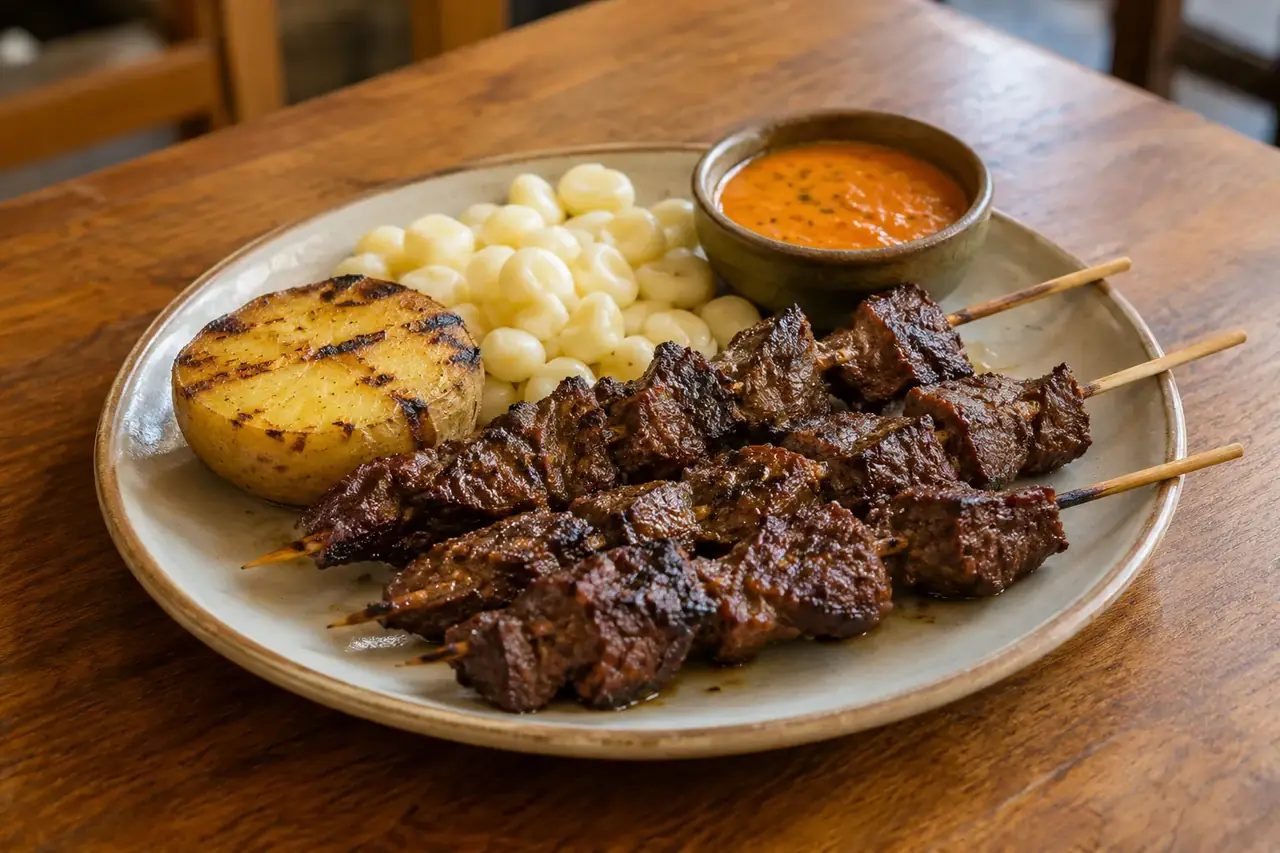
Skewers of beef heart, marinated and grilled over embers: the anticucho is sold in the evening in the streets of Lima and appears on the menus of criollo restaurants. A lot of it is eaten in October, the month of the processions of the Señor de los Milagros.
A history with several voices
Wikipedia reports several stories, without deciding between them: a name that is said to come from Quechua (“antikuchu”, cut in the Andean way, or “anti-uchu”, with chilli), a pre-Columbian preparation made with llama meat, the Spanish contribution of beef and garlic, and above all the role of the enslaved Africans, who were left the offal and turned it into this dish. The Afro-Peruvian painter Pancho Fierro drew anticucheros in the middle of the 19th century, and Ricardo Palma describes them being sold in the streets of Lima.
The marinade and the basting sauce
PROMPERÚ’s recipe is based on two separate preparations. The marinade (ají panca, garlic, cumin, oregano, vinegar, dark beer) flavours the meat for at least two hours; the vinegar tenderises the surface and the ají panca, mild and smoky, gives it its dark red colour. The basting sauce of oil and ají panca, made separately, is brushed on during cooking: it makes the skewers shine and caramelise.
Beef heart
The heart is a lean, firm muscle, without a pronounced offal taste when well trimmed. Order it from the butcher in advance: they will remove the fat, the membranes and the valves. The pieces should all be the same size so they cook at the same time.
Our version
Without embers, a very hot cast-iron frying pan colours the meat well, without the smoky taste of the barbecue. Keep the pieces an even thickness and rely on the core temperature.
Ingredients
Serves 4 (about 12 skewers)
Estimated preparation time
- Advance preparation
- 15 minutes to trim the heart, if the butcher has not done so; 30 minutes of soaking the wooden skewers
- Active time
- 30 minutes
- Cooking
- 6 to 8 minutes per batch
- Resting
- 2 hours of marinating in the fridge, up to overnight
- Total
- About 3 hours, including 2 hours of marinating
Techniques: Grill or griddle.
The skewers
The marinade
The basting sauce, made separately
To serve
Tick off the ingredients as you go: the boxes are remembered on this device.
Useful equipment
- 12 wooden or metal skewers
- A grill or cast-iron frying pan
- A pastry brush
- A cooking thermometer
Method
- Soak the wooden skewers in water for 30 minutes, so that they do not burn.
- If the butcher has not done so, remove the fat, the membranes and the white fibrous parts from the heart. Cut it into even pieces of about 3 × 4 cm and 1.5 cm thick: pieces of the same size cook at the same time.
- Make the basting sauce separately, in a small bowl: ají panca paste, oil, salt. It will never touch the raw meat.
- Mix the marinade ingredients, add the heart, cover and leave in the fridge for 2 hours, up to overnight.
- Drain the pieces and thread 3 or 4 onto each skewer, without packing them tightly. Throw away the marinade.
- Heat the grill or the frying pan over a high heat. Put the skewers on without crowding them, brush them and cook them for 3 to 4 minutes on each side, brushing again after turning them.
- Check the cooking with a thermometer on the largest piece: at least 70 °C at the core. Brown the potato rounds on the grill in the meantime.
- Serve straight away, with the potatoes, the corn and the sauce.
Signs of success
- The surface is well coloured, lightly caramelised, without being black.
- The heart stays firm to the bite, without being dry: pieces that are too thin or overcooked make it rubbery.
- The skewers shine thanks to the basting sauce, applied during cooking and not afterwards.
Precautions
- Marinade: do not reuse it for a raw dish (sauce, dressing). The basting sauce made separately serves as the cooking sauce.
- Cooking: at least 70 °C at the core (the FSVO benchmark for all meat).
- Keep a clean plate for the cooked skewers: not the one that held the raw meat.
Allergens identified
No major allergen in the list of ingredients. Possible: gluten (dark beer, if used).
Check the label of the ají panca paste.
Always check the labels of the products you buy (sauces, stocks, chilli pastes).
Variations and tips
- On the barbecue, over hot embers, like the anticucheros: the smoke adds a flavour the frying pan cannot give.
- Other versions use chicken hearts, chicken or fish; in Peru, these are usually called “brochetas”.
Reasonable substitutions
- A version with beef fillet or sirloin is possible: it is then a skewer of beef marinated the Peruvian way, to be presented as an adaptation.
- Without beer, increase the vinegar a little or add water: the marinade will be sharper.
Storage
- Raw heart: in the fridge, below 5 °C, to be cooked within the time given by the butcher.
- Cooked skewers: in the fridge within one to two hours of cooking, to be eaten within 48 hours or frozen.
Going further
Sources and dates
2 sources
Prices, opening hours and rules change: every piece of information cited links to its source, with the date it was consulted.
Figures and rules cited
- at least 70 °C at the core: Minimum core temperature for meat, poultry, fish and seafood (general Swiss guideline) (Switzerland) . A food safety guideline, not a culinary doneness criterion: some meats are served more cooked.
Official source: FSVO, Hygiène et aliments (food hygiene: four basic rules, in French) (new tab) · consulted on 3 October 2026 - in the fridge, below 5 °C: Storing meat, poultry, fish, seafood and leftovers (Switzerland) . The FSVO also asks you not to refreeze food that has been thawed.
Official source: FSVO, Hygiène et aliments (food hygiene, in French) (new tab) · consulted on 3 October 2026 - in the fridge within one to two hours of cooking, to be eaten within 48 hours or frozen: Cooling and keeping cooked leftovers (United Kingdom) . The same source asks you to thaw food in the fridge and to eat thawed food within 24 hours.
Official source: GOV.UK (Food Standards Agency), cooling, freezing and defrosting food safely (18 December 2017) (new tab) , published on 18 December 2017 · consulted on 3 October 2026 - do not reuse it for a raw dish (sauce, dressing): A marinade that has held raw meat or fish (Switzerland)
Official source: FSVO, Hygiène et aliments (food hygiene, in French) (new tab) · consulted on 3 October 2026
Sources consulted
- PROMPERÚ, recipe for anticucho (marinade, basting sauce, side dishes) (new tab) (consulted on 3 October 2026)
- Wikipedia (Spanish), Anticucho (history, Pancho Fierro, Ricardo Palma, October) (new tab) (consulted on 3 October 2026)
How we choose and date our information: our method. Has something changed? Let us know.