
Recipe · Main course · Ica
Carapulcra, a stew of pork and papa seca
Papa seca toasted and then slow-cooked with pork, ají panca, cinnamon and peanuts: the stew of Chincha and Cañete.
- Serves 4
- 1 hr 45 min on the day itself, after soaking overnight (estimate)
- Intermediate
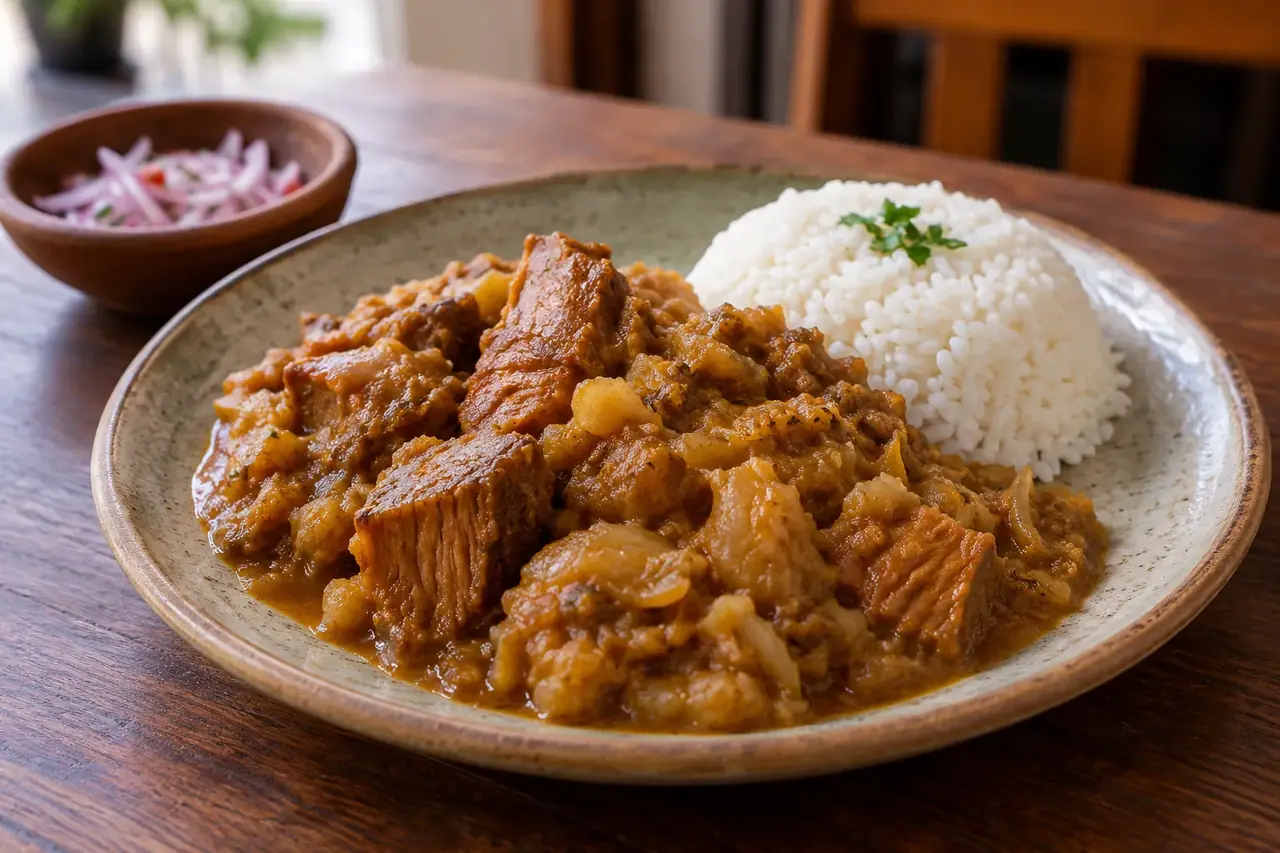
A thick stew of dried potato, pork and panca chilli, bound with peanuts: carapulcra is one of the oldest Peruvian dishes on record. It is eaten at big gatherings in Chincha and Cañete, often with sopa seca.
An Aymara name, a criollo table
According to Wikipedia, the name is said to come from the Aymara qala phurk’a, a stew cooked with heated stones, prepared in the Andes with llama meat and papa seca. The dish then made its way onto criollo tables: it is mentioned in 1822 at the banquet for the first anniversary of independence. Wikipedia links it to the blending of Indigenous and Afro-Peruvian cuisines, and particularly to the provinces of Chincha (Ica) and Cañete (Lima), where it is served on its own or with sopa seca, under the name “manchapecho”.
Papa seca, the key to the dish
Papa seca is a potato that has been cooked, dried and then crushed into small, hard pieces. PROMPERÚ’s recipe toasts it dry, then soaks it overnight in twice its volume of water: toasting gives it a nutty taste, soaking makes it swell. During cooking, it partly breaks down and thickens the stew. It can be found in packets in Latin American grocery shops.
Our version
Our version simplifies the techniques a little. Papa seca absorbs a lot: add the stock little by little, following the texture pointers.
Ingredients
Serves 4
Estimated preparation time
- Advance preparation
- 10 minutes to toast the papa seca, then soaking overnight (at least 8 hours)
- Active time
- 30 minutes
- Cooking
- 1 hr 15 min over a low heat
- Total
- 1 hr 45 min on the day itself, after soaking overnight
Techniques: Simmering.
The day before
The stew
To serve
Tick off the ingredients as you go: the boxes are remembered on this device.
Useful equipment
- A dry frying pan
- A bowl
- A heavy-based casserole
- A blender or grinder
Method
- The day before: toast the papa seca in a dry frying pan over a medium heat for 5 to 8 minutes, stirring, until it smells toasted and browns slightly. Leave to cool.
- Rinse it, remove any small stones or blackened pieces, then cover it with twice its volume of cold water. Leave it to soak overnight in the fridge.
- On the day itself, drain the papa seca: the pieces have swollen and can be marked with a fingernail.
- In the casserole, brown the pork in the oil over a medium-high heat, in two batches, for 8 to 10 minutes. Set aside.
- Lower the heat, fry the onion for 8 minutes, the garlic for one minute, then the ají panca, cumin and pepper for 3 minutes, until the oil turns a dark red colour.
- Return the pork, add the papa seca, the cinnamon, the cloves and 800 ml of hot stock. Simmer over a low heat, uncovered, for about 1 hour, scraping the bottom often: papa seca sticks easily.
- Add hot stock in small amounts whenever the stew becomes too thick. The papa seca is cooked when it is tender and starts to break down, thickening the sauce.
- Stir in the ground peanuts and the port, add salt, and cook for another 10 minutes, stirring. Remove the cinnamon and the cloves. The pork should be tender and cooked at least 70 °C at the core.
- Serve hot, with rice, cassava or a sopa seca.
Signs of success
- Toasted the day before, the papa seca has turned a light golden colour and smells nutty, without burning.
- The stew is thick, reddish-brown, coating; you can still make out tender pieces of potato in a thickened sauce.
- The peanuts thicken the sauce at the end of cooking: added too early, they stick.
Precautions
- While simmering, the papa seca sticks to the bottom: stir often and keep the heat low.
- Raw pork: in the fridge, below 5 °C.
Allergens identified
Present: peanuts. Possible: celery (depending on the stock used), sulphites (port).
Always check the labels of the products you buy (sauces, stocks, chilli pastes).
Variations and tips
- In Chincha, according to Wikipedia, carapulcra is also made with fresh potato.
- Other families add dark chocolate, pork jelly, mirasol chilli, poultry or chicken.
- The “manchapecho”: carapulcra and sopa seca served together.
Reasonable substitutions
- Fresh waxy potato, in small cubes, instead of papa seca: the dish is quicker but lacks the toasted, dense texture; it is another version.
- Without peanuts: leave them out; the sauce will be thinner and less rounded.
Storage
- Leftovers: in the fridge within one to two hours of cooking, to be eaten within 48 hours or frozen. Carapulcra thickens when cold: loosen it with water or stock when reheating to at least 70 °C.
Going further
Sources and dates
3 sources
Prices, opening hours and rules change: every piece of information cited links to its source, with the date it was consulted.
Figures and rules cited
- at least 70 °C at the core: Minimum core temperature for meat, poultry, fish and seafood (general Swiss guideline) (Switzerland) . A food safety guideline, not a culinary doneness criterion: some meats are served more cooked.
Official source: FSVO, Hygiène et aliments (food hygiene: four basic rules, in French) (new tab) · consulted on 3 October 2026 - in the fridge within one to two hours of cooking, to be eaten within 48 hours or frozen: Cooling and keeping cooked leftovers (United Kingdom) . The same source asks you to thaw food in the fridge and to eat thawed food within 24 hours.
Official source: GOV.UK (Food Standards Agency), cooling, freezing and defrosting food safely (18 December 2017) (new tab) , published on 18 December 2017 · consulted on 3 October 2026 - to at least 70 °C: Reheating a dish that is already cooked (Switzerland)
Official source: FSVO, Hygiène et aliments (food hygiene, in French) (new tab) · consulted on 3 October 2026 - in the fridge, below 5 °C: Storing meat, poultry, fish, seafood and leftovers (Switzerland) . The FSVO also asks you not to refreeze food that has been thawed.
Official source: FSVO, Hygiène et aliments (food hygiene, in French) (new tab) · consulted on 3 October 2026
Sources consulted
- PROMPERÚ, recipe for carapulcra (papa seca toasted and soaked, pork, peanuts) (new tab) (consulted on 3 October 2026)
- Wikipedia (Spanish), Carapulcra (etymology, Chincha and Cañete, manchapecho, variants) (new tab) (consulted on 3 October 2026)
- Marca Perú (PROMPERÚ), sopa seca from Chincha and the manchapecho (new tab) (consulted on 3 October 2026)
How we choose and date our information: our method. Has something changed? Let us know.