
Recipe · Main course · Chifa
Arroz chaufa
The fried rice of Lima’s chifas, with chicken, omelette, spring onion, ginger (kion) and soy sauce (sillao), made with well-chilled day-old rice.
- Serves 4
- 35 minutes with rice that is already cooked and cold (estimate)
- Easy
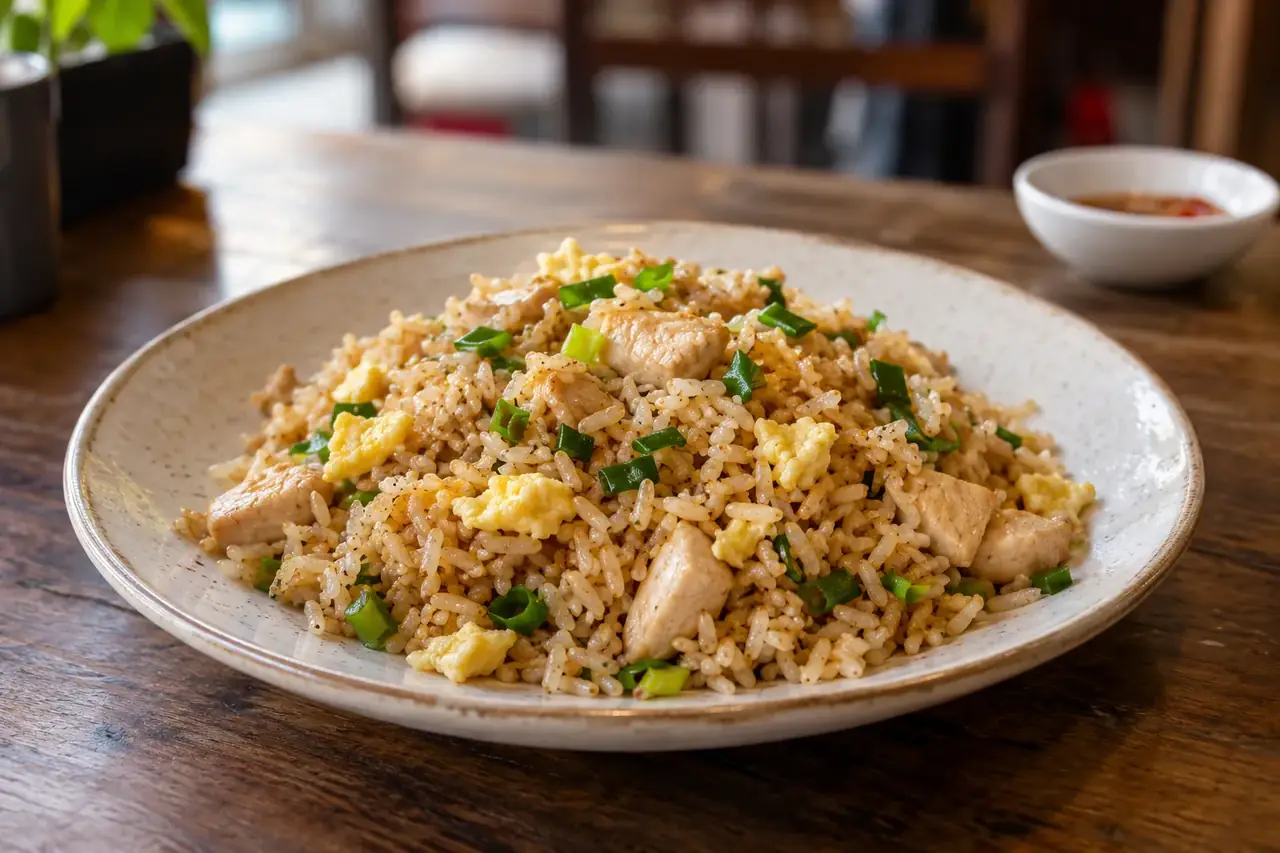
Chaufa is the emblematic dish of chifa, the cuisine born in Lima from the meeting between Chinese immigrants and Peruvian produce: rice stir-fried over a very high heat with spring onions, eggs, a meat and soy sauce. In Peru, the person who makes it is called a “chaufero”.
A dish from Canton
According to Wikipedia, chaufa derives from Cantonese fried rice, which arrived with the Chinese workers of the late 19th century. Their ingredients entered Lima’s family kitchens under local names: kion (ginger), sillao (soy sauce), cebolla china (spring onion, Allium fistulosum).
Why rice from the day before
Cold, slightly dry rice separates into grains and toasts instead of sticking. The condition is that it was cooled quickly and kept in the fridge: according to the NHS, raw rice can contain bacterial spores that survive cooking and multiply if the cooked rice is left at room temperature. That is why storing rice follows a precise rule, set out below.
The heat, the quantity, the order
The chifa wok gets much hotter than a domestic hob. To come close: prepare everything before you start, heat the pan for a long time, and cook in small quantities. Too much rice at once cools the pan and the rice boils in its own steam. Two batches are better than one.
Our version
Start with rice cooked the day before: about 250 g of raw rice gives 600 g of cooked rice, depending on the variety.
Ingredients
Serves 4
Estimated preparation time
- Advance preparation
- Rice cooked the day before or at least a few hours ahead, cooled within the hour and then kept in the fridge (about 250 g of raw rice, 20 minutes of cooking)
- Active time
- 25 minutes, chopping included
- Cooking
- 10 to 12 minutes over a high heat
- Total
- 35 minutes with rice that is already cooked and cold
Techniques: Stir-frying over high heat.
Tick off the ingredients as you go: the boxes are remembered on this device.
Useful equipment
- A wok or large frying pan (at least 28 cm)
- A spatula
- A cooking thermometer
Method
- Prepare everything before turning on the heat: the chicken cut up, the garlic and ginger chopped, the spring onions sliced (whites on one side, greens on the other), the soy sauce measured out. Break up the cold rice with your hands to separate the clumps.
- Beat the eggs with the salt. In the very hot wok with a spoonful of oil, make a thin omelette, turn it over, then roll it up and cut it into strips. Set aside.
- Add a spoonful of oil, stir-fry the chicken over a high heat for 5 to 6 minutes, in two batches if the wok is small, until it is golden and 74 °C (165 °F) at the thickest point. Set aside.
- Add the rest of the oil, then the garlic, the ginger and the spring onion whites: 30 seconds, stirring, without letting the garlic burn.
- Add the rice and stir-fry it for 3 to 4 minutes, turning it constantly, until the grains are hot, separate and lightly toasted in places.
- Pour the soy sauce onto the hot edge of the wok rather than the centre, then mix. Return the chicken and the omelette, add the spring onion greens and stir for one minute. The rice should be piping hot, reheated to at least 70 °C.
- Serve straight away, with a little soy sauce or chilli cream on the side.
Signs of success
- The grains are separate and shiny, evenly coloured a light brown, with no pool of sauce at the bottom.
- The rice “sings” in the wok: if it barely smokes and sticks, the heat is too low or the quantity too large.
- The spring onion greens stay bright green: added at the end, they hardly cook.
Precautions
- Never use rice that has been left at room temperature: it is the rapid cooling that counts, more than the texture.
- Keep the board for the raw chicken separate from the one for the spring onions.
Allergens identified
Present: egg, soy. Possible: gluten (often present in soy sauce).
Always check the labels of the products you buy (sauces, stocks, chilli pastes).
Variations and tips
- Chaufa with roast pork, prawns, or mixed: the method is the same, the protein changes.
- “Amazonian” chaufa: with cecina and chorizo from the forest, as on some Lima menus.
Reasonable substitutions
- Rice cooked on the same day: cool it spread out on a tray, then in the fridge; being moister, it sticks more.
- Gluten-free soy sauce (tamari): the taste stays close; check the label.
Storage
- Cooked rice: cooled within an hour of cooking, kept in the fridge, eaten within 24 hours, reheated only once to 70 °C at the core for 2 minutes. A chaufa made with the previous day’s rice should therefore be eaten straight away, not reheated a second time.
- Raw chicken: in the fridge, below 5 °C.
Going further
Sources and dates
3 sources
Prices, opening hours and rules change: every piece of information cited links to its source, with the date it was consulted.
Figures and rules cited
- 74 °C (165 °F) at the thickest point: Minimum core temperature for poultry (chicken, turkey, giblets, stuffing) (United States) . A US threshold, stricter than the FSVO’s general guideline of 70 °C; used for the poultry recipes.
Official source: FoodSafety.gov, safe minimum cooking temperatures (reviewed on 21 November 2024) (new tab) , published on 21 November 2024 · consulted on 3 October 2026 - to at least 70 °C: Reheating a dish that is already cooked (Switzerland)
Official source: FSVO, Hygiène et aliments (food hygiene, in French) (new tab) · consulted on 3 October 2026 - cooled within an hour of cooking, kept in the fridge, eaten within 24 hours, reheated only once to 70 °C at the core for 2 minutes: Storing cooked rice (United Kingdom)
Official source: NHS, starchy foods and carbohydrates (reviewed on 15 March 2023) (new tab) , published on 15 March 2023 · consulted on 3 October 2026 - in the fridge, below 5 °C: Storing meat, poultry, fish, seafood and leftovers (Switzerland) . The FSVO also asks you not to refreeze food that has been thawed.
Official source: FSVO, Hygiène et aliments (food hygiene, in French) (new tab) · consulted on 3 October 2026
Sources consulted
- Wikipedia (Spanish), Arroz chaufa (wok-fried rice, spring onion, soy sauce) (new tab) (consulted on 3 October 2026)
- NHS, starchy foods: storing and reheating rice (reviewed 15 March 2023) (new tab) (consulted on 3 October 2026)
- Wikipedia (Spanish), Cocina chifa (history, kión, sillao) (new tab) (consulted on 3 October 2026)
How we choose and date our information: our method. Has something changed? Let us know.