
Recipe · Starter or salad · Lima and criolla cooking
Peruvian ceviche: recipe and method
Fish sold for eating raw, limes squeezed at the last minute, red onion, chilli and coriander: the ceviche recipe, and a version with cooked fish.
- Makes 4 small starter portions
- About 45 minutes, side dishes included (estimate)
- Intermediate
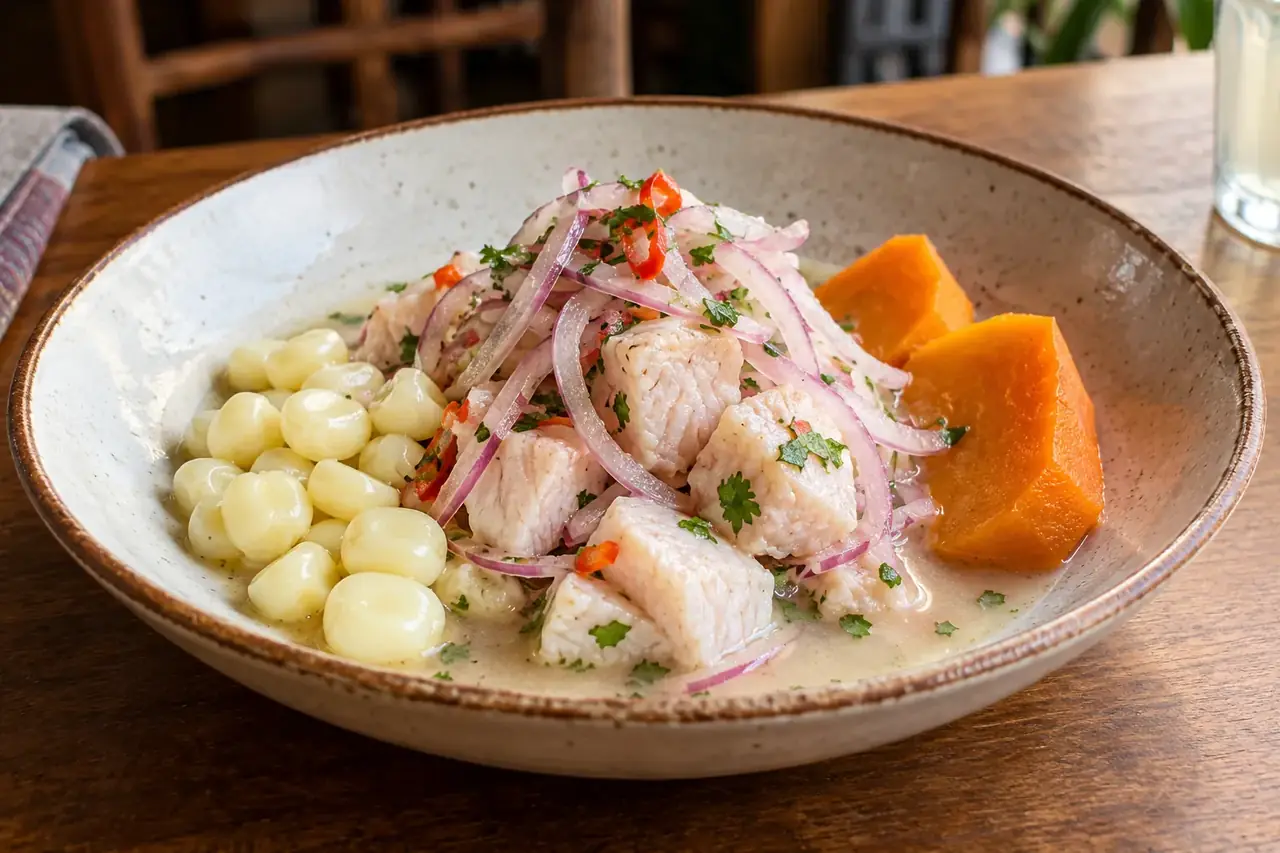
Raw fish cut into cubes, seasoned with salt, chilli and lime squeezed at the last minute, with red onion and coriander: ceviche is Peru’s national dish. In Peru, the useful question is “which fish and which chilli?”; at home, the first question is the quality of the fish.
A recognised heritage
In 2023, UNESCO inscribed the practices and meanings associated with ceviche on its Representative List of the Intangible Cultural Heritage. Its listing describes a dish of raw fish marinated in lime, spiced with chilli and salt, whose recipes vary from one region to another, passed down mainly within families, and linked to artisanal fishermen as well as to the cooks of the cebicherías.
What the lime does, and what it does not do
The acidity of the lime firms up and whitens the surface of the fish, which looks “cooked”. But it is not cooking: the FDA, the American food agency, states that marinades do not eliminate fish parasites, and the CDC points out the risk of infection linked to raw fish in Peru. Hence three rules: fish sold for eating raw, kept very cold, served straight away.
The techniques of ceviche
PROMPERÚ’s recipe insists on details that make the difference: cubes of about 2 cm, onion cut “in feathers”, very thin, softened in cold water, and limes squeezed without forcing, because the peel makes the juice bitter. The fish marinates for only a few minutes: in Peru, it is eaten at midday, freshly prepared.
Our version
The corvina used in Lima is rarely found in Switzerland: ask the fishmonger for a firm white fish sold for eating raw. For people for whom raw food is not recommended, the poached-fish version lets them share the meal.
Ingredients
Makes 4 small starter portions
Estimated preparation time
- Advance preparation
- Buy fish sold for eating raw on the day itself; cook the sweet potato and the corn (20 minutes) beforehand
- Active time
- 20 minutes
- Resting
- 2 to 5 minutes in contact with the lime, no more
- Total
- About 45 minutes, side dishes included
Techniques: No cooking.
The ceviche
To serve
Tick off the ingredients as you go: the boxes are remembered on this device.
Useful equipment
- A board and knife kept for the fish
- A glass or stainless steel bowl set on ice
- A hand citrus juicer
Method
- Buy the fish on the day itself from a fishmonger, telling them it will be eaten raw, and keep it in the fridge until the last moment. Cook the sweet potato and the corn in advance and leave them to cool.
- Put the onion slices in iced water for 10 minutes to soften their flavour, then drain and dry them.
- Squeeze the limes by hand, without crushing the peel, to avoid bitterness. Keep the juice cold.
- On the board kept for the fish, cut it into even cubes of about 2 cm. Put them in the bowl set on ice.
- Just before serving: salt the fish, add the chilli, the garlic and the lime juice, and mix gently. Leave for 2 to 5 minutes: the surface of the fish turns white, the centre stays translucent.
- Add the onion and the coriander, taste the juice (salty, sour, spicy) and serve straight away, with the sweet potato and the corn. The juice left at the bottom, the leche de tigre, is drunk from a small glass.
Signs of success
- The cubes are white and pearly on the surface, still translucent in the centre, firm to the bite.
- The juice is lively, salty and spicy, without bitterness: peel that has been pressed too hard makes it bitter.
- Served more than 15 minutes after the lime is added, the fish becomes mealy: it is a last-minute dish.
Precautions
- The lime changes the texture and appearance of the fish, but does not cook it: it destroys neither parasites nor all bacteria. Only fish intended for eating raw, treated by a professional, is suitable.
- We do not offer a home freezing protocol: the temperatures and times that kill parasites require professional equipment.
- Raw fish is not recommended for pregnant women, young children, older people and people with weakened immune systems: the cooked-fish version lets them share the meal.
- Board, knife and hands: wash them after touching the raw fish.
Allergens identified
Present: fish. Possible: molluscs and crustaceans (mixed variant), soy and sesame (Nikkei variant).
Always check the labels of the products you buy (sauces, stocks, chilli pastes).
Variations and tips
- Mixed: with seafood cooked and then cooled (added allergens: molluscs, crustaceans).
- Nikkei: a touch of soy sauce and sesame oil (added allergens: soy, sesame).
- With rocoto: spicier, instead of the ají limo.
Reasonable substitutions
- Without raw fish: poach the fish for 5 to 6 minutes, until at least 70 °C at the core, cool it quickly, then season it in the same way. It is a “cooked-fish ceviche”, an adaptation to be announced as such.
- Lemon: less sour and less fragrant; the taste changes noticeably.
Storage
- Does not keep: ceviche is prepared and eaten straight away. Leftovers are thrown away.
- Raw fish before preparation: in the fridge, below 5 °C, on the day of purchase.
Going further
Sources and dates
4 sources
Prices, opening hours and rules change: every piece of information cited links to its source, with the date it was consulted.
Figures and rules cited
- at least 70 °C at the core: Minimum core temperature for meat, poultry, fish and seafood (general Swiss guideline) (Switzerland) . A food safety guideline, not a culinary doneness criterion: some meats are served more cooked.
Official source: FSVO, Hygiène et aliments (food hygiene: four basic rules, in French) (new tab) · consulted on 3 October 2026 - in the fridge, below 5 °C: Storing meat, poultry, fish, seafood and leftovers (Switzerland) . The FSVO also asks you not to refreeze food that has been thawed.
Official source: FSVO, Hygiène et aliments (food hygiene, in French) (new tab) · consulted on 3 October 2026
Sources consulted
- UNESCO, Practices and meanings associated with the preparation and consumption of ceviche (Representative List, 2023) (new tab) (consulted on 3 October 2026)
- PROMPERÚ, recipe for fish cebiche (2 cm cubes, lime squeezed without crushing the peel, onion cut in feathers) (new tab) (consulted on 3 October 2026)
- FDA, fish parasites: marinating does not eliminate them (hazards and controls guidance, parasites section) (new tab) (consulted on 25 September 2026)
- CDC Yellow Book, Peru (raw fish and meat, risk of infection) (new tab) (consulted on 3 October 2026)
How we choose and date our information: our method. Has something changed? Let us know.