
Recipe · Starter or salad · Lima and criolla cooking
Causa with chicken and avocado
A cold mash of yellow potatoes with lime and ají amarillo, layered with chicken in mayonnaise and avocado. Serves four.
- Serves 4 (an 18 cm mould or 4 rings of 8 cm)
- About 2 hr 30 min, including 1 hr 30 min of cooling (estimate)
- Easy
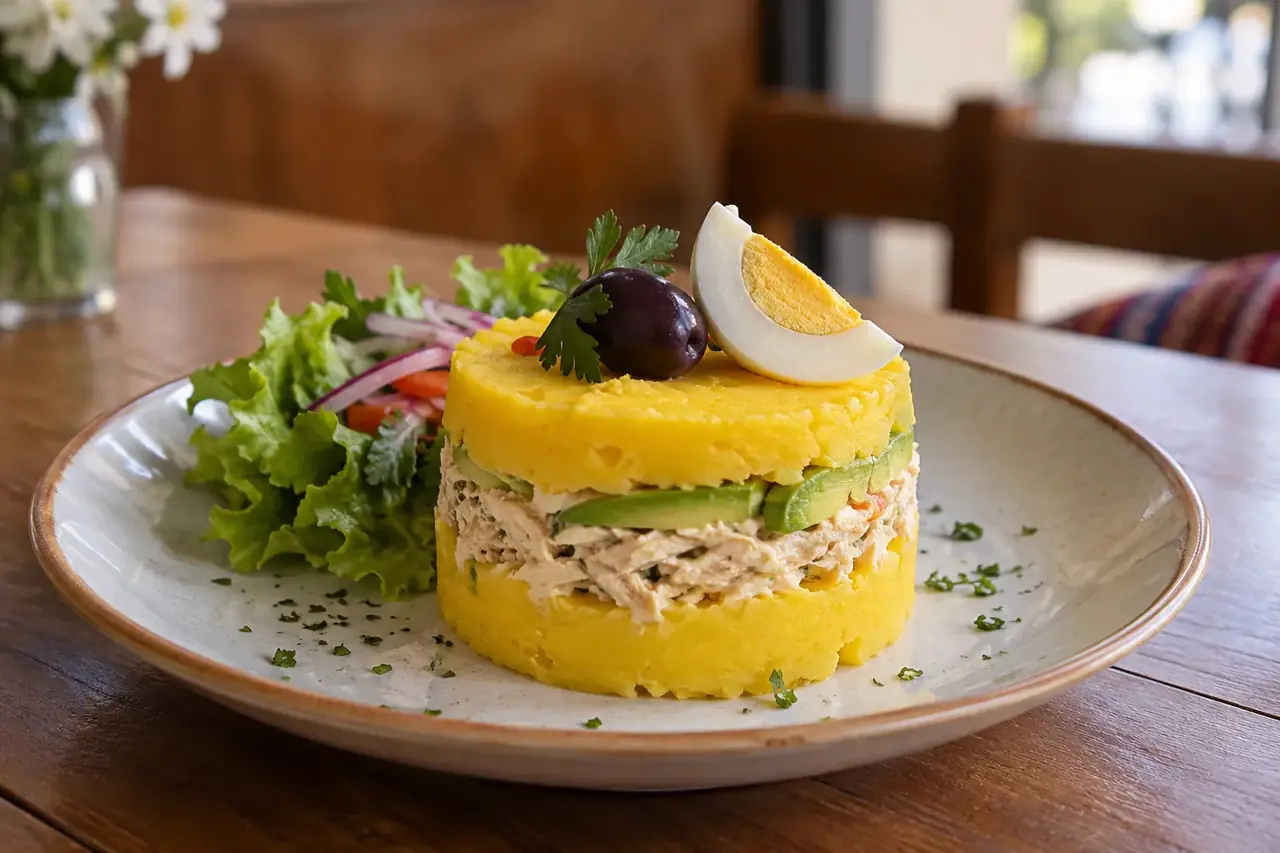
A cold mash of yellow potatoes, spiced up with lime and yellow chilli, layered around a filling: causa is the most widespread starter in Lima. At a restaurant, the useful question is simply “which filling?”.
An Andean potato, a lime from Asia
Wikipedia attributes a pre-Columbian origin to causa, based on papa amarilla and ají amarillo; the lime, which came from Asia, was added in colonial times, followed by hard-boiled egg, olives, and avocado for the filling. PROMPERÚ’s recipe gives the techniques: potatoes cooked, pressed, cooled, then seasoned with lime, oil and chilli, and assembled in two layers around a filling of chicken in mayonnaise.
Texture, the whole secret
The mash must be shapeable: neither so dry that it cracks, nor gluey. Three conditions: a floury potato, a ricer rather than a blender, and seasoning a cooled mash, adding the lime little by little. In Peru, papa amarilla is used, yellow and very floury; in Switzerland, a Bintje or an Agria comes close.
Our version
The quantities of lime and oil depend on the potato: follow the texture pointers rather than the measurements to the letter.
Ingredients
Serves 4 (an 18 cm mould or 4 rings of 8 cm)
Estimated preparation time
- Advance preparation
- 20 minutes to poach the chicken (not needed with chicken that is already cooked)
- Active time
- 35 minutes
- Cooking
- 20 to 25 minutes for the potatoes
- Resting
- 30 minutes of cooling the mash, then 1 hour in the fridge after assembling
- Total
- About 2 hr 30 min, including 1 hr 30 min of cooling
Techniques: Boiling, No cooking.
The mash
The filling
To decorate
Tick off the ingredients as you go: the boxes are remembered on this device.
Useful equipment
- A potato ricer or food mill
- An 18 cm mould or pastry rings
- Cling film
- A cooking thermometer
Method
- Poach the chicken for 15 to 20 minutes in simmering salted water, until 74 °C (165 °F) at the thickest point. Leave it to cool, shred it finely and refrigerate it.
- Cook the potatoes whole, in their skins, in salted water for 20 to 25 minutes: the tip of a knife should go in without resistance, without the skins splitting.
- Peel them while hot and put them through the ricer or food mill. Never in a blender: the mash would become gluey. Spread it out in a large dish and leave it to cool for 30 minutes.
- Onto the lukewarm to cold mash, add the salt, the oil, the ají paste and then the lime juice, spoonful by spoonful, kneading with your hands or a spatula. Taste: the mash should be distinctly tangy and salty, because the cold dulls the flavours.
- If the mash cracks and crumbles, add a spoonful of oil or a little of the chicken’s cooking water; if it sticks to your fingers, it is too moist: add a little plain mash if you have kept some.
- Mix the chicken with the mayonnaise and a little salt. Cut the avocado into slices and sprinkle them with lime.
- Line the mould with cling film. Spread half the mash in a layer about 1.5 cm thick, press down, then the chicken, then the avocado. Cover with the rest of the mash and smooth it, pressing down.
- Cover and refrigerate for 1 hour. Turn out, decorate with egg, olives and parsley, and serve cold, cut into portions.
Signs of success
- The seasoned mash can be rolled into a ball between your hands without sticking or cracking, like soft modelling clay.
- It is bright yellow and smooth, and you taste the lime before the chilli.
- The layers stay clean when cut: the filling is not too moist.
Precautions
- Poultry: 74 °C (165 °F) at the thickest point.
- Shop-bought mayonnaise avoids a sauce made with raw eggs.
- Assemble the dish with cold ingredients and put it straight back in the fridge.
Allergens identified
Present: egg (mayonnaise). Possible: mustard (depending on the mayonnaise), fish (tuna variant), crustaceans (variant).
Always check the labels of the products you buy (sauces, stocks, chilli pastes).
Variations and tips
- With tuna: drained tuna in mayonnaise instead of the chicken (added allergen: fish).
- With crab or prawns, as in many cebicherías.
- Vegetarian: cooked vegetables (corn, carrot, peas) and avocado; check the mayonnaise.
- As a roll, as PROMPERÚ suggests: the mash spread on cling film, filled and then rolled up.
Reasonable substitutions
- Waxy potato (Charlotte type): the mash does not hold well and becomes gluey; choose a floury variety.
- Lemon: milder and less fragrant than lime; increase the quantity slightly.
Storage
- Assembled cold dish: in the fridge, below 5 °C; do not leave it at room temperature for longer than it takes to serve. Leftovers: in the fridge within one to two hours of cooking, to be eaten within 48 hours or frozen.
Going further
Sources and dates
2 sources
Prices, opening hours and rules change: every piece of information cited links to its source, with the date it was consulted.
Figures and rules cited
- 74 °C (165 °F) at the thickest point: Minimum core temperature for poultry (chicken, turkey, giblets, stuffing) (United States) . A US threshold, stricter than the FSVO’s general guideline of 70 °C; used for the poultry recipes.
Official source: FoodSafety.gov, safe minimum cooking temperatures (reviewed on 21 November 2024) (new tab) , published on 21 November 2024 · consulted on 3 October 2026 - in the fridge, below 5 °C: Storing meat, poultry, fish, seafood and leftovers (Switzerland) . The FSVO also asks you not to refreeze food that has been thawed.
Official source: FSVO, Hygiène et aliments (food hygiene, in French) (new tab) · consulted on 3 October 2026 - in the fridge within one to two hours of cooking, to be eaten within 48 hours or frozen: Cooling and keeping cooked leftovers (United Kingdom) . The same source asks you to thaw food in the fridge and to eat thawed food within 24 hours.
Official source: GOV.UK (Food Standards Agency), cooling, freezing and defrosting food safely (18 December 2017) (new tab) , published on 18 December 2017 · consulted on 3 October 2026
Sources consulted
- PROMPERÚ, recipe for causa (pressed potatoes, seasoned cold, assembly, roll) (new tab) (consulted on 3 October 2026)
- Wikipedia (Spanish), Causa a la limeña (pre-Columbian origin, papa amarilla, colonial lime) (new tab) (consulted on 3 October 2026)
How we choose and date our information: our method. Has something changed? Let us know.