
Recipe · Starter or salad · Lima and criolla cooking
Papa a la huancaína
Potatoes coated in a cream of fresh cheese, yellow chilli and milk, with hard-boiled egg and olive. Serves four as a starter.
- Serves 4 as a starter
- About 35 minutes (estimate)
- Easy
- Vegetarian, judging by the ingredients
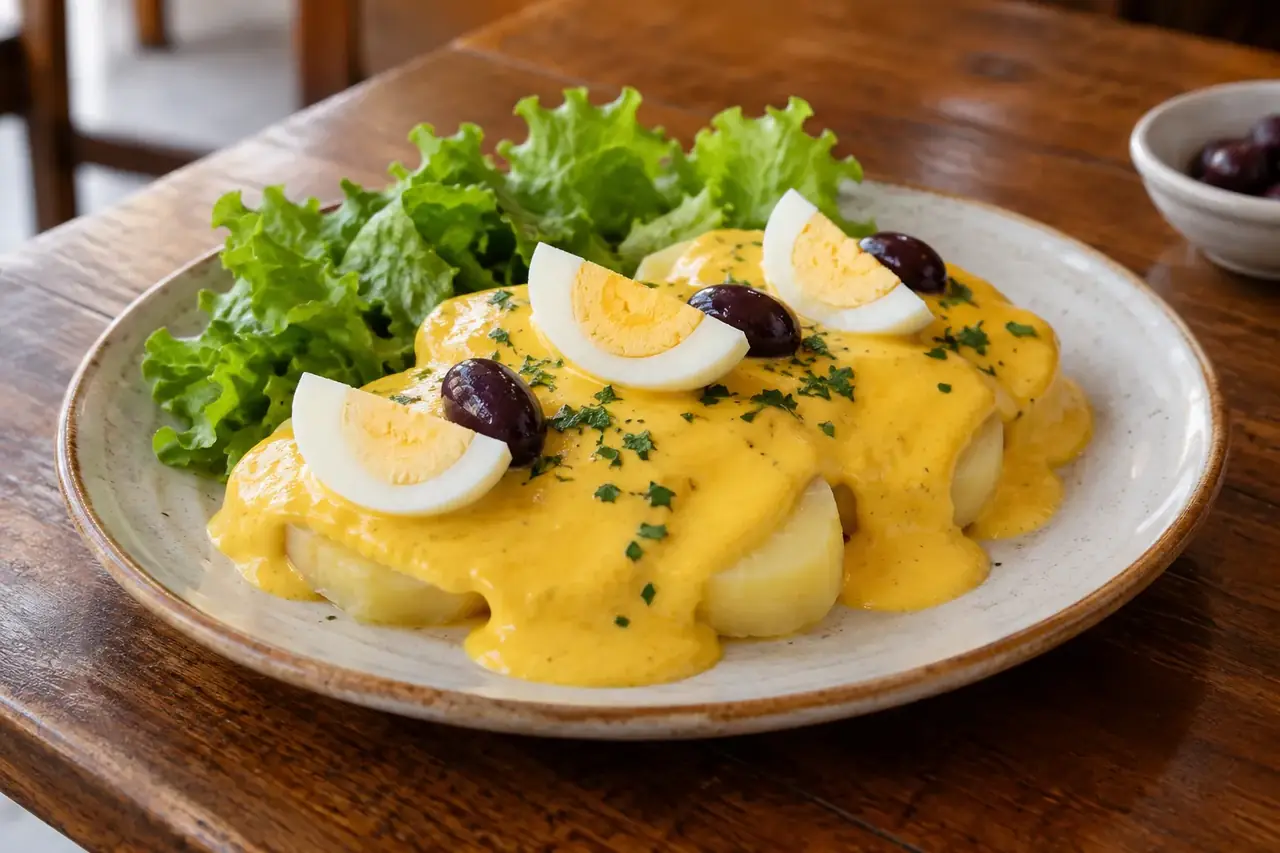
Rounds of potato under a yellow cream of fresh cheese and chilli: papa a la huancaína is one of the most popular starters in Peru. The same sauce, the huancaína, also goes with pasta, rice or corn cobs.
One name, two stories
The name refers to Huancayo, in the central Andes. Wikipedia reports two stories linked to the central railway between Lima and Huancayo: cooks from Huancayo feeding the workers, or potatoes sold to travellers at the stations. Neither is established, and the same source points out that ají amarillo and olives come from the coast, where the dish is eaten mainly as a starter.
The cheese and the chilli
PROMPERÚ’s recipe is based on Andean fresh cheese, ajís amarillos with the seeds and membranes removed, milk, oil, a browned onion and a little lime. Peruvian queso fresco, salty and firm, is rarely found in Switzerland: a mix of mild feta and ricotta comes close. Many cooks add a few savoury crackers to thicken it; they are optional here.
Our version
The salt depends on the cheese chosen: taste before adding any.
Ingredients
Serves 4 as a starter
Estimated preparation time
- Active time
- 20 minutes
- Cooking
- 20 to 25 minutes for the potatoes
- Total
- About 35 minutes
Techniques: Boiling, Blended sauce.
The huancaína sauce
To serve
Tick off the ingredients as you go: the boxes are remembered on this device.
Useful equipment
- A blender
- A saucepan
- A frying pan (if you brown the onion)
Method
- Cook the potatoes in their skins in salted water for 20 to 25 minutes, until a knife goes in without resistance. Peel them and leave them to cool slightly.
- If you are using the onion, brown it for 5 minutes in a spoonful of oil. It softens the sauce, as in PROMPERÚ’s recipe.
- Blend the cheese, the ají, the onion, the oil and 100 ml of milk until you have a perfectly smooth cream.
- Add the remaining milk little by little: the sauce should be semi-liquid, coat a spoon and run off slowly. If it is too thin, add a cracker and blend; too thick, a little milk.
- Taste, add a few drops of lime juice, then salt only if needed: the cheese is already salty.
- Place the potato rounds on the lettuce, coat with the sauce just before serving and garnish with hard-boiled egg and olive.
Signs of success
- The sauce is bright yellow, smooth, with no grains of cheese.
- It coats the potatoes and runs slowly down the sides.
- You taste the cheese and the fruity aroma of the chilli before its heat.
Precautions
- A cold preparation made with cheese: keep it in the fridge until serving.
Allergens identified
Present: milk. Possible: gluten (crackers, if used), egg (garnish).
Always check the labels of the products you buy (sauces, stocks, chilli pastes).
Variations and tips
- Huancaína sauce also goes with pasta, rice, a causa or corn cobs, according to Wikipedia.
- On the north coast, the pressed, seasoned potato is rolled into balls, coated with the sauce.
Reasonable substitutions
- Queso fresco impossible to find: a mix of mild feta and ricotta comes close; feta alone is saltier and sharper.
- Gluten-free: leave out the crackers and thicken with a little more cheese.
Storage
- Sauce: in the fridge, below 5 °C; in the fridge within one to two hours of cooking, to be eaten within 48 hours or frozen. It thickens when cold: loosen it with a little milk.
Going further
Sources and dates
2 sources
Prices, opening hours and rules change: every piece of information cited links to its source, with the date it was consulted.
Figures and rules cited
- in the fridge, below 5 °C: Storing meat, poultry, fish, seafood and leftovers (Switzerland) . The FSVO also asks you not to refreeze food that has been thawed.
Official source: FSVO, Hygiène et aliments (food hygiene, in French) (new tab) · consulted on 3 October 2026 - in the fridge within one to two hours of cooking, to be eaten within 48 hours or frozen: Cooling and keeping cooked leftovers (United Kingdom) . The same source asks you to thaw food in the fridge and to eat thawed food within 24 hours.
Official source: GOV.UK (Food Standards Agency), cooling, freezing and defrosting food safely (18 December 2017) (new tab) , published on 18 December 2017 · consulted on 3 October 2026
Sources consulted
- PROMPERÚ, recipe for papa a la huancaína (fresh cheese, deseeded ajís, milk, oil, browned onion, lime) (new tab) (consulted on 3 October 2026)
- Wikipedia (Spanish), Papa a la huancaína (composition, origin stories, uses of the sauce) (new tab) (consulted on 3 October 2026)
How we choose and date our information: our method. Has something changed? Let us know.