
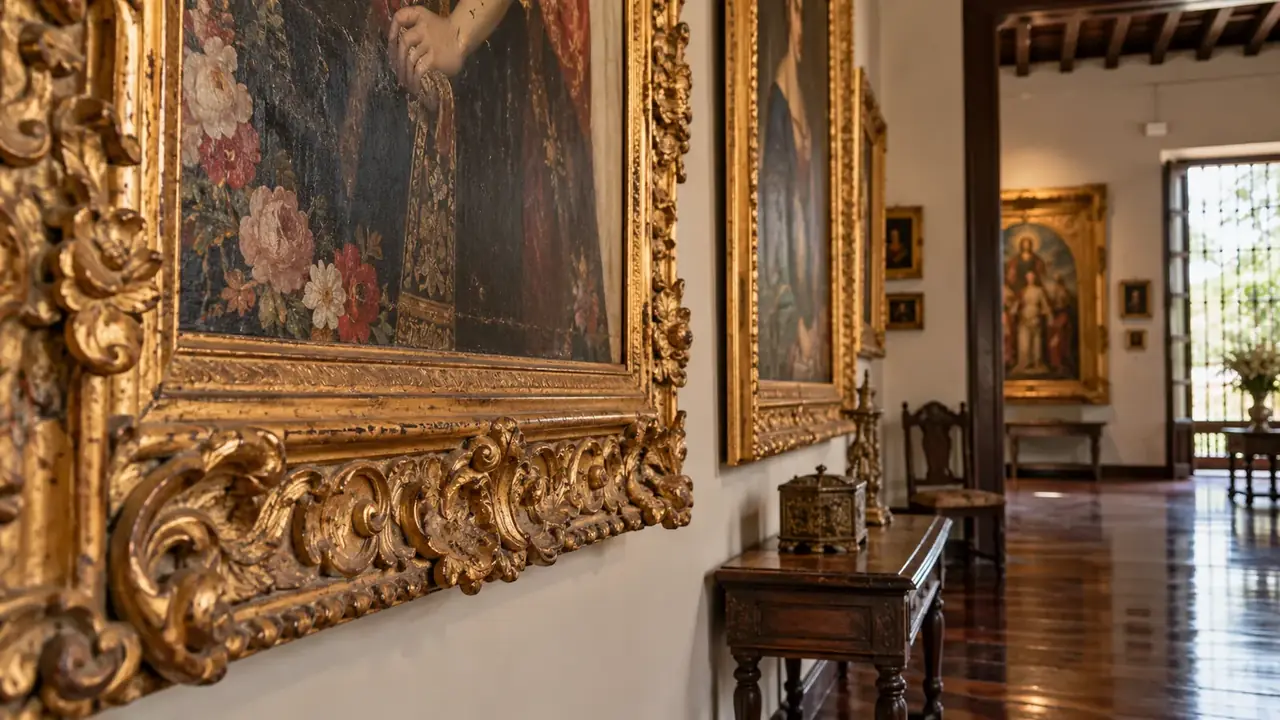
Viceregal art, in a Barranco house
The Museo Pedro de Osma brings together one of the great collections of art from the Viceroyalty of Peru: painting, sculpture, furniture and silverware from the 16th, 17th, 18th and 19th centuries. The viceroyalty is the period when Peru was governed by a viceroy in the name of the King of Spain, from the middle of the 16th century until independence in the early 19th century. The art of this period is mainly religious: it was used to decorate churches and convents, and to teach Christianity.
The collection was assembled between 1936 and 1967 by the de Osma family and is now held by the Pedro and Angélica de Osma Gildemeister foundation. It is displayed in the former family residence, an early 20th-century mansion with Art Nouveau stained glass, metal ceilings and crystal chandeliers, which is part of the history of Barranco, when the neighbourhood was the holiday resort of Lima families. The museum has more than 400 pieces spread over fourteen themed rooms.
Looking without being a specialist: four groups
1. The arquebusier angels. One room is devoted to angels and archangels, including “arquebusier angels”: angels dressed as gentlemen of the period, with plumed hats and lace, handling a musket. This theme is characteristic of Andean painting. The museum presents an Archangel Ariel among its main works. Look at the clothes: the painters showed the luxurious fabrics of their time.
2. The Virgins. Several key works depict the Virgin Mary: the Virgin of la Almudena, the Virgin of the Apocalypse, the Virgin as a child spinning (Virgen niña hilando), the Virgin of the Tailors (Virgen de los Sastres). In Andean painting, Virgins are often depicted as dressed statues, with a triangular gown covered in embroidery and gilding: artists painted the image of the statue venerated in a church, in its feast-day clothes. A recent exhibition at the museum, in room 10, was indeed called “María, Materialidad Divina”.
3. The Incas after the conquest. Two works show how the colonial period depicted the Inca lineages. The Genealogy of the Incas lines up the Inca rulers as portraits. The painting of the marriage of Martín de Loyola to doña Beatriz Ñusta, and of don Juan Borja to Lorenza Ñusta stages two unions between Spaniards and princesses from the Inca nobility. These images served to assert legitimacy: that of families who claimed descent from both Spain and the Incas.
4. Silverware. Silver from the Andean mines fed a considerable craft: reliquaries, liturgical objects, tableware, jewellery, weapons. The silverware room shows the virtuosity of these silversmiths and recalls where the wealth of the viceroyalty came from.
There are also paintings of the Cusco School, a style born in that city, recognisable by the gilding applied to the clothes and by landscapes in which Andean plants and birds appear, a Corpus Christi procession and a gavetero (cabinet of drawers).
Pavilion 2
Part of the collection is displayed in a space called Pabellón 2 (Pavilion 2). Ask at reception whether all the rooms are open during your visit.
Practical information
- Opening: Tuesday to Sunday, from 10:00 to 18:00. On its “Planea tu visita” page, the museum publishes a list of exceptional closing days and reduced hours (public holidays, end of the year): check it for your date, as the list changes from one year to the next.
- Admission: S/ 35 for a foreign adult; reduced rates for students and retirees, with proof; free up to age 10. These amounts are published by the museum itself, on the same page, consulted on 7 October 2026. Guided tour: S/ 10 extra per person. Photography forbidden inside.
- Getting there: south of the centre of Barranco, Avenida Pedro de Osma 421. MAC Lima is about 2.6 km, a 35 to 40-minute walk away according to a route calculation, not ten minutes as you sometimes read: plan a short taxi ride if you are doing both.
Pedro de Osma or MAC?
The two museums are neighbours and have nothing in common, which is precisely what makes it worth pairing them: the Pedro de Osma shows the art of a colonial, religious society, the MAC that of contemporary Peru. If you can only choose one and you are going on to Cusco, the Pedro de Osma will prepare you better for the city’s churches. If you like current art, the MAC says more about the country today.
Our suggestion
An hour and a quarter for the main rooms, following the four groups described here, then the garden. The MAC is about 2.6 km, a 35 to 40-minute walk away if you want to see today’s art on the same day: a short taxi ride is the other option.
What to ask before you go
- Exceptional closures and reduced hours in the year of your visit: the museum publishes the list on its “Planea tu visita” page.
- The times of guided tours (S/ 10 extra per person according to the museum).
- Photography: the museum forbids it inside.
Have the opening hours, a dish or a price changed? Let us know and we will correct this page.
Sources and dates
5 sources
Prices, opening hours and rules change: every piece of information cited links to its source, with the date it was consulted.
Figures and rules cited
- Tuesday to Sunday, from 10:00 to 18:00: Opening hours of the Museo Pedro de Osma (Museo Pedro de Osma, avenida Pedro de Osma 421, Barranco) . The museum publishes a list of exceptional closing days and shorter hours (holidays, end of year): check it for the date of your visit.
Site management: Museo Pedro de Osma, “Planea tu visita” (opening hours, prices, closures) (new tab) · consulted on 7 October 2026 - S/ 35 per admission: Museo Pedro de Osma: admission, foreign visitor (Museo Pedro de Osma (Barranco), Lima) (Foreign adult (student S/ 20, retiree S/ 30, with proof; free up to age 10)) . Price published by the museum on its visit-planning page; the museum also publishes a list of exceptional closing days.
Price recorded: Museo Pedro de Osma, “Planea tu visita” (new tab) · consulted on 7 October 2026 - about 2.6 km, a 35 to 40-minute walk: Walking distance and time, MAC Lima (av. Grau 1511)–Museo Pedro de Osma (av. Pedro de Osma 421) (Barranco) . Automatic calculation (2.59 km, 35 minutes at the calculator’s pace), not a timed walk; about 2 km as the crow flies. The earlier figure of 800 m was wrong.
Press or reseller: Walking route calculated on OpenStreetMap (FOSSGIS routing server, pedestrian profile), between the two geocoded entrances (new tab) · consulted on 7 October 2026
Sources consulted
- Museo Pedro de Osma, “Planea tu visita” (opening hours, prices, free up to age 10, guided tours, closures) (new tab) (consulted on 7 October 2026)
- Museo Pedro de Osma, official website (collection, main works) (new tab) (consulted on 2 October 2026)
- Museo Pedro de Osma, Pabellón 2 (new tab) (consulted on 1 October 2026)
- Y tú qué planes? (PROMPERÚ), Museo Pedro de Osma (rooms, prices, opening hours) (new tab) (consulted on 2 October 2026)
- enlima.pe, Museo Pedro de Osma (history of the mansion and the collection) (new tab) (consulted on 2 October 2026)
How we choose and date our information: our method. Has something changed? Let us know.