
What the MAC is, and what it is not
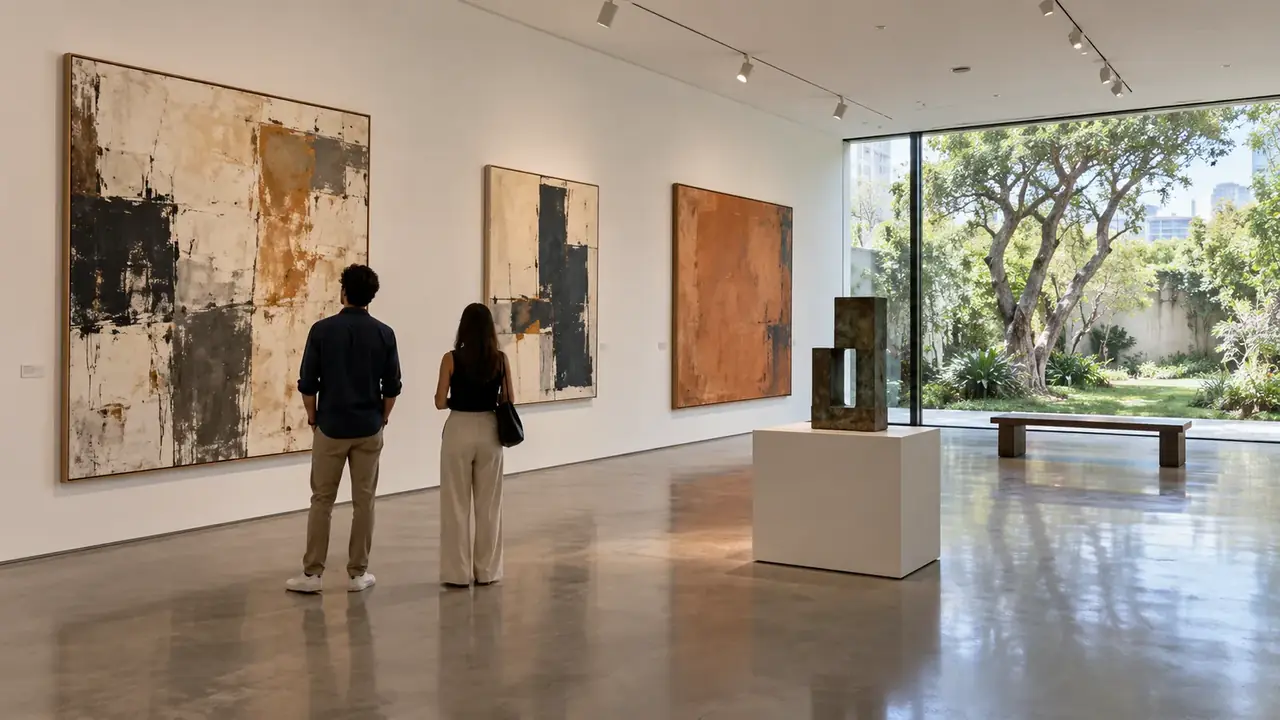
The Museo de Arte Contemporáneo de Lima presents Peruvian and Latin American art from the middle of the 20th century to the present day. It is not an art history museum like the MALI, which covers three thousand years: here, the visit is mainly through exhibitions, which change several times a year and take up most of the rooms. Coming to the MAC therefore means, above all, looking at what is on show when you visit.
An institution from 1955, a building from 2013
The museum carries on the Instituto de Arte Contemporáneo (IAC), founded in 1955, which gathered works and organised exhibitions in various places in Lima for decades. The plan for a permanent museum dates back to the early 1980s; the current building, designed by the Peruvian architect Frederick Cooper Llosa, was inaugurated at the end of January 2013. It stands on land given by the municipality of Barranco, on the site of the neighbourhood’s former artificial lake and small zoo, closed in 1970.
The collection: names to know before you go in
The MAC holds the original IAC collection, made up of works from the 1950s to the 1970s, since enriched by gifts and loans: drawing, sculpture, photography, printmaking, painting, mixed media and video. Not all of them are on show at the same time. A few names will help you find your bearings if their works are on display:
- Fernando de Szyszlo (1925-2017), a major figure of Peruvian abstraction, who drew on the forms and colours of the pre-Columbian world;
- Jorge Eduardo Eielson, poet and visual artist, known for his works of knotted fabric;
- José Tola and Ramiro Llona, painters of the following generation;
- Peruvian women artists who have mattered in avant-garde art, whom the museum highlights: Claudia Coca, Kukuli Velarde, Patricia Bueno, Angie Bonino;
- Latin American artists: Wifredo Lam (Cuba), René Portocarrero (Cuba), Carlos Cruz-Diez (Venezuela), Beatriz González (Colombia).
The museum’s digital catalogue lets you look at the works in the collection before your visit, useful for knowing what you would like to find.
Current exhibitions
As of 2 October 2026, the museum’s website announced two exhibitions: “Construcción de los hechos” in rooms 1 and 2, until 4 October 2026, and “Contemporáneo 1. Materia :: Alquimia :: Dispositivo :: Flujo” in room 3, until 31 December 2026. The programme changes several times a year: it is published on the museum’s home page.
Visiting without being a specialist
Contemporary art is sometimes intimidating. Three habits make the visit simpler:
- Read the exhibition’s introductory text before the works: it says what the curator wanted to bring together.
- Choose three works and stay in front of each for a few minutes: materials, scale, title, date. What you feel counts as much as what you know.
- Look for the link with Peru: many artists work there on memory, the political violence of the 1980s and 1990s, the land, indigenous identities or the city of Lima itself.
For children and teenagers, the museum runs art classes (“aula MAC”) announced on its website.
Practical information
- Opening: Tuesday to Sunday, from 10:00 to 19:00 (last entry at 18:30). Also closed on 24, 25 and 31 December and 1 January.
- Admission: S/ 20 for a non-resident visitor; S/ 12 for a resident; reduced rates for students, children aged 5 to 12 and seniors; free under 5; half price on the first Sunday of the month at the ticket office.
- Getting there: Avenida Grau 1511, in the north of Barranco, about 2.6 km, a 35 to 40-minute walk on foot from the Museo Pedro de Osma. From Miraflores, the Metropolitano (Bulevar stop) or a walk along the seafront.
Combining with Barranco
The MAC goes well with half a day in the neighbourhood: the Museo Pedro de Osma for a complete contrast (religious art from the 16th to the 19th centuries), then the municipal park, the Ermita church and the Bridge of Sighs. See the route on the Barranco page.
Our suggestion
An hour at the MAC in the late morning, then a walk around Barranco: the Bridge of Sighs is very close, the Museo Pedro de Osma further south, about 2.6 km, a 35 to 40-minute walk away according to a route calculation (a short taxi ride saves the walk). Two very different museums on the same day are still possible when they are this close.
What to ask before you go
- The exhibitions on at your date: the programme changes several times a year.
- Guided tours or weekend activities, if there are any.
Have the opening hours, a dish or a price changed? Let us know and we will correct this page.
Sources and dates
4 sources
Prices, opening hours and rules change: every piece of information cited links to its source, with the date it was consulted.
Figures and rules cited
- Tuesday to Sunday, from 10:00 to 19:00 (last entry at 18:30): Opening hours of MAC Lima (MAC Lima, avenida Grau 1511, Barranco) . Closed on Mondays.
Site management: MAC Lima, buying tickets (new tab) · consulted on 2 October 2026 - S/ 20 per admission: MAC Lima: general admission, non-resident visitor (Museo de Arte Contemporáneo (MAC Lima, Barranco), Lima) (Non-resident (S/ 12 for students, children aged 5 to 12 and seniors; S/ 12 at the general resident rate))
Price recorded: MAC Lima, buying tickets (new tab) · consulted on 2 October 2026 - about 2.6 km, a 35 to 40-minute walk: Walking distance and time, MAC Lima (av. Grau 1511)–Museo Pedro de Osma (av. Pedro de Osma 421) (Barranco) . Automatic calculation (2.59 km, 35 minutes at the calculator’s pace), not a timed walk; about 2 km as the crow flies. The earlier figure of 800 m was wrong.
Press or reseller: Walking route calculated on OpenStreetMap (FOSSGIS routing server, pedestrian profile), between the two geocoded entrances (new tab) · consulted on 7 October 2026
Sources consulted
- MAC Lima, official website (opening hours, exhibitions) (new tab) (consulted on 2 October 2026)
- MAC Lima, buying tickets (prices) (new tab) (consulted on 2 October 2026)
- MAC Lima, digital catalogue of the collection (new tab) (consulted on 2 October 2026)
- Wikipedia (English), Museum of Contemporary Art of Lima (opening, architect, site) (new tab) (consulted on 2 October 2026)
How we choose and date our information: our method. Has something changed? Let us know.