
In short
Chinchero is about 30 km from Cusco, at an altitude of around 3,750 m, higher than Cusco. Allow half a day: the Inca site and its terraces (included in the Boleto Turístico, circuit III, with Pisac, Ollantaytambo and Moray), the colonial church (ask at the ticket office whether it is included), then a textile centre. On Sundays, the traditional fair livens up the village. Before buying a textile, ask for its exact composition.
A plateau village, between Cusco and the Sacred Valley
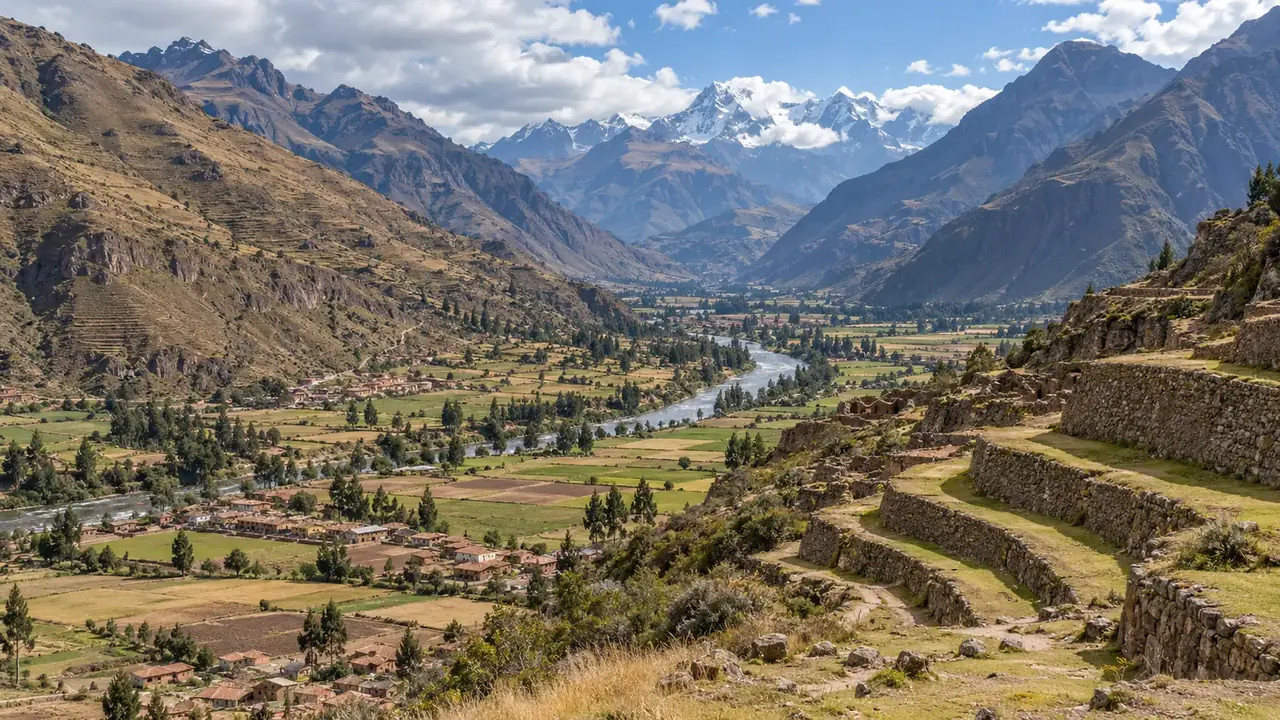
Chinchero is about 30 km from Cusco on the paved Urubamba road; open from 7:00 to 18:00; entry with the Boleto Turístico. The village spreads across a farming plateau, above the Urubamba Valley. Its place in a route is simple: on the road that goes down from Cusco to Urubamba, before the Maras salt pans and the circular terraces of Moray, further along the same plateau. Distances: Cusco–Pisac 32 km; Pisac–Urubamba 39 km; Urubamba–Ollantaytambo 19 km; Cusco–Chinchero 27 km; Chinchero–Maras 22 km; Maras–Moray 8 km; Moray–Maras salt pans 17 km; salt pans–Urubamba 19 km; Cusco–Tipón 24 km.
Altitude first. Chinchero is at about 3,750 m, higher than Cusco (about 3,400 m). It is not a low stop for acclimatising: walk slowly, especially on the stairs of the terraces, and place the visit after a few days in the region. See altitude.
The Inca site and the colonial church
According to historical accounts, the Inca Túpac Yupanqui chose Chinchero for his residence and had palaces built there for himself and his lineage. Today you can see its walls of large stones, enclosures, shrines and agricultural terraces. The Cusco Directorate of Culture manages this archaeological park; excavations by a Spanish archaeological mission, between 1968 and 1970, uncovered and restored part of it.
In 1536, during the uprising of Manco Inca, the village was burned. In colonial times, Viceroy Toledo gathered the population together there and had the church built, on the Inca halls: it is the most telling image of the place, a colonial façade set on Inca walls. A mural in the village commemorates another episode: the victory of the cacique of Chinchero, Mateo García Pumacahua, over the rebellion of Túpac Amaru II, in the form of a puma bringing down a snake. The park’s rules prohibit drones, camping and climbing on the walls.
Textiles: a living craft
Chinchero is one of the centres of Andean weaving, studied by anthropologists since the 1970s. In 1996, weavers from Chinchero founded, with international support, the Centro de Textiles Tradicionales del Cusco, which now works with ten communities in the region; since the 1990s, weavers’ associations have revived natural dyes, using cochineal and local plants.
In the village’s textile centres, you generally watch hand spinning, a dyeing demonstration and weaving on a loom, before moving on to the shop. It is often the most instructive part of the visit. Two nuances, with no suspicion towards anyone:
- A demonstration is not a guarantee. It shows a skill; it does not prove that every piece on display was woven on the spot, or with the fibre or the dye shown. Ask who wove the piece, how long it took, with which fibre and which dye.
- Nothing obliges you to buy. A demonstration often ends in the shop: look, compare, and leave with nothing if nothing suits you.
The Sunday fair, and the rest of the week
On Sundays, a traditional fair is held next to the tourist coach car park: local textiles and crafts, produce from the region and, according to the MINCETUR inventory, a form of barter still practised by the elders, the “chalay”. It is the liveliest day, and the busiest. This record dates from 2022: confirm the day and the location on the spot.
On other days, the village is quieter: the site, the church and the textile centres, which welcome visitors outside the fair. Do not confuse the two: a textile centre is a house or an association that demonstrates and sells; the fair is a market.
The ticket, and what it does not cover
The archaeological park is visited with the Boleto Turístico del Cusco: S/ 70, valid for 2 days, for Pisac, Ollantaytambo, Chinchero and Moray, or the full ticket for 16 sites (S/ 130 for 16 sites, valid for 10 days). Unless the ticket office says otherwise, this ticket covers neither the church, about which the sales page says nothing, nor the textile centres, which are private or community initiatives.
How long, and what to combine it with
Allow about an hour for the site and its terraces at a slow pace, half an hour for the church, an hour for a textile centre, more on Sundays with the fair. Three ways to fit it in:
- On the way to the valley: Cusco early in the morning, Chinchero, then down to Urubamba for the night, lower down.
- The plateau day: Chinchero in the morning, Maras and Moray in the afternoon, the salt pans at the end of the day. See Chinchero, Maras and Moray.
- On a Sunday: the fair in the morning, the site afterwards, once the groups have left.
The guide’s itineraries that go through Chinchero: a first trip to Peru in 15 days, Peru for food lovers, Cusco and the southern Amazon, the southern classic and a month.
Frequently asked questions
Is the Boleto Turístico enough for Chinchero?
It gives access to the archaeological park: S/ 70, valid for 2 days, for Pisac, Ollantaytambo, Chinchero and Moray, or the full ticket. The sales page does not say whether the church is included, and the workshops and textile centres are not covered by the ticket: ask at the ticket office.
Is Chinchero a good stop for acclimatising?
No: at about 3,750 m, the village is higher than Cusco. Visit it after a few days in the region, and keep your nights in the Sacred Valley, which is lower.
Are all the textiles on sale woven on the spot?
Not necessarily. The textile centres show spinning, dyeing and weaving, but a demonstration does not guarantee that each piece on sale was made in front of you. Ask who wove it, with which fibre and which dye, and read the label.
Sources and dates
8 sources
Prices, opening hours and rules change: every piece of information cited links to its source, with the date it was consulted.
Figures and rules cited
- S/ 70, valid for 2 days, for Pisac, Ollantaytambo, Chinchero and Moray: Boleto Turístico del Cusco, partial ticket for circuit III, foreign visitor (Sacred Valley) (Foreign adult) . The page does not say whether the Chinchero church is included: ask at the ticket office. The weaving workshops are not covered by the ticket.
Site management: COSITUC, partial ticket for foreigners, circuit III (new tab) · consulted on 7 October 2026 - about 30 km from Cusco on the paved Urubamba road; open from 7:00 to 18:00; entry with the Boleto Turístico: Chinchero archaeological park: distance, opening hours, ticket (Chinchero archaeological park, Urubamba province) . A 43-hectare park: a palace attributed to Túpac Yupanqui, enclosures, shrines, terraces, and colonial buildings built on top. Drones, camping and climbing the walls are forbidden.
Official source: Cusco Directorate of Culture, Chinchero archaeological park (new tab) · consulted on 7 October 2026 - Cusco–Pisac 32 km; Pisac–Urubamba 39 km; Urubamba–Ollantaytambo 19 km; Cusco–Chinchero 27 km; Chinchero–Maras 22 km; Maras–Moray 8 km; Moray–Maras salt pans 17 km; salt pans–Urubamba 19 km; Cusco–Tipón 24 km: Road distances between the stops in the Sacred Valley (Cusco and the Sacred Valley) . Centre-to-centre distances (or to the site entrance). Mountain roads: allow much more than the calculated time, especially beyond Moray and towards the salt pans.
Press or reseller: Road routes calculated on OpenStreetMap (FOSSGIS routing server) (new tab) · consulted on 2 October 2026 - about 3,750 m: Altitude of Chinchero (village, on the plateau) (Chinchero)
Official source: Cusco Directorate of Culture, Chinchero archaeological park (average altitude 3,750 m) (new tab) · consulted on 7 October 2026 - about 3,400 m: Altitude of Cusco (centre) (Cusco) . Wikidata gives 3,399 m, the CDC about 3,350 m: the city spreads over several tens of metres of height.
Press or reseller: Wikidata, Cuzco (Q5582862), altitude (new tab) · consulted on 1 October 2026 - S/ 130 for 16 sites, valid for 10 days: Full Boleto Turístico del Cusco, foreign adult visitor (Cusco and the Sacred Valley) (Foreign adult (S/ 70 for a foreign student))
Site management: COSITUC, Boleto Turístico del Cusco (new tab) · consulted on 1 October 2026
Sources consulted
- Cusco Directorate of Culture, Chinchero archaeological park (altitude, distance, opening hours, ticket, rules) (new tab) (consulted on 7 October 2026)
- MINCETUR, tourism inventory, “Feria Tradicional de Chinchero” (record 2686, 10 August 2022) (new tab) (consulted on 7 October 2026)
- COSITUC, partial ticket for foreigners, circuit III (S/ 70, 2 days) (new tab) (consulted on 7 October 2026)
- Centro de Textiles Tradicionales del Cusco, about us (founded in 1996, Chinchero weavers, natural dyes) (new tab) (consulted on 7 October 2026)
- Wikipedia (Spanish), Chinchero and the district of Chinchero (palace of Túpac Yupanqui, church built under Viceroy Toledo, 1968–1970 excavations, textile centres) (new tab) (consulted on 7 October 2026)
- Inacal, checking labels and origin for a safe purchase (16 June 2026) (new tab) (consulted on 7 October 2026)
- Inacal, technical standards for artisanal weaving and embroidery, labelling (1 March 2022) (new tab) (consulted on 7 October 2026)
- alpaca.ch (a Swiss seller of alpaca clothing), fibre categories (“baby alpaca”) (new tab) (consulted on 7 October 2026)
How we choose and date our information: our method. Has something changed? Let us know.