
Why start with this museum
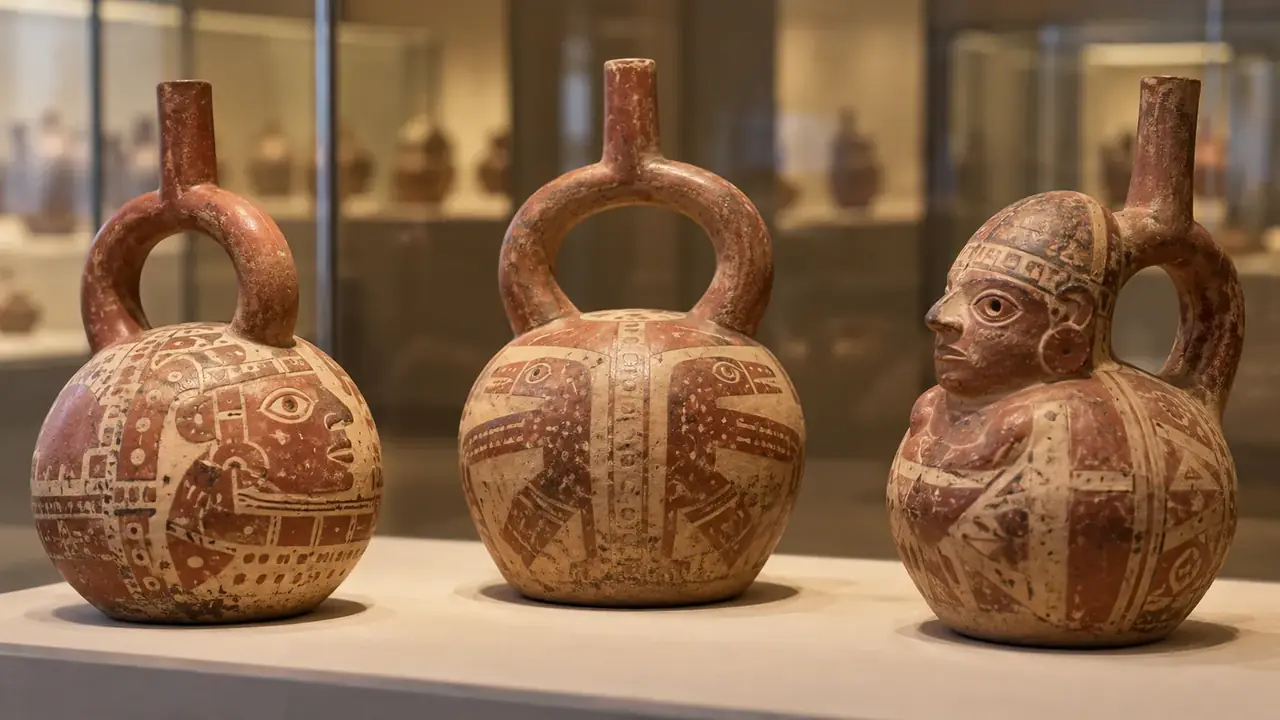
The Museo Larco presents the history of Peru before the arrival of the Spanish through objects: ceramics, textiles, metalwork, carved stone. For a traveller who will then visit Trujillo, Chiclayo, the south coast or Cusco, it is the best way to put names, periods and styles to what they will see at the sites, where the objects often left the tombs long ago.
The museum was founded on 28 July 1926 by Rafael Larco Hoyle, then aged 25, in tribute to his father, Rafael Larco Herrera. The first piece, given by his father in 1923, was a Mochica portrait vessel. The collection was moved to Lima in the 1950s, into a mansion dating from 1700 that Larco Hoyle altered with features salvaged from an old house in Trujillo. Today it holds some 50,000 archaeological pieces, all of which can be consulted online since 2007.
How to read the permanent exhibition
The collection covers several millennia and an immense territory. Two landmarks help you avoid mixing everything up:
- The north coast is the great strength of the collection, inherited from Larco Hoyle’s research in the Trujillo region: Cupisnique, Salinar, Virú and above all Mochica (also called Moche), then Chimú. These are the cultures you will find again at the Huacas del Sol y de la Luna, Chan Chan and El Brujo.
- The other regions are represented by smaller groups: textiles from the south coast (Paracas), objects from the highlands and from the Inca period.
The cultures do not follow one another like the chapters of a textbook: some coexisted in neighbouring valleys, others occupied the same territory centuries apart. On its website, the museum offers an introductory video and a plan of the exhibition: watching them before the visit stops you mixing everything up in front of the display cases.
Four objects to look for
These pieces are part of the permanent exhibition according to the museum’s online catalogue; their inventory number lets you find them and read their full record.
| Object | Culture | Why look at it |
|---|---|---|
| Portrait vessel of a priest (ML013572) | Mochica | Mochica “huacos retratos” depict individualised faces: wrinkles, scars, expressions. Researchers see them as one of the rare groups in the ancient Americas where real individuals can be recognised, sometimes depicted at several ages. |
| Vessel of the “journeys of Ai Apaec” (ML018882) | Mochica | Painted Mochica ceramics tell scenes in a frieze around the vessel. Ai Apaec is the name researchers give to a figure with feline fangs, central to Mochica iconography; the precise meaning of his “journeys” remains an interpretation. |
| Funerary mantle (ML600068) | Paracas | The large embroidered textiles of Paracas wrapped the dead. Look at the fineness of the repeated motifs and how well the colours have survived: the very dry coastal desert protected these fabrics for about two thousand years. |
| Gold pectoral (ML100855) | Chimú | Chimú metalwork, on the north coast, used large sheets of hammered and embossed gold. These ornaments signalled the rank of the person who wore them. |
The visitable storerooms
The museum lets the public into its storerooms, which is still rare: some 30,000 ceramics are stored and classified there on glass-fronted shelves. The visit gives an idea of the scale of the ancient potters’ output and of how archaeologists classify by shapes and themes. You go through quickly, but you come out with a different sense of scale.
The erotic gallery
A separate gallery presents ceramics with sexual depictions. The museum interprets them as an expression of desire and of the union of opposing and complementary forces that ensure the regeneration of life, and not as scandalous images. The gallery is set apart: with children, you can simply skip it.
Three ways to do the visit
In one hour. The four objects in the table above and the rooms where they are, then a quick walk through the storerooms.
In two to three hours. The whole permanent exhibition, stopping at the north coast rooms, then the storerooms and a break in the gardens. The online catalogue lets you prepare a list of pieces to see the day before.
With the family. The animals depicted on the ceramics (felines, birds, snakes, crabs) offer a simple observation game: “find three sea creatures”. Children aged 3 to 8 pay a token price, or nothing depending on where you buy.
Linking the visit to the rest of the trip
| What you see at the Larco | Where to find it next |
|---|---|
| Mochica ceramics and iconography | Trujillo: Huacas del Sol y de la Luna, El Brujo |
| Chimú metalwork and architecture | Chan Chan, near Trujillo |
| North coast metalwork, tombs of lords | Chiclayo and Lambayeque |
| Paracas textiles | The south coast: Paracas and the Ica museum |
| Inca objects | Cusco and the Sacred Valley |
Practical information
- Opening: every day, public holidays included, from 9:00 to 19:00.
- Admission: S/ 50 at the ticket office for general admission, S/ 45 online according to the visit page. Prices and opening hours change from time to time.
- Getting there: the museum is about 10 km by road from Kennedy Park, in Miraflores. No rapid transit links the two neighbourhoods: a taxi booked by app is still the simplest option. Set off in the morning, before the afternoon traffic.
- On site: gardens; the museum publishes pages on its services, accessibility, photography and welcoming visitors with special needs.
- Afterwards: Plaza Bolívar and the Antigua Taberna Queirolo are in the same neighbourhood; see Pueblo Libre.
Our suggestion
Come in the morning, look at the chronology first, then look for the four objects described on this page before going down to the storerooms. Allow an hour and a half, two with a break in the gardens.
What to ask before you go
- The price and opening hours on the day: the museum changes them from time to time.
- Private guided tours, separate from the ticket, if you want one.
Have the opening hours, a dish or a price changed? Let us know and we will correct this page.
Sources and dates
7 sources
Prices, opening hours and rules change: every piece of information cited links to its source, with the date it was consulted.
Figures and rules cited
- every day, public holidays included, from 9:00 to 19:00: Opening hours of the Museo Larco (Museo Larco, avenida Simón Bolívar 1515, Pueblo Libre (entrance at calle Navarra 169)) . Shorter hours on some days at the end of the year; the hours change from time to time: check on the museum’s website.
Site management: Museo Larco, official website (opening hours and admission) (new tab) · consulted on 2 October 2026 - S/ 50 per admission: Museo Larco: general admission at the ticket office (Museo Larco (Pueblo Libre), Lima) (General admission (at the ticket office: S/ 35 for over-60s, S/ 25 for students and ages 9–17, S/ 1 for ages 3 to 8, proof required)) . The museum’s prices change from time to time.
Price recorded: Museo Larco, “Planea tu visita” (prices at the ticket office and online) (new tab) · consulted on 7 October 2026 - S/ 45 per admission: Museo Larco: general admission online (Museo Larco (Pueblo Libre), Lima) (General admission) . The museum’s prices change from time to time.
Price recorded: Museo Larco, “Planea tu visita” (new tab) · consulted on 7 October 2026 - about 10 km: Distance by road, Kennedy park–Museo Larco (Pueblo Libre) (Miraflores–Pueblo Libre) . Distance only: the actual time depends on the traffic.
Press or reseller: Route calculated on OpenStreetMap (FOSSGIS routing server, car profile) (new tab) · consulted on 2 October 2026
Sources consulted
- Museo Larco, opening hours and admission (new tab) (consulted on 2 October 2026)
- Museo Larco, “Planea tu visita” (ticket office and online prices, opening hours) (new tab) (consulted on 7 October 2026)
- Museo Larco, online ticket office (web prices) (new tab) (consulted on 7 October 2026)
- Museo Larco, history of the collection (new tab) (consulted on 2 October 2026)
- Museo Larco, online catalogue (pieces in the permanent exhibition) (new tab) (consulted on 2 October 2026)
- Museo Larco, visitable storerooms and erotic gallery (new tab) (consulted on 2 October 2026)
- Route calculated on OpenStreetMap (distance from Miraflores) (new tab) (consulted on 2 October 2026)
How we choose and date our information: our method. Has something changed? Let us know.