
Recipe · Main course · Ica
Sopa seca with chicken
Broken spaghetti cooked in a stock with basil, ají panca, tomato and carrot until it is absorbed, with chicken. To serve with carapulcra.
- Serves 4
- About 1 hour (estimate)
- Intermediate
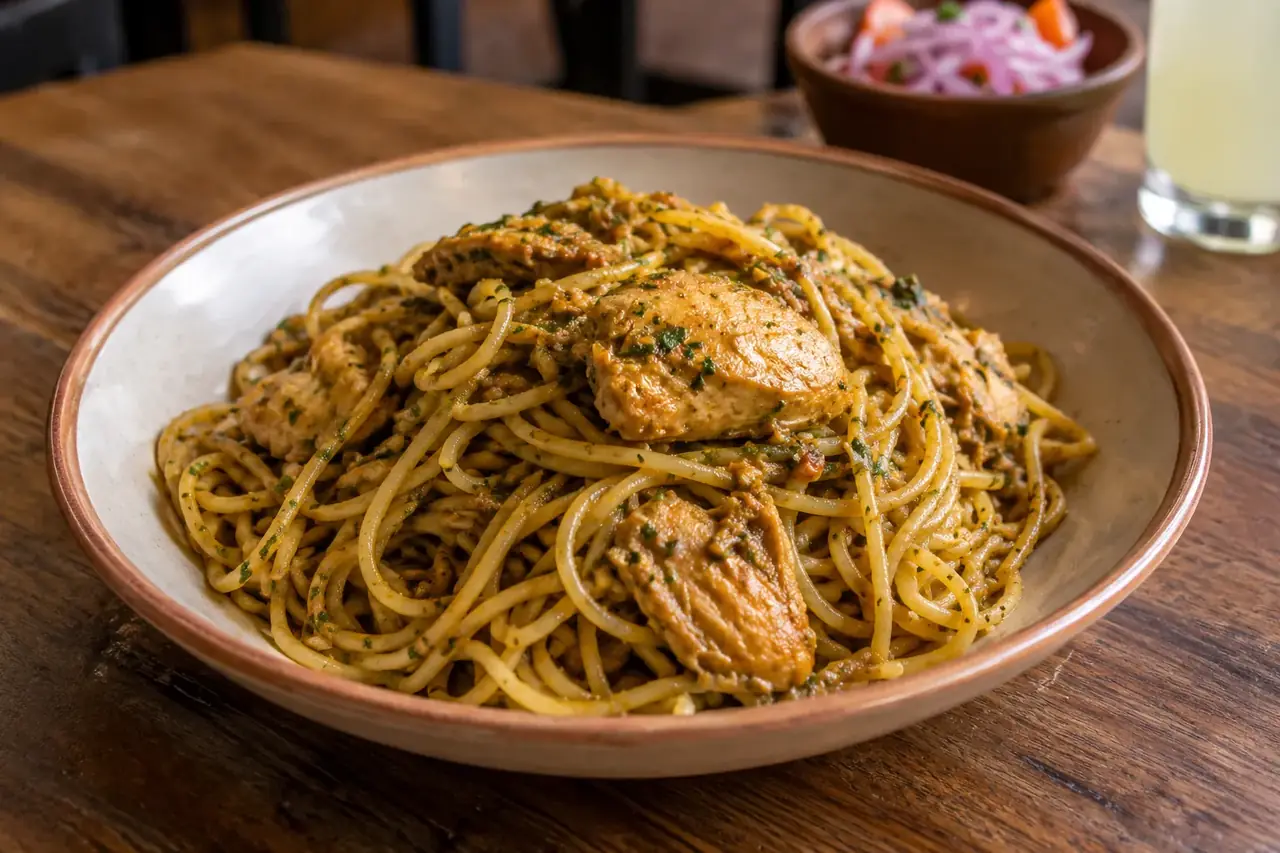
Despite its name, sopa seca is not a soup: it is spaghetti cooked in a stock with basil and chilli until it has absorbed it completely. It is the dish of Chincha, south of Lima, where it is served with carapulcra.
Italian pasta, Afro-Peruvian cooking
According to Marca Perú, sopa seca dates back to the time of independence, when Italian immigrants settled in Chincha with their pasta; Afro-Peruvian cooks adapted it with chilli and local spices. Since the last century, it has accompanied carapulcra at weddings and christenings: this is the manchapecho, a name that is said to come from the risk of staining your chest while eating it.
The method: like a risotto
The preparation described by Marca Perú comes down to a few steps: an aderezo of onion, garlic and spices, basil blended with chicken stock, tomato and carrot, then broken spaghetti, cooked until the liquid has reduced. The stock is added little by little: that is what gives pasta that is coated rather than drowned.
Our version
The volume of stock depends on the pasta and the width of the sauté pan: add more if needed, a ladleful at a time.
Ingredients
Serves 4
Estimated preparation time
- Active time
- 30 minutes
- Cooking
- 20 minutes for the chicken, 15 to 20 minutes for the pasta
- Total
- About 1 hour
Techniques: Simmering, Blended sauce.
The chicken and the stock
The base
The pasta
To serve
Tick off the ingredients as you go: the boxes are remembered on this device.
Useful equipment
- A large sauté pan or wide casserole (about 28 cm)
- A blender
- A cooking thermometer
Method
- Brown the chicken in the sauté pan with a spoonful of oil, for 5 minutes. Add 400 ml of stock, cover and cook for 15 minutes, until 74 °C (165 °F) at the thickest point. Take out the chicken and keep the cooking stock with the rest of the hot stock.
- Blend the basil with 150 ml of stock until you have a smooth green purée.
- In the sauté pan, fry the onion in the rest of the oil for 8 minutes, then the garlic, ají panca and cumin for 2 minutes. Add the grated tomato and carrot and let them soften for 5 minutes.
- Pour in the basil purée and, about 2 minutes later, about 700 ml of stock. Bring to a simmer, add a little salt.
- Add the broken spaghetti, push it down into the liquid and cook over a medium-low heat, uncovered, stirring often with a fork so that it does not stick.
- Add hot stock in small ladlefuls, each time the pasta has almost absorbed it, as for a risotto. Allow 15 to 20 minutes: the pasta is tender and the liquid has reduced to a sauce that coats it.
- Return the chicken to heat it through for 3 minutes, adjust the seasoning and serve, with hard-boiled egg, olives and parsley.
Signs of success
- The pasta is orange-red, coated in a glossy sauce, with no liquid at the bottom: it is a “dry soup”.
- It is tender without being mushy; too much stock at once makes it boil and stick.
- You taste the basil, then the panca chilli, mild and smoky.
Precautions
- Poultry: 74 °C (165 °F) at the thickest point.
Allergens identified
Present: gluten. Possible: egg (garnish), celery (depending on the stock used).
Always check the labels of the products you buy (sauces, stocks, chilli pastes).
Variations and tips
- The “manchapecho” of Chincha and Cañete: sopa seca and carapulcra served together, for weddings and christenings.
- With a piece of pork or turkey, depending on the family.
Reasonable substitutions
- Basil alone or mixed with a little coriander: both are found depending on the recipe; the taste changes slightly.
- Gluten-free pasta: it absorbs differently and sticks more; keep an eye on the cooking.
Storage
- Leftovers: in the fridge within one to two hours of cooking, to be eaten within 48 hours or frozen. The pasta keeps absorbing: reheat it with a little stock, to at least 70 °C.
Going further
Sources and dates
2 sources
Prices, opening hours and rules change: every piece of information cited links to its source, with the date it was consulted.
Figures and rules cited
- 74 °C (165 °F) at the thickest point: Minimum core temperature for poultry (chicken, turkey, giblets, stuffing) (United States) . A US threshold, stricter than the FSVO’s general guideline of 70 °C; used for the poultry recipes.
Official source: FoodSafety.gov, safe minimum cooking temperatures (reviewed on 21 November 2024) (new tab) , published on 21 November 2024 · consulted on 3 October 2026 - in the fridge within one to two hours of cooking, to be eaten within 48 hours or frozen: Cooling and keeping cooked leftovers (United Kingdom) . The same source asks you to thaw food in the fridge and to eat thawed food within 24 hours.
Official source: GOV.UK (Food Standards Agency), cooling, freezing and defrosting food safely (18 December 2017) (new tab) , published on 18 December 2017 · consulted on 3 October 2026 - to at least 70 °C: Reheating a dish that is already cooked (Switzerland)
Official source: FSVO, Hygiène et aliments (food hygiene, in French) (new tab) · consulted on 3 October 2026
Sources consulted
- Marca Perú (PROMPERÚ), sopa seca, a typical dish from Chincha (18 January 2022) (new tab) (consulted on 3 October 2026)
- Wikipedia (Spanish), Carapulcra (the manchapecho of Chincha and Cañete) (new tab) (consulted on 3 October 2026)
How we choose and date our information: our method. Has something changed? Let us know.