
Recipe · Sauce · Lima and criolla cooking
Salsa criolla
Red onion cut in feathers, lime, chilli and coriander: the garnish for pan con chicharrón, tamales and seco, to be made just before the meal.
- Serves 4 as a side
- 20 minutes (estimate)
- Easy
- Vegetarian, judging by the ingredients
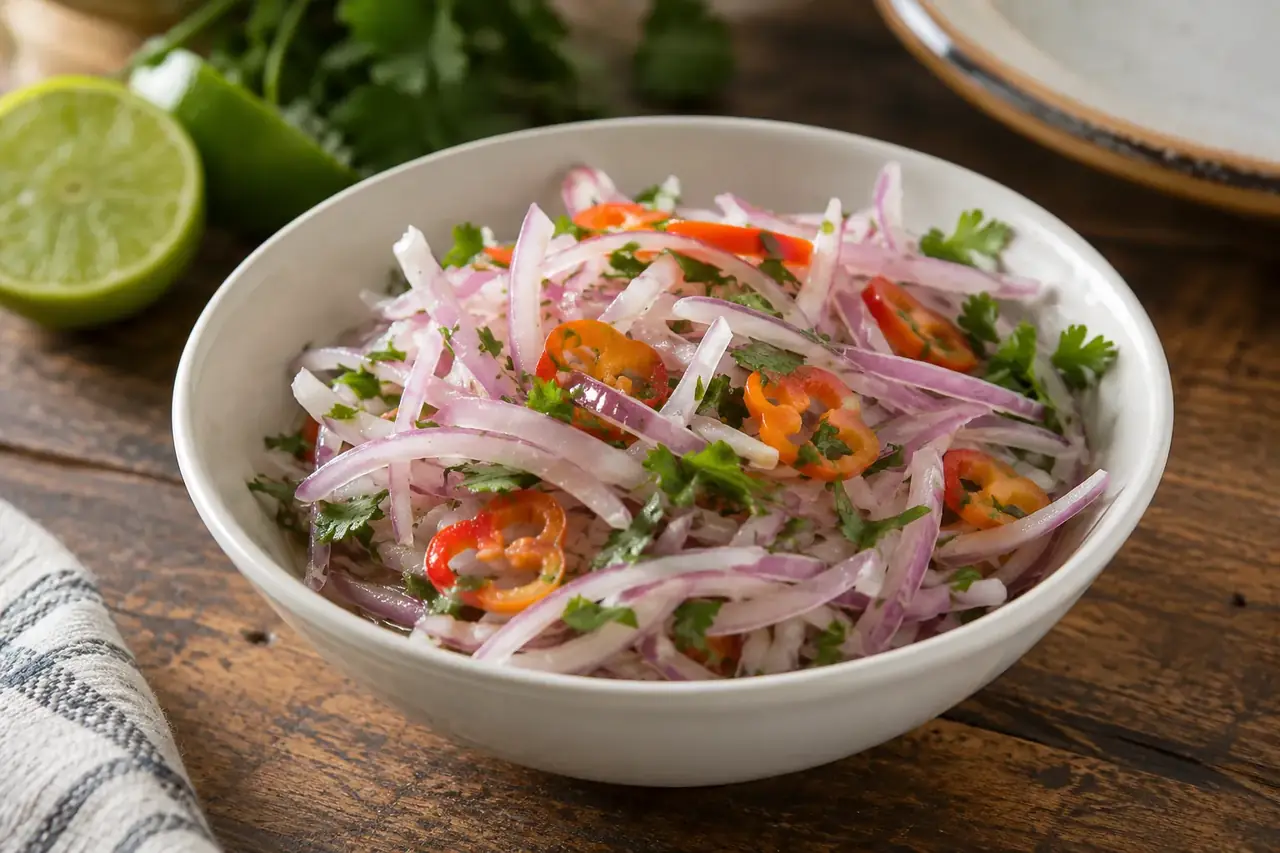
Slices of red onion, lime, a little chilli and coriander: salsa criolla, or “sarza criolla”, is probably the most common garnish in everyday Peruvian cooking. According to Wikipedia, it goes with pan con chicharrón, butifarra, pan con pejerrey, tamales, seco, papa rellena or arroz con pato.
It is all in the cut
The onion is cut “in feathers”: in thin, long slices, along the grain. PROMPERÚ’s ceviche recipe insists on this point, and advises softening it in cold water. Once seasoned, the onion softens quickly: it is mixed with the lime just before serving.
Three pairings with the recipes in this guide
- Pan con chicharrón: the salsa cuts through the fat of the pork and adds crunch.
- Seco: with rice and beans, it freshens up a slow-cooked dish.
- Tacu tacu: placed on the golden cake, it balances the rice and beans.
Our version
The acidity depends on the limes: taste, then adjust the salt and the juice.
Ingredients
Serves 4 as a side
Estimated preparation time
- Active time
- 10 minutes
- Resting
- 10 minutes of soaking the onion
- Total
- 20 minutes
Techniques: No cooking.
Tick off the ingredients as you go: the boxes are remembered on this device.
Useful equipment
- A very sharp knife
- A board
- A bowl of iced water
- A colander
Method
- Cut the onion in half from stem to root, remove the skin, then slice each half in the same direction, into very thin slices of about 2 mm: this is the “feather” cut, which gives long, curved slices.
- Put the slices in iced water for 10 minutes: they become crisper and less pungent. This rinsing is optional if you like a strong onion taste.
- Drain them and dry them carefully in a clean tea towel: wet onion dilutes the seasoning.
- Just before serving, mix the onion with the lime juice, the salt, the chilli and the coriander, and the oil if you are using it. Taste: the sauce should be sour, salty and slightly spicy.
- Serve within 15 minutes, while the onion is crisp.
Signs of success
- The slices are thin, even, translucent at the edges and crisp to the bite.
- The onion glistens with lime without swimming in juice.
- Made too early, the salsa softens and takes on a stronger taste: it is made at the last minute.
Precautions
- Use drinking water for soaking the onion.
Allergens identified
No major allergen in the list of ingredients.
No major allergen identified in this list of ingredients.
Always check the labels of the products you buy (sauces, stocks, chilli pastes).
Variations and tips
- With diced tomato, to go with a fish dish.
- With rocoto, spicier, for anticuchos or grilled meats.
Reasonable substitutions
- Lemon: less sour and less fragrant; increase the quantity a little.
- White onion: more pungent, less colourful; rinsing in iced water becomes useful.
Storage
- To be made at the last moment. Leftovers: in the fridge within one to two hours of cooking, to be eaten within 48 hours or frozen; the onion will have lost its crunch.
Going further
Sources and dates
2 sources
Prices, opening hours and rules change: every piece of information cited links to its source, with the date it was consulted.
Figures and rules cited
- in the fridge within one to two hours of cooking, to be eaten within 48 hours or frozen: Cooling and keeping cooked leftovers (United Kingdom) . The same source asks you to thaw food in the fridge and to eat thawed food within 24 hours.
Official source: GOV.UK (Food Standards Agency), cooling, freezing and defrosting food safely (18 December 2017) (new tab) , published on 18 December 2017 · consulted on 3 October 2026
Sources consulted
- Wikipedia (Spanish), Salsa criolla (Peruvian version: red onion cut in feathers, ají, lime; uses) (new tab) (consulted on 3 October 2026)
- PROMPERÚ, recipe for cebiche (onion cut “in feathers”, softened in cold water) (new tab) (consulted on 3 October 2026)
How we choose and date our information: our method. Has something changed? Let us know.