
Recipe · Dessert · Lima and criolla cooking
Picarones, squash and sweet potato doughnuts
Ring-shaped doughnuts made with squash and sweet potato, risen and then fried, served with a spiced chancaca syrup, with guidance on rising and frying.
- About 20 picarones, for 4 to 6 people
- About 3 hours (estimate)
- Tricky
- Vegetarian, judging by the ingredients
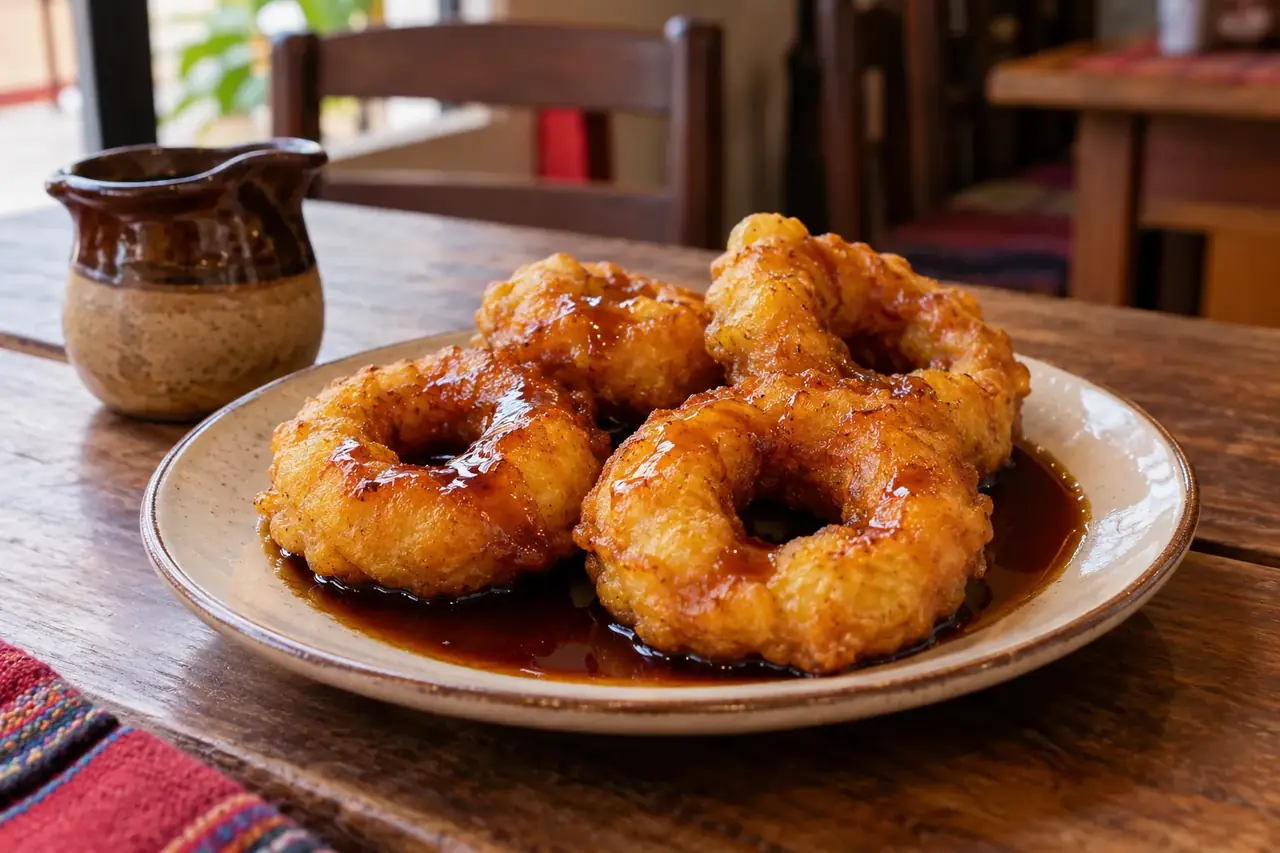
Ring-shaped doughnuts, light and golden, made from a risen dough of squash and sweet potato and coated in a spiced chancaca syrup: picarones are sold in the streets of Lima, especially in October, during the Señor de los Milagros processions.
From buñuelos to picarones
According to Wikipedia, picarones descend from buñuelos, the fritters brought by the Spanish. In Peru, the dough came to be made with American ingredients, squash and sweet potato, and the syrup with chancaca, cane sugar in blocks. From colonial times, Black and mixed-race women cooks sold them by street cry; today they remain one of Lima’s most popular desserts.
The three critical points
- How moist the purées are: badly drained squash needs more flour and gives heavy doughnuts. Weigh the purées after draining.
- The rising: it is how the dough looks that counts, not the time. It doubles and fills with bubbles in one to two hours depending on the warmth.
- The frying: at 170-175 °C, the rings puff up and turn golden in a few minutes. Cooler, the oil soaks into them; hotter, the inside stays raw.
Our version
This is the trickiest recipe in the guide. Shaping by hand takes practice: start with the baking paper square method.
Ingredients
The yield depends on how moist the purées are and the size of the rings: it has yet to be measured. The quantities are therefore not recalculated automatically.
About 20 picarones, for 4 to 6 people
Estimated preparation time
- Advance preparation
- 30 minutes to cook the squash and sweet potato, and leave them to drain and cool slightly
- Active time
- 45 minutes, frying included
- Cooking
- 3 to 4 minutes per batch
- Resting
- 1 to 2 hours of rising, depending on the temperature of the kitchen
- Total
- About 3 hours
Techniques: Boiling, Frying.
The dough
The syrup
Tick off the ingredients as you go: the boxes are remembered on this device.
Useful equipment
- A deep, stable saucepan
- A cooking thermometer
- A slotted spoon
- Kitchen paper
- A bowl of cold salted water for your hands
- A small saucepan for the syrup
Method
- Cook the squash and sweet potato in pieces in water (with the aniseed if you are using it) for 15 to 20 minutes, until very tender. Drain them thoroughly in a colander, keep a little of the cooking water, then weigh the purées.
- Mash them into a smooth purée. When it is lukewarm, not hot, add the yeast, sugar and salt, then the flour little by little, beating with a spoon.
- Add lukewarm cooking water a little at a time: the dough should be very soft, elastic and sticky, thicker than a crêpe batter, and fall from the spoon in a ribbon.
- Cover and leave to rise in a warm place until the dough has doubled in volume and is full of bubbles: 1 hour in summer, up to 2 hours in a cool kitchen.
- Meanwhile, simmer the syrup ingredients for 15 to 20 minutes, until it coats a spoon. Remove the spices and keep it warm.
- Heat the oil to 170-175 °C, checked with the thermometer, in a saucepan filled to one third at most.
- Wet your fingers in the cold salted water, take a small ball of dough, push your thumb through the centre to form a ring, and lower it gently just at the surface of the oil, without dropping it from a height. Or shape the rings on small squares of oiled baking paper and slide them into the oil with the paper, which you then remove with tongs.
- Make just one first, to adjust the size and the time. Then 3 or 4 at a time: 1 minute 30 to 2 minutes on each side, until golden and puffed up. Drain and serve straight away, coated in syrup.
Signs of success
- The risen dough has doubled, smells slightly of yeast, and wobbles when you move the bowl.
- The picarones are golden, light, crisp outside and soft inside, with a well-opened hole in the centre.
- Pale and greasy: the oil was not hot enough. Brown outside and raw inside: too hot, or the rings were too thick.
Precautions
- Frying: a stable saucepan on a back burner, filled to one third, a thermometer, a lid within reach. Never pour water onto hot oil, and never leave it unattended.
- Wet fingers stop the dough from sticking; shake them dry before going near the oil to limit spattering.
Allergens identified
Present: gluten.
Always check the labels of the products you buy (sauces, stocks, chilli pastes).
Variations and tips
- Syrup scented with fig leaf, as on Panchita’s menu in Lima.
- With squash only, no sweet potato: the dough is a little moister.
Reasonable substitutions
- Chancaca impossible to find: a wholemeal cane sugar or a brown sugar gives a similar syrup, a little less deep in taste.
Storage
- Picarones are eaten as soon as they come out of the fryer: they go soft within a few minutes. The syrup keeps in the fridge in a closed jar.
- Cooled frying oil: strain it before reusing it, or take it to the recycling centre, never down the sink.
Going further
Sources and dates
2 sources
Prices, opening hours and rules change: every piece of information cited links to its source, with the date it was consulted.
Sources consulted
- Wikipedia (Spanish), Picarón (Spanish buñuelos, squash and sweet potato, chancaca, Señor de los Milagros) (new tab) (consulted on 3 October 2026)
- Panchita, dessert menu (picarones with fig leaf syrup) (new tab) (consulted on 3 October 2026)
How we choose and date our information: our method. Has something changed? Let us know.