
Recipe · Main course · Amazon
Chicken juane: a homemade recipe
The dish of the San Juan festival in the Amazon: seasoned rice bound with egg, chicken, hard-boiled egg and olive, sealed in a leaf and steamed. Makes four.
- Serves 4 (4 juanes of about 350 g)
- About 2 hours (estimate)
- Tricky
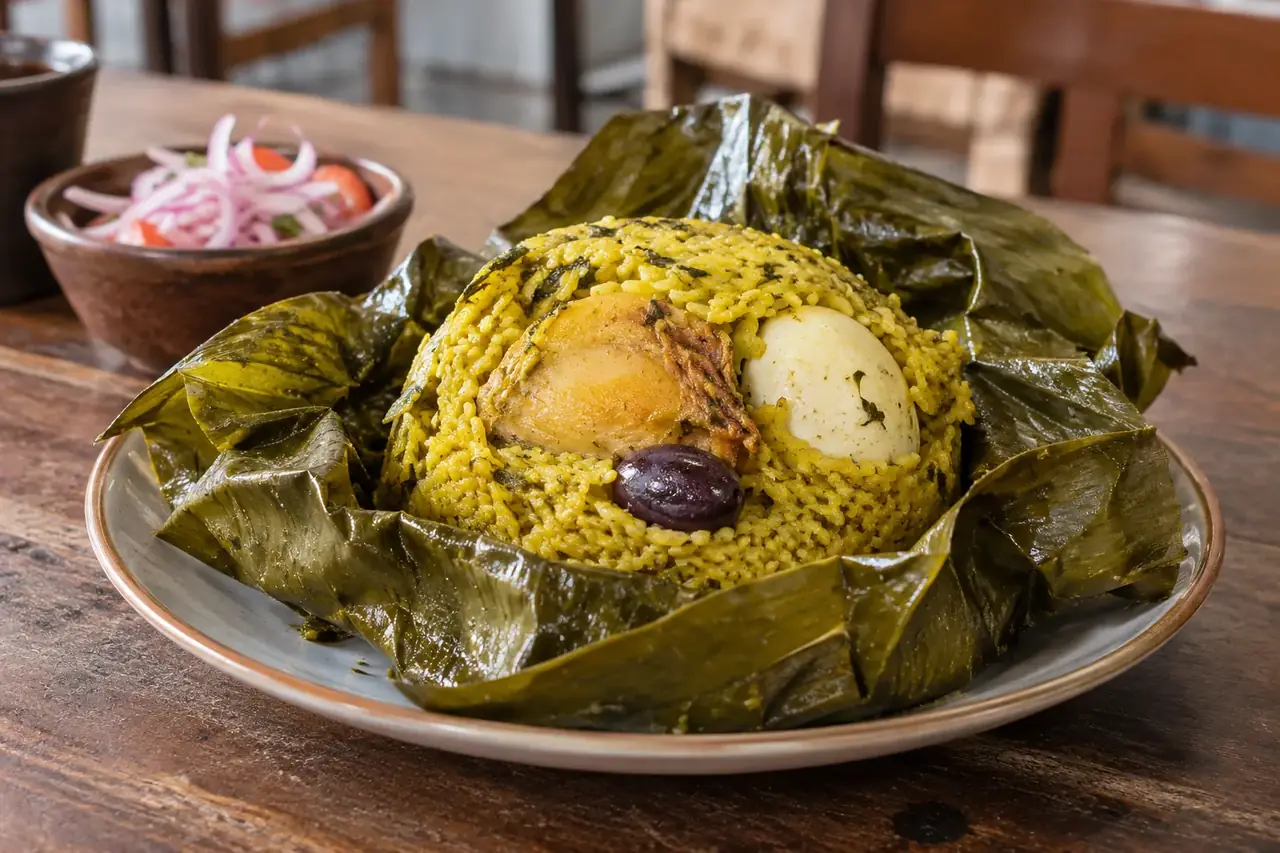
A ball of yellow rice, bound with egg, hiding a piece of hen, a hard-boiled egg and an olive, all sealed in a leaf: juane is the dish of the San Juan festival, on 24 June, throughout the Peruvian Amazon.
A dish for festivals and journeys
According to Wikipedia, juane is said to come from Moyobamba, in the San Martín region, according to the National Library of Peru. Well sealed in its leaf, it kept for travellers. Its name is said to refer to Saint John the Baptist, whose feast day, 24 June, is the great moment for juane. The preparation described combines rice and pieces of hen, bound with beaten eggs, wrapped in a bijao leaf, then boiled.
The leaf, and what replaces it
Bijao, a large forest leaf, flavours the rice and protects the parcel from the water. In Switzerland, banana leaves, often frozen, can be found in Asian grocery shops; they play the same role. Greaseproof paper works for the cooking, but the taste of the leaf disappears.
Our version
We steam the juanes, which is easier to control at home; the traditional method is to cook them in boiling water. Take the time to close each leaf properly.
Ingredients
Serves 4 (4 juanes of about 350 g)
Estimated preparation time
- Advance preparation
- Thawing the banana leaves, if they are frozen (in the fridge, the day before)
- Active time
- 45 minutes, folding included
- Cooking
- 25 minutes for the chicken, 15 minutes for the rice, 40 minutes of steaming
- Total
- About 2 hours
Techniques: Simmering, Steaming, En papillote.
The chicken
The rice
The assembly
Tick off the ingredients as you go: the boxes are remembered on this device.
Useful equipment
- A casserole
- A saucepan for the rice
- A steamer or a large pot with a basket and lid
- Scissors
- A cooking thermometer
Method
- In the casserole, fry the onion in the oil for 6 minutes, then the garlic, turmeric, cumin and oregano for one minute.
- Add the chicken, season with salt and pepper, pour in 400 ml of water and simmer, covered, for 20 to 25 minutes, until 74 °C (165 °F) at the thickest point. Take out the chicken; keep the juices.
- Measure the juices and top them up with water to 550 ml. Cook the rice in it, covered, over a low heat, for 15 minutes: it should be just cooked, still firm, as it will finish cooking in the leaf.
- Leave the rice to cool slightly for 5 minutes uncovered, then mix it with the beaten eggs. Move straight on to the assembly, without leaving this mixture to wait.
- Soften the leaves for a few seconds over a flame or in very hot water: they become shiny and supple. Wipe them.
- Cross two leaves, shiny side up. In the centre, place a quarter of the rice, a chicken thigh, half a hard-boiled egg and an olive, and cover with a little rice.
- Fold the leaves over to form a ball, then tie the “neck” of the parcel tightly with the string, using a double knot. The parcel must be well closed so that no water gets in.
- Steam the juanes, lid closed, for 40 minutes, checking the water level halfway through. Open one: the rice forms a block that holds together, and the centre reaches at least 70 °C at the core.
- Serve hot, in the opened leaf, with cooked cassava or plantain.
Signs of success
- The rice is golden yellow, compact, and can be cut with a spoon like a rice cake.
- The beaten egg has set: no liquid traces in the centre.
- The leaf has flavoured the rice: a light plant aroma, which paper does not give.
Precautions
- Rice mixed with raw egg must never be left to wait while lukewarm: assemble and cook straight away.
- Poultry: 74 °C (165 °F) at the thickest point. The centre of the cooked juane must reach at least 70 °C at the core.
- Banana leaves: buy them sold for food use and wash them.
Allergens identified
Present: egg. Possible: celery (depending on the stock used).
Always check the labels of the products you buy (sauces, stocks, chilli pastes).
Variations and tips
- Boiled juane: the method described by Wikipedia; the well-closed parcels cook immersed in boiling water.
- Juane de yuca (cassava), de chonta (palm heart) or with fish, depending on the region of the forest.
Reasonable substitutions
- Greaseproof paper and then foil instead of the leaves: the cooking works, but the aroma of the leaf disappears; it is an adaptation.
- Sacha culantro, an Amazonian herb: coriander comes close without replacing it.
Storage
- Cooked juanes: cooled within an hour of cooking, kept in the fridge, eaten within 24 hours, reheated only once to 70 °C at the core for 2 minutes (the rule for cooked rice applies to juane).
Going further
Sources and dates
2 sources
Prices, opening hours and rules change: every piece of information cited links to its source, with the date it was consulted.
Figures and rules cited
- 74 °C (165 °F) at the thickest point: Minimum core temperature for poultry (chicken, turkey, giblets, stuffing) (United States) . A US threshold, stricter than the FSVO’s general guideline of 70 °C; used for the poultry recipes.
Official source: FoodSafety.gov, safe minimum cooking temperatures (reviewed on 21 November 2024) (new tab) , published on 21 November 2024 · consulted on 3 October 2026 - at least 70 °C at the core: Minimum core temperature for meat, poultry, fish and seafood (general Swiss guideline) (Switzerland) . A food safety guideline, not a culinary doneness criterion: some meats are served more cooked.
Official source: FSVO, Hygiène et aliments (food hygiene: four basic rules, in French) (new tab) · consulted on 3 October 2026 - cooled within an hour of cooking, kept in the fridge, eaten within 24 hours, reheated only once to 70 °C at the core for 2 minutes: Storing cooked rice (United Kingdom)
Official source: NHS, starchy foods and carbohydrates (reviewed on 15 March 2023) (new tab) , published on 15 March 2023 · consulted on 3 October 2026
Sources consulted
- Wikipedia (Spanish), Juane (San Juan, Moyobamba, bijao leaf, cooking in water, variants) (new tab) (consulted on 3 October 2026)
- PROMPERÚ, the cooking of the Amazon (juanes) (new tab) (consulted on 3 October 2026)
How we choose and date our information: our method. Has something changed? Let us know.